


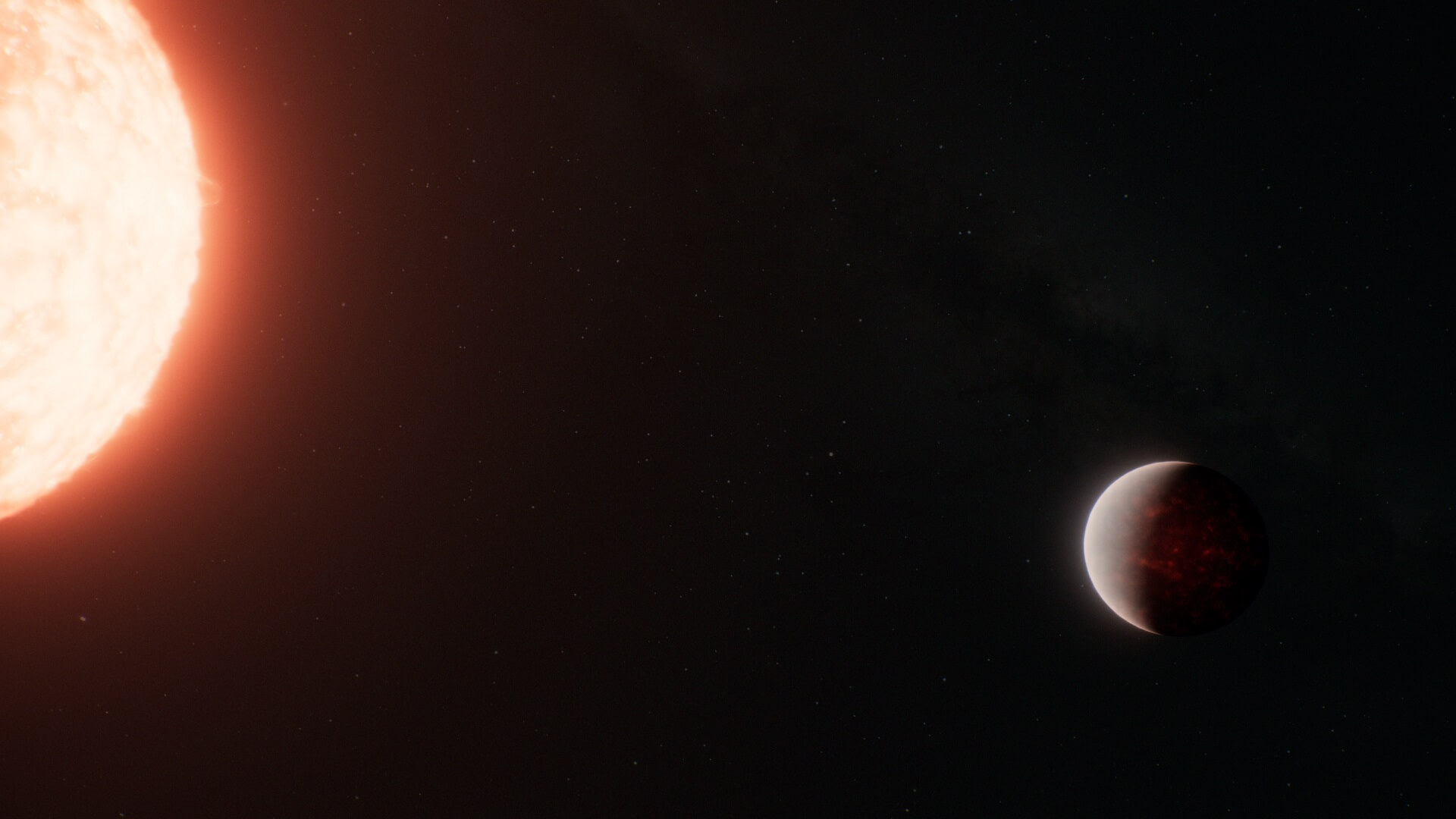
Scientists using NASA’s James Webb Space Telescope (JWST) have identified the strongest evidence so far of an atmosphere surrounding a rocky exoplanet, in findings that question long-standing assumptions about whether small, super-heated worlds can retain volatile gases.
The study focuses on TOI-561 b, an ultra-hot “super-Earth” that orbits its star in less than 11 hours. With a radius around 1.4 times that of Earth and an orbit placing it less than one million miles from its host star, the planet belongs to a rare class known as ultra-short period exoplanets. Its intense proximity means the planet is likely tidally locked, creating a permanent dayside hot enough to maintain a global magma ocean.
Evidence points to a thick, volatile-rich atmosphere
Despite its extreme conditions, TOI-561 b displays an unusually low density — a result that initially puzzled researchers. The latest Webb observations suggest the presence of a substantial atmosphere, providing a key to understanding this anomaly.
Co-author Dr Anjali Piette of the University of Birmingham said a thick, volatile-rich atmosphere is required to make sense of the readings. “We really need a thick volatile-rich atmosphere to explain all the observations. Strong winds would cool the dayside by transporting heat over to the nightside.
“Gases like water vapour would absorb some wavelengths of near-infrared light emitted by the surface before they make it all the way up through the atmosphere. The planet would look colder because the telescope detects less light, but it’s also possible that there are bright silicate clouds that cool the atmosphere by reflecting starlight.”
The team had considered whether the planet’s structure might differ fundamentally from Earth’s — perhaps with a smaller iron core or a less dense mantle. But atmospheric effects provided a far more convincing explanation.
Lead author Johanna Teske, staff scientist at Carnegie Science Earth and Planets Laboratory, said the planet’s physical characteristics distinguish it from other ultra-short period worlds. “What really sets this planet apart is its anomalously low density. It is less dense than you would expect if it had an Earth-like composition.
“TOI-561 b is distinct among ultra-short period planets in that it orbits a very old, iron-poor star – twice as old as our sun – in a region of the Milky Way known as the thick disk. It must have formed in a very different chemical environment from planets in our own solar system.”
Webb observations reveal unexpectedly cool dayside
To test the atmospheric hypothesis, researchers used JWST’s NIRSpec instrument to measure temperature variations based on the planet’s infrared brightness as it passed behind its star. If TOI-561 b were a bare rock with no atmospheric heat circulation, its dayside temperature would be expected to reach roughly 4,900°F (2,700°C). Instead, the telescope measured a significantly cooler value of around 3,200°F (1,800°C).
The team evaluated alternate explanations — heat flow within the magma ocean or a thin rock-vapour layer — but neither could account for the observed cooling.
This raises a central question: how a small planet subjected to such intense stellar radiation could retain a substantial atmosphere at all.
A dynamic exchange between magma ocean and atmosphere
Co-author Tim Lichtenberg of the University of Groningen said the answer may lie in a continuous exchange between molten rock and atmospheric gases. “We think there is an equilibrium between the magma ocean and the atmosphere. While gases are coming out of the planet to feed the atmosphere, the magma ocean is sucking them back into the interior. This planet must be much, much more volatile-rich than Earth to explain the observations. It’s really like a wet lava ball.”
Further analysis underway to map atmospheric composition
The findings are the first results from JWST’s General Observers Program 3860, which observed TOI-561 b continuously for more than 37 hours, covering nearly four full orbits. Researchers are now analysing the full dataset to map temperature distribution across the planet and refine estimates of atmospheric composition.
As the world’s leading space observatory, the James Webb Space Telescope continues to shed new light on distant planetary systems, revealing atmospheric signatures even in environments once thought too extreme for such features to endure.