

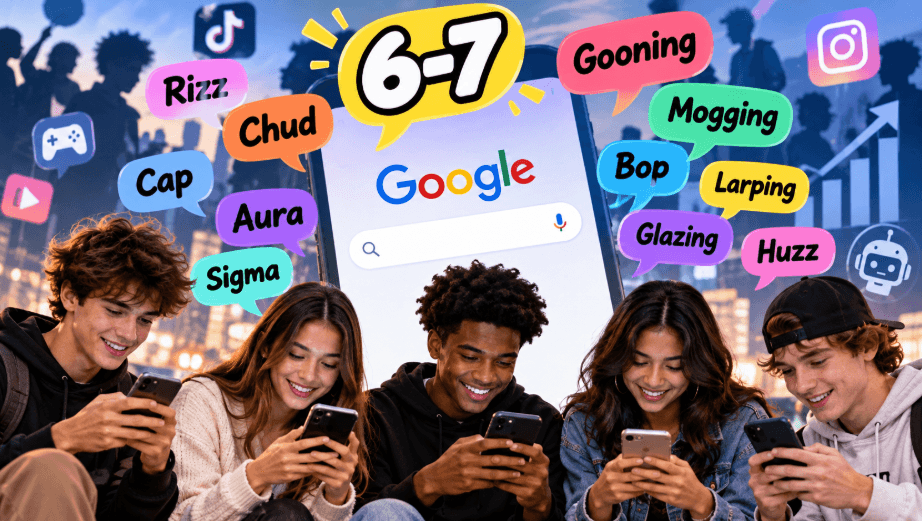
Internet culture continues to reshape how Americans communicate, with new research identifying “6-7” as the most searched slang term in the United States in 2026. The analysis highlights the growing influence of social media, music, gaming communities and online humor on everyday vocabulary.
The research, conducted by word-unscrambling experts at Unscramblerer.com, analyzed Google Trends search data from Jan. 1 through Aug. 17, 2026. According to the findings, “6-7” generated 1.6 million monthly searches, significantly more than any other slang expression included in the analysis.
‘6-7’ Leads Slang Searches Across America
The expression “6-7” was linked by researchers to the song “Doot Doot (6 7)” by Skrilla and subsequent online content involving basketball player LaMelo Ball and his 6-foot-7 height. Rather than having a conventional definition, the phrase has become associated with intentionally absurd internet humor and is frequently repeated with exaggerated hand gestures.
“Chud” ranked second with 184,900 monthly searches. The term is commonly used online as an insult for someone considered a fool, troll or obnoxious person.
“Rizz,” referring to charm, attractiveness or the ability to attract a romantic partner, followed with 171,100 searches.
“Gooning” ranked fourth at 158,700 searches. While the expression has an explicit meaning in some online communities, researchers said it has also evolved into a more casual way of describing someone becoming excessively absorbed in an activity or interest.
“Cap” and “no cap” generated 96,600 searches. “Cap” generally refers to a lie, exaggeration or false claim, while “no cap” indicates that someone is being truthful or serious.
Social Media Shapes a Rapidly Changing Vocabulary
Several other highly searched expressions focus on appearance, status and online social behavior.
“Mogging,” along with variations including “mogged,” “mog” and “framemog,” generated 82,800 searches. The expression generally describes outclassing another person through appearance, skill or success.
“Bop,” a derogatory expression that can refer to someone’s sexual behavior or the way they present themselves online, attracted 78,300 searches. “Larping” and “larper,” which can be used to accuse someone of pretending to have a lifestyle or identity they do not actually possess, recorded 74,400 searches.
“Aura,” “aura points” and “aura farming” collectively reached 66,400 searches. In contemporary internet slang, aura describes a person’s perceived coolness, confidence or presence. Aura farming refers to deliberately behaving in a way intended to appear impressive.
“Sigma,” generally referring to an independent or self-reliant person operating outside conventional social hierarchies, registered 65,400 searches.
Other prominent expressions included “crash out” with 60,500 searches and “glazing” with 59,600. “Huzz” received 57,300 searches, while “chopped” reached 53,600 and “based” recorded 51,400.
AI and Self-Improvement Terms Gain Attention
Technology has also entered America’s evolving slang vocabulary. “Clanker,” a derogatory expression for robots, bots, chatbots or artificial intelligence technology, generated 42,300 searches.
“Maxxing” recorded 41,100 searches. Derived from the concept of maximizing or optimizing something, the word has become a flexible suffix that can describe efforts to improve a particular part of someone’s appearance, lifestyle or behavior.
“Unc,” short for uncle and often humorously applied to someone perceived as old, out of touch or past their prime, generated 37,400 searches.
“Ate,” an expression of admiration for someone who performed exceptionally well or looked impressive, recorded 35,100 searches. “Cheugy,” used to describe something considered outdated or uncool, followed with 33,100.
The ranking also included “foid” at 31,200 searches. Researchers described it as a derogatory and misogynistic expression for women. “Mid,” meaning mediocre or disappointing, generated 29,200 searches.
“Crine” and the phrase “son im crine,” used to express laughing so hard that someone is crying, attracted 27,600 searches. “Delulu,” short for delusional and commonly associated with unrealistic expectations or fantasies, received 25,800 searches.
“Quiet on the creek” completed the list with 14,600 searches. Researchers linked the phrase to a Saucy Santana TikTok Live stream in which he recalled childhood fishing advice: “I used to go fishing when I was a little girl, you got to be real quiet on the creek.”
Search Trends Highlight Slang’s Role in Online Communities
Randoh Sallihall, a spokesperson for Word Unscrambler, said the findings provide a broader look at how slang functions within American culture.
“The most searched slang words of 2026 give insight into the cultural conversations happening in America. Using slang is a social signal. What people search for can tell us something about what they are trying to understand and participate in culturally. Slang may look like a collection of throwaway jokes from the internet, but psychology suggests it is doing something much more interesting. Using slang helps people navigate identity and belong to a community. Research highlighted by the American Psychological Association, including the work of psychologist Ryan Boyd, shows that our language choices can act as signals of who we are, who we identify with and how we relate to other people. Research by Alice Damirjian (post-doctoral Department of Philosophy) similarly describes slang as a way of identifying group affiliation, distinguishing insiders from outsiders and reinforcing social cohesion. Today new slang terms can spread like wildfire around the world thanks to big online communities on social media like TikTok, Instagram, gaming chats, streaming and so on. The popularity of trending slang words can change quickly, but the psychological need behind them stays the same. People want to understand one another and belong.”
The findings illustrate how quickly vocabulary can move from niche online communities into mainstream conversation. As social platforms and digital communities accelerate the spread of new expressions, search behavior offers one measure of which slang terms Americans are trying most frequently to understand.



:quality(85)/cloudfront-us-east-1.images.arcpublishing.com/infobae/45OXD2PP2VAWTFEPJZPEDWSDC4.jpg "The Ortega regime is closing embassies in cities with high immigrant populations, leaving thousands of Nicaraguans homeless.")