

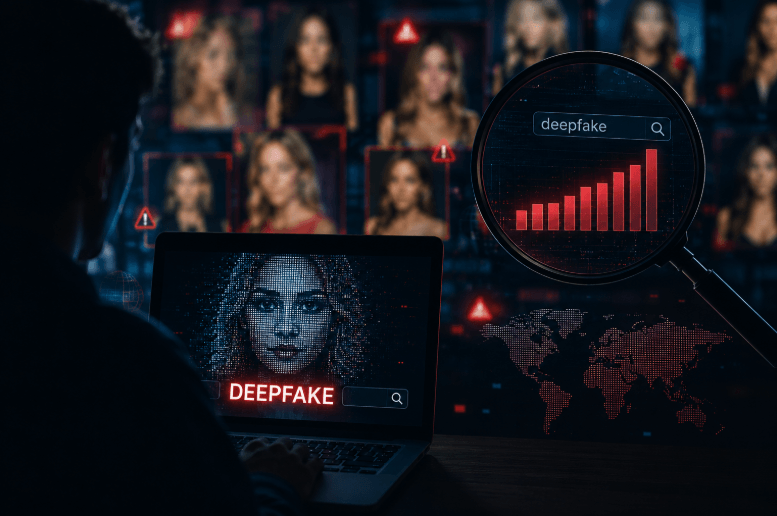
A new analysis of global search behavior has found that women account for all 10 celebrities with the highest volume of deepfake-related searches, underscoring concerns about the misuse of artificial intelligence as Australia moves to address so-called “nudify” applications.
The research, conducted by AI content platform CreateUGC, analyzed Google Keyword Planner data covering average monthly global searches between June 2025 and May 2026. Researchers assessed celebrities drawn from YouGov’s list of 250 prominent figures and examined search combinations involving celebrity names and the term “deepfake,” among other related queries.
Influencer Pokimane, whose real name is Imane Anys, ranked first, generating an average of 13,833 deepfake-related searches worldwide each month.
Pokimane, Taylor Swift and Scarlett Johansson Lead Rankings
Taylor Swift ranked second with an average of 11,300 monthly deepfake-related searches, making her the highest-ranked musician in the study. Her total was about 18% below Pokimane’s figure.
Scarlett Johansson placed third with 8,750 searches per month, followed by Ariana Grande with 5,133.
Australian actress Margot Robbie ranked fifth, recording an average of 3,217 monthly searches. Anne Hathaway followed with 3,033, while content creator Charli D’Amelio ranked seventh with 2,367.
Jennifer Lawrence placed eighth with an average of 1,850 monthly searches. Social media personality Lil Tay ranked ninth with 1,622, while Kim Kardashian completed the top 10 with 1,517.
| Rank | Celebrity | Average Monthly Deepfake-Related Searches |
|---|---|---|
| 1 | Pokimane | 13,833 |
| 2 | Taylor Swift | 11,300 |
| 3 | Scarlett Johansson | 8,750 |
| 4 | Ariana Grande | 5,133 |
| 5 | Margot Robbie | 3,217 |
| 6 | Anne Hathaway | 3,033 |
| 7 | Charli D’Amelio | 2,367 |
| 8 | Jennifer Lawrence | 1,850 |
| 9 | Lil Tay | 1,622 |
| 10 | Kim Kardashian | 1,517 |
The figures represent estimated search interest in terms associated with deepfakes and the celebrities listed. They do not establish how many deepfake images or videos involving any individual have actually been created.
Findings Come Amid Scrutiny of AI-Generated Intimate Images
The research arrives as governments and technology regulators face increasing pressure to address AI tools capable of producing manipulated intimate imagery.
In Australia, attention has focused on applications capable of digitally altering photographs to simulate nudity. The country’s eSafety Commissioner has said reports involving digitally altered intimate images of people under 18 more than doubled over an 18-month period, with four in five of those reports involving women and girls.
The CreateUGC study also identified a pronounced gender disparity. According to the research, the top 10 celebrities in deepfake-related searches were all women, while the first man did not appear until 19th place.
Lior Pozin, CEO of CreateUGC, commented on the findings:
“The most striking part of this data isn’t the numbers – it’s that a list which began with an equal split of men and women produced a top 10 that’s entirely female, with the first man appearing only at 19th. That gap tells us deepfake abuse isn’t evenly distributed; it disproportionately targets women, and increasingly influencers, whose audiences are conditioned to trust a familiar face.
“What stands out is that Pokimane, an influencer whose content exists almost entirely online, generates more deepfake-related searches than even Taylor Swift or Scarlett Johansson.
“Women are far more likely to be affected by the use of deepfake content with influencers being used even more than some of the biggest names in Hollywood such as Taylor Swift and Margot Robbie. It goes to show how quickly social media users will trust an influencer.”
Deepfake Technology Poses Growing Challenge for Digital Platforms
The findings highlight a broader challenge for technology companies, regulators and policymakers as generative AI makes sophisticated image and video manipulation increasingly accessible.
Deepfake technology can have legitimate applications across entertainment, advertising and digital production, but its potential use for deceptive or non-consensual material has prompted calls for stronger safeguards and regulatory oversight.
CreateUGC’s analysis indicates substantial search interest surrounding deepfake-related terms associated with prominent women, particularly entertainers and online creators. As Australia and other governments consider stronger responses to AI-generated intimate imagery, the research provides another measure of the growing public interest surrounding deepfake technology and its potential misuse.