


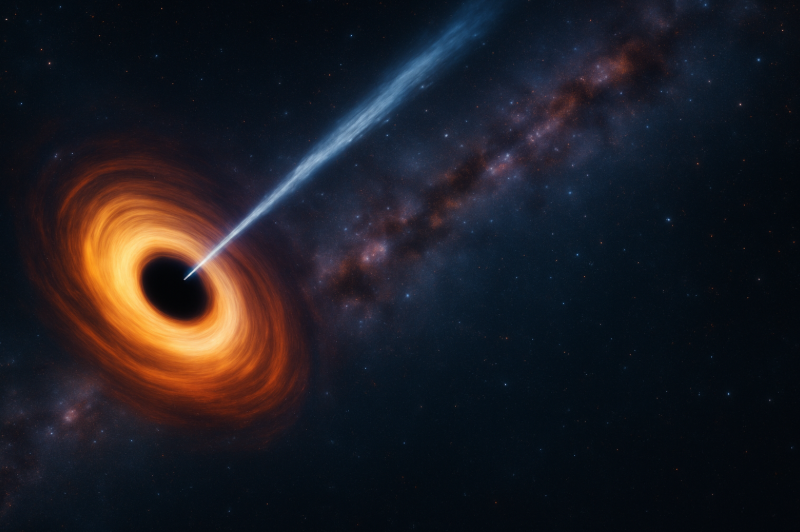
Astronomers have detected a powerful radio signal from a black hole tearing apart a star outside a galactic centre — a discovery that could reshape scientific understanding of how and where supermassive black holes exist and operate.
The phenomenon, known as a tidal disruption event (TDE), occurs when a star wanders too close to a black hole and is torn apart by its immense gravitational forces. In this latest finding, researchers observed such an event taking place some 2,600 light-years — roughly 0.8 kiloparsecs — from the host galaxy’s core. The discovery challenges the assumption that supermassive black holes remain confined to galactic centres.
An international team led by Dr Itai Sfaradi and Professor Raffaella Margutti of the University of California, Berkeley, identified the event, designated AT 2024tvd, which produced the fastest-evolving radio emission ever recorded from a black-hole-driven stellar disruption. The project brought together researchers from the United States, Europe and Israel, including Professor Assaf Horesh from the Racah Institute of Physics at the Hebrew University of Jerusalem.
“This is truly extraordinary,” said Dr Itai Sfaradi, lead author of the study. “Never before have we seen such bright radio emission from a black hole tearing apart a star, away from a galaxy’s centre, and evolving this fast. It changes how we think about black holes and their behaviour.”
Professor Horesh, who supervised Dr Sfaradi during his graduate studies, added:
“This is one of the fascinating discoveries I’ve been part of. The fact that it was led by my former student, Itai, makes it even more meaningful. It’s another scientific achievement that places Israel at the forefront of international astrophysics.”
A black hole far from home
The black hole’s distance from its galactic core provides rare observational evidence that massive black holes may roam outside their expected positions. Astronomers believe this may have resulted from a galactic merger or gravitational recoil in the system’s past, leaving the black hole adrift but still capable of accreting matter and generating energetic emissions.
The crucial role of radio telescopes
The discovery relied on precision data from several leading radio observatories around the world. Observations were carried out using the Very Large Array (VLA) in New Mexico, ALMA in Chile, ATA, SMA, and the Arcminute Microkelvin Imager Large Array (AMI-LA) in the United Kingdom.
The AMI-LA observations, coordinated by the Hebrew University team, were essential in revealing the rapid evolution of the radio emission — the most striking feature of the event. The measurements showed two separate radio flares, both developing faster than any previously observed TDE. This pattern points to violent and delayed ejections of material from the black hole, occurring months after the initial stellar destruction.
Researchers concluded that at least two distinct ejection episodes took place, each separated by several months. This implies that black holes may “reawaken” intermittently, releasing stored energy in bursts long after the main disruption — a process that had not been observed before.
Implications for astrophysics
The delayed and unusually strong radio outbursts indicate that black-hole jets and outflows can behave in far more complex ways than previously thought. The findings suggest that, even outside galactic centres, supermassive black holes remain capable of launching high-energy emissions that rival those of their central counterparts.
For scientists, the observation of AT 2024tvd opens new avenues to study how black holes interact with their surroundings and how matter behaves under extreme gravitational forces. The work also highlights the growing role of coordinated global radio-telescope networks in advancing astrophysical discovery.
The full study, involving collaborators including Professor Paz Beniamini of the Open University of Israel, will be published in The Astrophysical Journal Letters.