


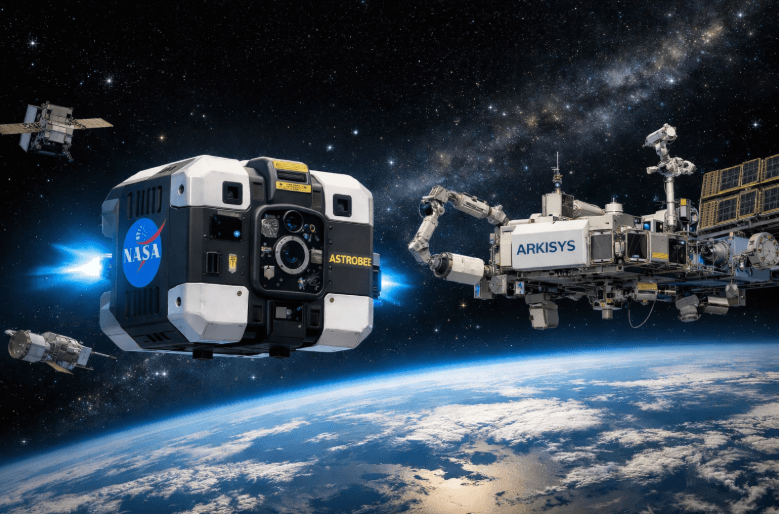
Arkisys has announced the return to operational status of NASA’s Astrobee, the bee-inspired free-flying robotic system designed to support research and technology demonstrations aboard the International Space Station (ISS), in a move that reflects the growing shift towards commercial sustainment of space-based capabilities.
The company, based in Los Alamitos, California, said Astrobee has “officially activated operational status”, returning the cube-shaped robot to active duty after a period offline. Arkisys described itself as a provider of on-orbit services on long-duration platforms for post-launch applications, and said it is now taking over payload operations for the system as a commercial sustainer.
Astrobee is a well-established robotics platform on the ISS, used to support a range of scientific investigations and technology demonstrations that would otherwise require crew time. The robot’s free-flying design enables it to navigate inside the station’s pressurised modules, positioning itself for inspections, data capture, and experiments without relying on fixed rails or permanent installation.
For commercial and academic users, Astrobee offers a relatively accessible way to validate technologies in a real microgravity environment, particularly in areas such as autonomous navigation, machine vision, and robotic manipulation. Its return is expected to be welcomed by research groups that depend on repeatable in-orbit demonstrations, as well as firms seeking to de-risk hardware and software systems before committing to larger-scale space missions.
Arkisys framed the milestone as both a continuation of Astrobee’s established role and an expansion of its potential user base under commercial operations. “We’re excited to bring Astrobee back online to support current users, welcome new ones, and unlock the unique opportunities made possible as a commercial sustainer,” says Yashvi Deliwala, Mission Manager of Arkisys. “Astrobee is a payload that has facilitated extensive collaboration between space agencies, universities, and commercial partners; Arkisys is ready to take it to new heights.”
The announcement highlights a wider trend in the space sector, as NASA and other agencies increasingly pursue commercial partnerships to sustain operational capabilities and encourage private-sector innovation. Rather than solely developing, operating, and maintaining systems internally, NASA has been pushing to transition certain assets and services into commercially managed frameworks, creating opportunities for companies to provide operational support, user access, and service expansion.
In Astrobee’s case, the handover positions Arkisys as the operator responsible for payload operations, while keeping the platform available for ongoing demonstrations aboard the ISS. The company said the system will continue to enable experiments and demonstrations that advance the future of autonomous operations in space, including tasks such as rendezvous and docking demonstrations and the validation of computer vision algorithms.
These applications are increasingly relevant as space missions become more complex and more autonomous. With growing interest in on-orbit servicing, assembly, and manufacturing, as well as long-duration exploration missions, autonomous robotics is viewed as a critical capability to reduce risk, manage operational costs, and limit reliance on human intervention.
Arkisys also pointed to the policy direction behind the transition, stating that the move aligns directly with NASA leadership’s drive to accelerate commercial hand-offs in order to expand US industrial capability. Such transitions are designed to create a more sustainable marketplace for space operations, enabling commercial providers to build service models around proven technologies while broadening participation beyond government-led programmes.
In practical terms, Astrobee’s renewed availability could support a wider range of users seeking a flight-proven testbed for robotics and autonomy. The system has historically been used by a mix of government, academic, and commercial organisations, and Arkisys indicated it intends to broaden that access further.
The company said it plans to expand access to Astrobee’s services through ongoing system innovation and broadened international participation, with the aim of demonstrating that free-flyer services can be operational, repeatable, and commercially valuable. For researchers, that could translate into more regular opportunities to run experiments and validate new capabilities in orbit. For commercial users, it may provide a pathway to test systems and build confidence in technologies that could later support missions beyond the ISS.
While Arkisys did not disclose commercial terms, pricing, or timelines for new user onboarding, the announcement signals a continued push to create scalable, service-based models around ISS-enabled capabilities. As the space economy evolves, assets like Astrobee may increasingly serve as stepping stones for companies and institutions looking to prove technologies in low Earth orbit before deploying them in more demanding operational environments.