


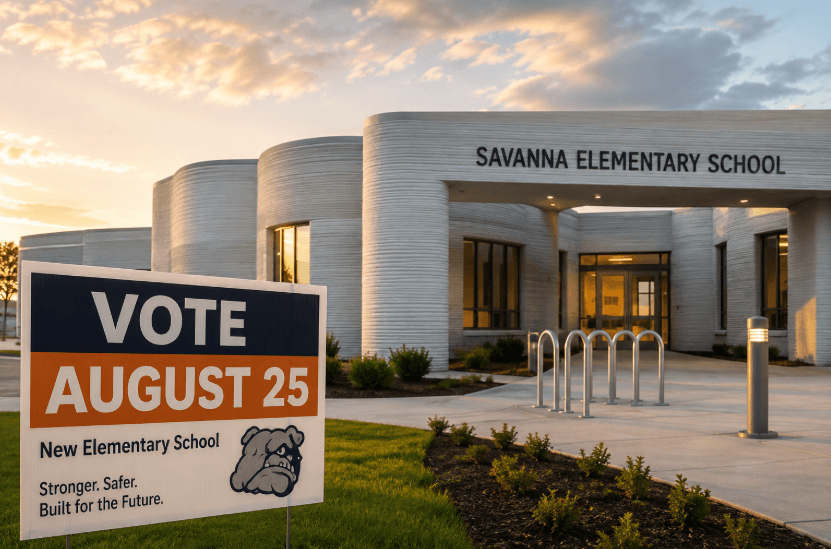
Savanna voters will decide on August 25 whether to approve a revised school bond proposal that would fund a new elementary school using 3D-printing construction technology, along with additional classrooms, safety improvements and upgrades to district facilities.
Supporters of the proposal say the project could address concerns about the condition of the existing elementary building while providing additional space and modern infrastructure. According to project representatives, the proposed facility would become the first 3D-printed school in the United States.
Longtime Savanna educator and community figure Joe Brown has expressed support for the proposal. Brown coached at the school for 19 years before retiring from coaching in 1986 and later served as both principal and superintendent.
“I just hope and pray that people understand, because we need it bad… the kids need it bad,” said Joe Brown of the proposal
Revised Bond Proposal Focuses on Space and Safety
The revised bond plan calls for new elementary classrooms, additional offices and bathrooms, and expanded academic space. It would also introduce air conditioning to the school gymnasium for the first time.
“This one will give us more space, classrooms, offices and bathrooms, and comes in at less money” said Savanna Public Schools Superintendent Adam Newman.
“it’s been a long time coming and way overdue to make our community and patrons more comfortable and safe.”
Safety provisions are another major component of the project. Newman said the proposed design includes storm shelters intended to serve students and residents.
“The designs include storm shelters that will be accessible to students and the public during school hours as well as to the community after-hours” Newman said.
“We’ve been working with the Police Department on having officers authorized to open the school after hours in the event of a tornado or inclement weather.”
Concerns about the existing elementary building have contributed to the district’s push for a replacement. Nathan Cole, a professional and structural engineer with Connect Structural Engineering, raised concerns about the condition of the structure.
“In our professional opinion based on our observations the structure of the existing building has exceeded its design life span” said Nathan Cole Professional and Structural Engineer with Connect Structural Engineering.
“The degradation is severe and the necessary structural repairs will involve significant demolition and reconstruction. due to the age of the facility it should be expected to continue to rapidly decline creating ongoing structural issues as well as issues related to occupant comfort, convenience, serviceability and aesthetics.”
3D-Printing Technology at Center of Proposed School
Oklahoma state Rep. Mickey Dollens, an advocate for 3D-printing construction technology, has pointed to its potential applications in resilient buildings and emergency response, saying that “both FEMA and Emergency Responders are starting to use it.”
“We did a study on it and brought in Oklahoma State University” he said.
“OSU has their own proprietary plans for building barns and other Agricultural buildings. We’ve worked with engineers that have built homes that can withstand F4 tornados.”
Dr. Tyler Ley with Oklahoma State University Engineering and Technology, who participated in the study, described the approach as “great technology that is going to help a ton of people.” Potential advantages cited for 3D-printing construction include labor savings, faster project delivery and reduced material waste.
Brady Deaton, a business development representative for Lee Simon, said the revised proposal provides more rooms and space and carries a higher strength rating than the district’s earlier proposal.
“The entire school will be hurricane rated with 3 classrooms and bathroom area being engineered even stronger wind speeds” he said adding that the latter will be able to hold up to 400 students and staff.”
Revised Plan Follows Earlier Bond Rejection
The latest proposal follows voters’ rejection of an earlier school bond measure. Savanna School Board Member Lee Skinner said the previous vote prompted those involved to pursue another approach for addressing the elementary school’s needs.
“We’ve already opened everyone’s eyes as to how bad a shape the elementary school is in, so now we are saying “here’s another option” he said.
Supporters of the project say 3D-printing construction could offer cost, energy-efficiency and durability advantages compared with conventional building methods. Dollens also said he does not expect the technology to eliminate traditional construction jobs.
“There’s still a demand for traditional build housing, as roofs are still being built with traditional lumber” he said. “3D can make it very accessible for electricians to pull wires or plumbers to access pipes. When it comes to innovative housing solutions it’s interesting to see the competition in the market and which will prevail. I’m very proud to be a part of this.”
The August 25 vote will determine whether Savanna moves forward with the revised bond proposal and its plans for a new elementary facility centered on 3D-printing construction technology and expanded safety features.