


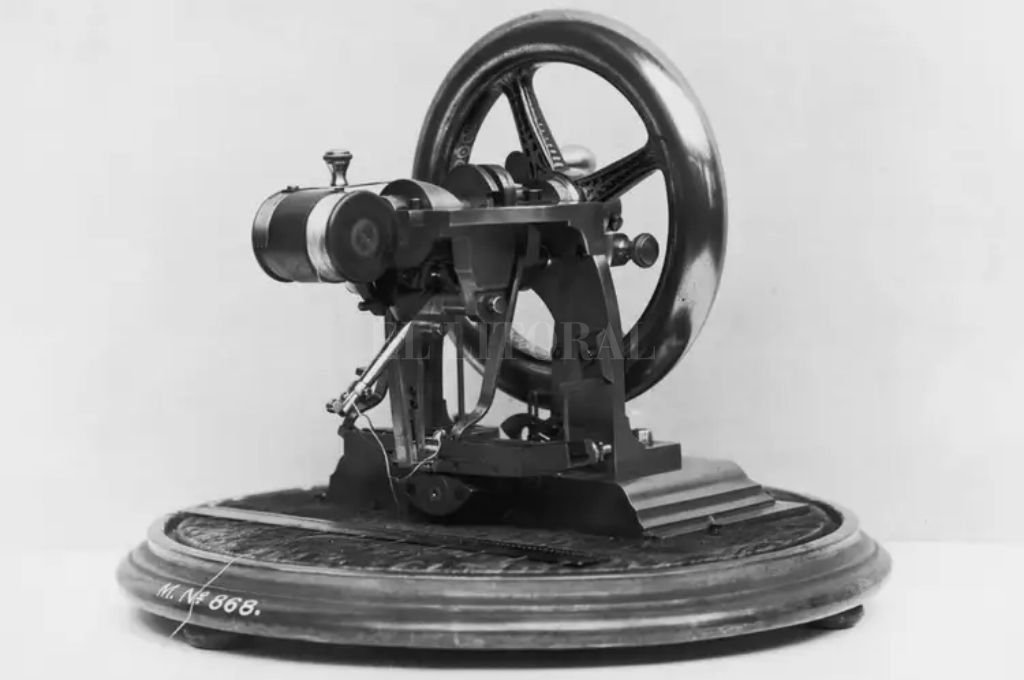
In 1846, Elias Howe obtained the first patent for a functional sewing machine, really practical and whose seams do not come undone. Credit: Internet Capture
By Claudio H. Sánchez
One of the things that this pandemic will leave us with is the revaluation of audiovisual media as an educational resource. And this does not necessarily apply to videos created for educational purposes. Also a movie or a series can teach us something. For example, the names of some inventors forgotten by history.
The Godfather and the telephone
In The Godfather III, Michael Corleone receives an award from the Meucci Association. When the godfather asks who this Meucci is, they explain that he is “the Italian-American who invented the telephone.”
Although, according to tradition, the telephone was invented in 1876 by Alexander Graham Bell, it is known that the Italian Antonio Meucci had been working on the problem of transmitting the voice through a cable since the 1850s.
Meucci was born in Florence on April 13, 1808. In Italy he took engineering and design courses until he established himself as a theatrical designer and technician. In October 1835 he had to emigrate to Cuba for political reasons. There he worked at the Gran Teatro de La Habana, built a water purification system and investigated the effect of electrical discharges on the human body. While working on this issue, he discovered, by chance, the possibility of transmitting the voice over a telegraph cable through what he called “talking telegraph.”
In 1845 he emigrated to the United States. There he carried out different jobs and founded a paraffin candle factory in which Giuseppe Garibaldi worked.
In 1854, Meucci perfected his talking telegraph to build what he called a telettrophone. His wife was ill and the apparatus allowed him to communicate from his bedroom with the other rooms of the house. In 1860 he made a public demonstration of the device in New York, but the news only appeared in the media of the Italian community.
Meucci was aware of the benefits of the telethrophone, but did not have the necessary means to patent it, much less to exploit it en masse. He filed a provisional patent, which established his priority and which he had to renew periodically, while he tried to sell the invention to a company that could meet the costs of patenting and production. He interviewed Western Union officials and, although the company never showed interest, it did not return the models and documentation that Meucci had provided to them.
When Meucci learned of the patent granted to Graham Bell, he complained through an attorney to the patent office. For some reason, the claim was unsuccessful. There is believed to have been pressure from Western Union, which had signed an agreement with Graham Bell to collect 20 percent of the profits from operating the phone.
In 1886 a trial was held in which Meucci demonstrated his priority over the telephone. However, the process suffered complications and delays until it was closed in 1896 with the death of Meucci.
Although Meucci was always recognized in Italy as the true inventor of the telephone, he remained unknown in the rest of the world. Finally, on June 11, 2002, the United States House of Representatives issued a resolution recognizing Antonio Meucci’s contribution to the invention of the telephone, prior to the work of Graham Bell.
Help! and the sewing machine
In 1965 Help !, the second Beatles film was released, after Nightfall of a Troubled Day. It is an entertaining film, but with no other pretensions than showing the Beatles, making their songs heard and selling records. But the most interesting appears at the end: at the end of the film a plaque appears stating that the film is “respectfully dedicated to the memory of Elias Howe who in 1846 invented the sewing machine.”
Although sewing machines had been around since the late 18th century, these machines were heavy, uncomfortable, and the seams came apart easily. It was the American Elías Howe who, in 1846, obtained the first patent for a functional sewing machine. Howe introduced a few essential innovations to make the sewing machine a truly practical machine. In particular, he adopted the chain stitch stitching, which remained firm without coming undone and the needle with the eye at its pointed end.
By the 1850s there were already several manufacturers of sewing machines. Each was responsible for some specific improvement on the original Howe concept but, at the same time, all used the improvements introduced by their competitors. This led to cross accusations of plagiarism in what became known as the Sewing Machine Wars. Manufacturers spent more time in court resolving patent disputes than in their workshops improving machines.
In 1856, the major manufacturers met in New York and agreed to share the technology, paying appropriate royalties to the respective patent holders.
The royalties Howe received for his patent on the sewing machine made him a millionaire. In 1867 he won a gold medal for his sewing machine at the Paris Exposition and was decorated by Napoleon III with the Legion of Honor, the highest distinction awarded by the French government. He died that same year in New York, at the age of 48.
In 2004, Elias Howe was inducted into the United States Inventors Hall of Fame. But, probably, his greatest fame was obtained by the dedication in Help !.
The Simpsons and the correction fluid
In Girls Just Want to Add, director Skinner suggests that girls are not as good as boys at math. This unleashes a scandal that ends with the separation between female and male students at Springfield Elementary School.
Marge finds it silly to think that women are less intelligent than men and, to illustrate her point, she says that a woman invented the concealer for paper.
Marge refers to the American Bette Nesmith Graham, who worked as a typist in a bank and who was also an amateur painter. He once realized that when an artist makes a mistake in painting, he does not erase what he has done, but covers the mistake with more paint. He decided he could do something similar with typing mistakes: cover them with paint. He put some white paint in a bottle, brought it to his office, and secretly used it to correct his typos.
Although his boss did not like this way of correcting mistakes, his colleagues at the office continually asked him for his “correction paint.” In 1951 he decided to produce and distribute it commercially under the name Mistake Out (something like “out of errors”). Years later he changed the name to Liquid Paper, which we know today.
Graham grew to over 200 employees and sold 25 million bottles of Liquid Paper per year. In 1979 he sold his company for more than $ 40 million to the Gillette Company. He died in 1980 at the age of 56.
Teacher and science communicator
Although Meucci was always recognized in Italy as the true inventor of the telephone, he remained unknown in the rest of the world.
Bette Nesmith Graham, worked as a typist and was an amateur artist. He once realized that when an artist makes a mistake, he doesn’t erase it, but covers it with more paint.
:quality(75)/cloudfront-us-east-1.images.arcpublishing.com/elcomercio/7LVSWZ7XMJHJLK4FZKLRJ37ACQ.jpg "Viral Video | Adam Chandler recreates one of the best scenes of the movie ‘Happy Gilmore’ for his 25th anniversary | Twitter | Christopher McDonald | Celebrities | Celebrities | nnda nnni | FAME")