


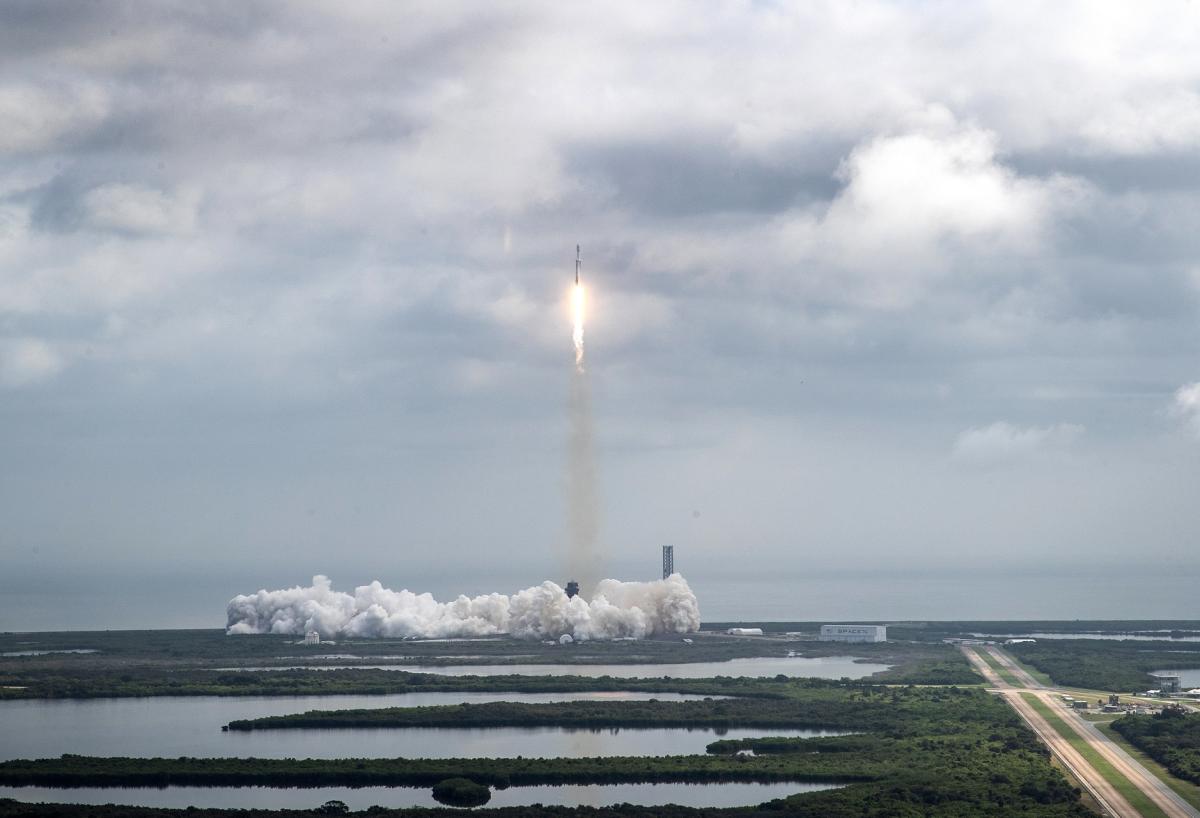
Madrid, October 24 (EFE).- It has been just over a week since the launch of the Psyche mission, the NASA mission that will study a huge metallic asteroid whose material is estimated to be worth several trillion dollars. But what are space minerals? Well, today, its interests are only scientific, and its commercial exploitation is not viable.
This was explained to EFE by researchers Michael Kuipers, from the European Space Agency (ESA), and Javier Lecandro, from the Institute of Astrophysics of the Canary Islands (IAC), in the Spanish archipelago of the Canary Islands, who stated that the samples of materials brought from space are rare, but important. To study our solar system and, ultimately, our planet.
NASA’s new mission will survey 16 Psyche, a 165,800 square kilometer potato-shaped asteroid orbiting the Sun in the outer part of the asteroid belt, between Mars and Jupiter.
Scientists think it may be the remains (essentially the core) of a planetoid, something like an attempt at a planet that never formed but contains the basic components of Earth and its neighbourhood.
“This small planet, large and massive enough to accumulate the heaviest material in the center (core) and the lightest in the mantle and crust, was destroyed by one or several collisions with other bodies, giving rise to several small asteroids. Of them, Psyche, will be a piece of The metallic core of that primitive body,” LeCandro told EFE.
He added that studying the Earth’s interior is very difficult because it reaches thousands of kilometers deep, “and that is why we want to study Psyche, because if it is indeed a nucleus, it will be a wonderful opportunity to analyze the interior of terrestrial planets.” Michael Kuipers (ESA).+
Time capsules
The Psyche mission will be the first to analyze a metallic asteroid, as all missions so far have focused on rocky asteroids, and three of them (Esiris-Rex from the European Space Agency, and Hayabusa and Hayabusa 2 from the Japanese Space Agency) have obtained asteroid samples. Asteroids Bennu, Itokawa, and Ryugu.
These fragments, along with Moon rocks acquired by NASA, the former Soviet Union, and, more recently, China, are the only “chunks” from space that have been explicitly brought to Earth, although NASA and the European Space Agency are already working on a joint project. To return Mars samples collected by the Perseverance rover.
The Martian samples will allow access to a “time capsule” dating back to between 4,000 and 3,500 million years ago, when rocks formed the surface of Mars and the planet was habitable for life, a period that coincides with the moment life appeared on Earth.
In the case of asteroids, studying them is important because they serve as the “bricks” with which the planets of the solar system are assembled.
Those that did not form planets were left to travel through space and maintain their “original composition, which is practically the same for about 4,000 million years,” Lecandro (IAC) commented.
Studying them is essential not only to understand the different stages of the evolution of our planetary system, but also to find out whether some of these “ingredients,” such as water or certain organic compounds, are what made the formation of life possible. On the planet. Earth.
On-site mining and water
In the case of the Moon, interests expand, and with scientific interest in knowing how the Moon and Earth formed, people start talking about mining, although “I don’t think the intention is to bring minerals to Earth.” Kuipers warned that this would not make any economic sense.
“Launching a rocket to bring back samples is very expensive. These missions spend hundreds of millions of euros or dollars to bring back a few grams of material,” but it has scientific value, as it does the same to bring back other materials and exploit them commercially. “I think it would not be economically viable.”
Kuipers believes that in the near future space mining will be used “to use those materials found in space itself, as fuel for rockets and satellites,” for example. “It will be more for use in space than bringing it to Earth, at least in the medium term.”
Moon water will also be important in the future. “We know that there is water near the poles, at least, that could be used for long-term residence — such as a potential colony — or for satellites, or perhaps one day, for missions further into space.”
Lecandro supports the same opinion, stressing that “mining in space today is not viable,” but in the future, “we will use minerals from space no matter what.”
“When we send manned missions to the solar system, using the resources we find on site or along the way will be absolutely essential, because bringing everything from Earth is nonsense.”
He commented that one of the things that space will make easier for us is the fuel that rockets use, hydrogen and oxygen, that is, water.
So, if we find asteroids that have water in their structure and are able to remove them, “the ship’s engines could be powered, and obviously they could also be used for human consumption on missions or colonies” like the one NASA wants to put on the Moon (Artemis program).
What is not viable for either of these worlds is the thought of space mining to extract and commercially exploit minerals, even if they are as rare, essential and difficult to obtain as the rare earth elements that today are essential components of technology.
“It’s a question of cost and benefit,” the IAC researcher concluded. “As long as it’s cheaper to remove them from Earth than to bring them from space, space mining won’t be viable.”
(c) EFE Agency
/cloudfront-eu-central-1.images.arcpublishing.com/diarioas/CL3TRGLW45M2JMDDX542SCOSWQ.jpg "They reveal what Tekashi 6ix9ine’s life was like in prison")