

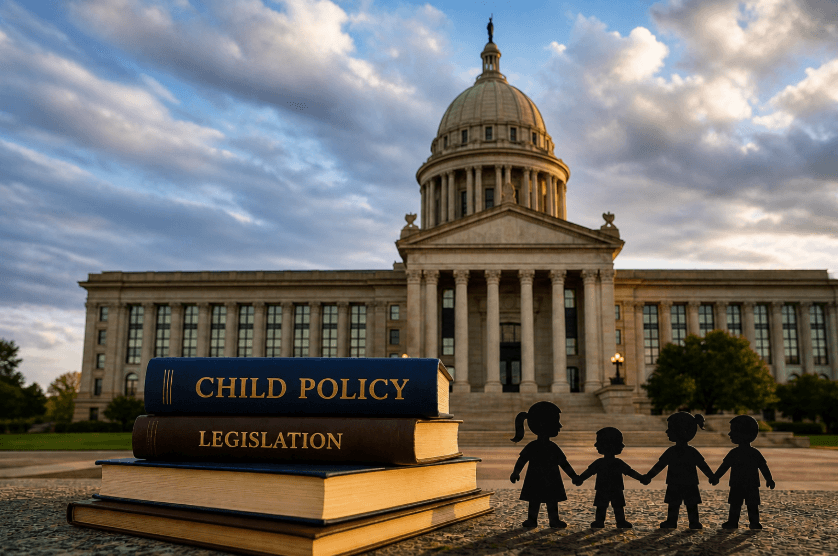
As the legislative session in Oklahoma approaches its conclusion, a series of child-focused bills remain under consideration, highlighting both policy priorities and the mounting pressure on state systems amid anticipated federal budget changes.
In a statement issued from Oklahoma City, the Oklahoma Institute for Child Advocacy underscored the significance of the current legislative efforts while acknowledging the broader fiscal environment shaping decision-making. “We at the Oklahoma Institute for Child Advocacy appreciate the diligent work of lawmakers regarding children’s policies this year. It has been a tough year with impending federal budget changes, shifting more burden to states. Here are a few of the children-related bills remaining for consideration.”
Among the measures still progressing is House Bill 1082, authored by Mark Tedford and Jonathan Wingard. The bill proposes a rebuttable presumption of equal parenting time in custody cases. It is currently eligible for consideration in the Oklahoma State Senate but would need to return to the House before adjournment to advance to the governor’s desk. The advocacy group added: “Thank you to Rep. Mark Tedford, R-Jenks, and Sen. Jonathan Wingard, R-Ada, for writing this bill and to the other lawmakers who authored similar bills.”
Another notable proposal, House Bill 1979, seeks structural reform in early childhood governance. Introduced by Trish Ranson and Chuck Hall, the bill would establish an Early Childhood Task Force tasked with exploring the consolidation of youth services under a single state agency. The measure is scheduled for consideration in the House. The organisation also recognised contributions from Paul Rosino, stating: “We also appreciate Sen. Paul Rosino, R-Oklahoma City, for his work in this area.”
Public health and child safety concerns are central to House Bill 4454, introduced by Carl Newton and Darcy Jech. The legislation proposes stricter controls on THC levels in edible medical marijuana products and mandates packaging standards designed to prevent appeal to children. The issue has gained urgency following a rise in accidental ingestion cases among minors, with increased emergency room visits reported. The bill is currently awaiting Senate consideration.
Judicial processes involving minors are also under review through House Bill 3298. Brought forward by Aletia Timmons and Mary Boren, the proposal introduces the Uniform Judicial Interview of Children Act. The legislation aims to modernise court procedures by ensuring that interviews and testimony involving children are conducted in an age-appropriate manner. It is presently awaiting a House vote on Senate amendments.
In the area of juvenile justice, House Bill 3755 focuses on healthcare continuity for young people in detention. Sponsored by Danny Sterling and Brenda Stanley, the bill would require the Office of Juvenile Affairs to provide prescribed medications at the time of placement and enable direct funding to facilities when necessary. The measure aligns with broader national discussions on improving medical care access within youth detention systems and is awaiting a final House vote.
Meanwhile, Senate Bill 1379 addresses support mechanisms for victims of human trafficking. Introduced by Aaron Reinhardt and Mark Lawson, the bill proposes a two-year pilot programme under the Office of the Attorney General. The initiative would provide grants to organisations assisting victims of sex and labour trafficking. Amendments made in the House are currently pending Senate approval.
Despite the progress on these measures, the advocacy group emphasised the importance of continued public engagement as the session draws to a close. “There are, of course, many other bills which will be considered in the remaining days of the session. We encourage you to reach out to your lawmakers to share your ideas on these bills and others. Citizen input is vital, and a few calls can truly make a difference.”
Looking beyond the current legislative cycle, attention is already turning to interim studies, which allow committees to explore policy ideas ahead of the next session. “Many lawmakers will also work on ideas over the interim. That is when legislative committees consider ideas for the next session. These studies are an opportunity to raise awareness on bills for next year or issues needing attention. If you have a good idea for lawmakers regarding a youth issue, please send us those ideas at https://tinyurl.com/2026InterimStudySuggest.”
The organisation concluded by reiterating its commitment to facilitating dialogue between the public and policymakers: “We will forward those thoughts to policymakers before the deadline to request these studies and look forward to working with them as they examine the issues. By hearing your ideas, this will help them create better laws for children in Oklahoma.”
With only days remaining in the session, the fate of these proposals will depend on legislative timelines and consensus-building efforts, underscoring the complexities of advancing child-focused policy in a constrained fiscal environment.