


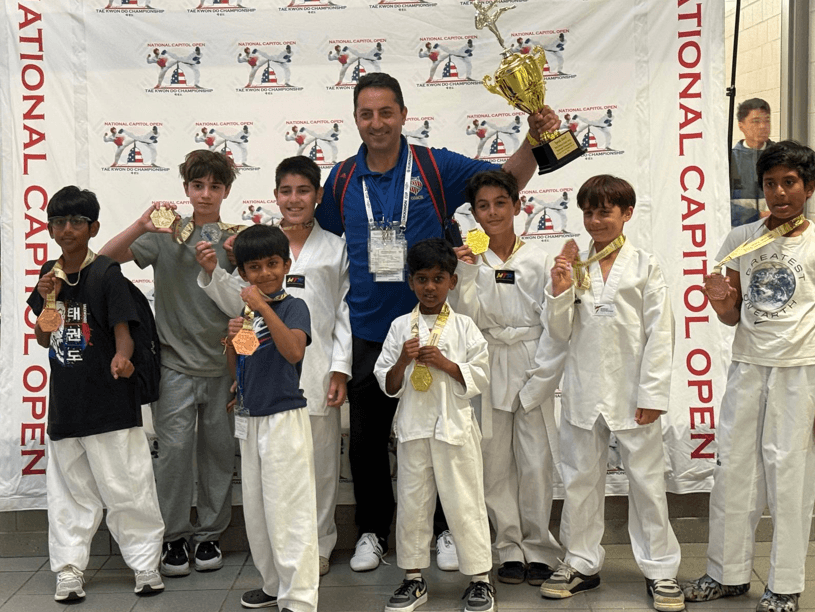
Apex, North Carolina — The TMSA Taekwondo Club has delivered a notable performance at the 2026 National Capitol Open Taekwondo Championship, securing a total of 14 medals and reinforcing the strength of its structured youth development programme.
Competing across elementary, middle, and high school divisions, 14 student-athletes represented the institution at the two-day event held in Virginia on 24–25 April. The team returned with six gold, five silver, and three bronze medals, marking a clean one-to-one conversion of participants to podium finishes.
The result reflects sustained investment in training and athlete development, particularly among younger participants. According to programme organisers, many of the elementary and middle school competitors have undergone approximately three years of foundational training, a factor that contributed significantly to their performance consistency and technical maturity.
The club’s showing also highlights the growing competitiveness of school-based martial arts programmes, particularly those that integrate long-term skill development with structured progression. Observers at the event noted that TMSA athletes demonstrated discipline and composure beyond their age groups, indicating a well-established coaching framework.
Beyond competitive results, the championship underscored the role of family engagement in youth sports. Ten of the 14 athletes were accompanied by family members, contributing to a strong support presence throughout the event. This backing created what organisers described as a unified and celebratory environment, reinforcing the programme’s emphasis on community as well as performance.
In a further endorsement of the team’s progress, the programme received special recognition from the tournament’s leadership. Grand Master Hyo Joo Lee, the event organiser, presented TMSA with a large trophy and a special award, acknowledging it as the first high school team to participate in the competition. The recognition signals a widening pathway for school-level teams to engage in higher-level tournaments traditionally dominated by independent clubs.
Coaching leadership also emphasised the broader value of the achievement beyond medal counts. “We are incredibly proud of our students—not only for their medals but for their discipline, perseverance, and sportsmanship,” said coach Bastug. “This accomplishment marks an important milestone for our program and sets a strong foundation for future success.”
From a performance standpoint, the distribution of medals across age groups demonstrates depth within the programme. Gold medal winners included A. Marikanti (1st Grade), Y. Senthilkumar (6th Grade), Z. Keskin (5th Grade), S. Aramadaka (3rd Grade), Z. Panchal (3rd Grade), and S. Gandhi (5th Grade), reflecting strong outcomes among younger competitors.
Silver medals were secured by N. Uyar (8th Grade), A. Bastug (6th Grade), A. Sarka (High School Team), and Arov (High School Team), indicating competitive strength extending into higher age categories. Bronze medalists included M. Keskin (5th Grade), H. Thati (6th Grade), and S. Aramadaka (6th Grade), rounding out the team’s overall tally.
The results suggest a balanced pipeline of talent, with athletes progressing through different stages of development while maintaining competitive standards. For education-led programmes, this type of continuity is often viewed as critical to sustaining long-term success.
Institutional support also played a key role in the team’s participation and outcomes. The TMSA Taekwondo Club formally acknowledged the contributions of school leadership and staff, including TMSA Triangle High School Principal Mr. Alden, TMSA Apex Principal Mr. Yuksekkaya, and staff members Mr. Pamuk, Mr. Yildirim, Ms. Sharma, Ms. Ensi, Mr. Philip, Mr. Iyigun, and Mr. Dogru.
Their involvement reflects a broader alignment between academic institutions and extracurricular development, where athletics is positioned as a vehicle for leadership, discipline, and student engagement.
Looking ahead, the club’s performance at the National Capitol Open is likely to strengthen its profile within regional and national circuits. With a proven training model and growing participation across age groups, the programme appears well positioned to build on this momentum in future competitions.
Overall, the outcome not only marks a successful tournament campaign but also underscores the value of structured training, community support, and institutional backing in shaping high-performing youth athletes.