


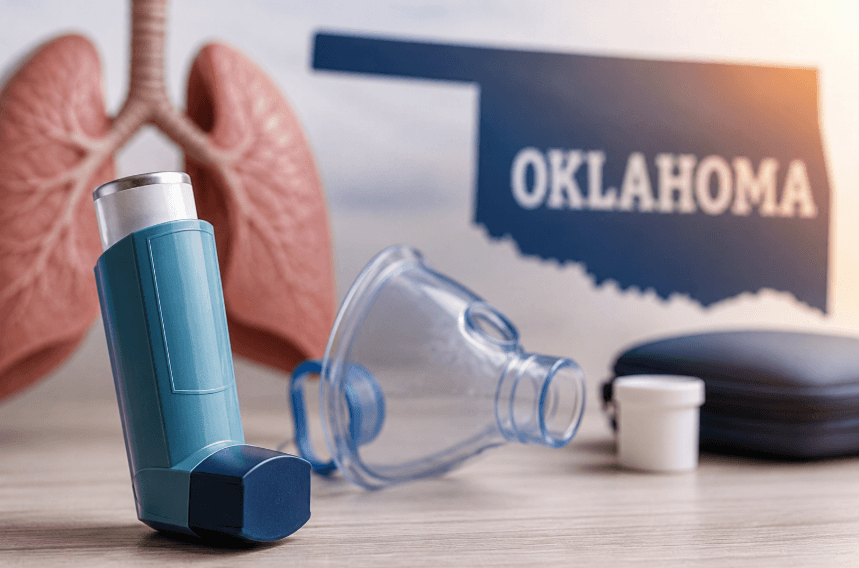
A new nationwide analysis has identified Oklahoma as the third most challenging state in the United States for people living with asthma, pointing to limited healthcare access and elevated asthma prevalence as major contributors to the state’s ranking.
The study, conducted by Premier Allergy and Asthma, evaluated all 50 states across four categories that influence asthma management: asthma prevalence, healthcare access, environmental conditions, and transportation-related pollution. Researchers combined data on air quality, smoking regulations, access to medical care, and proximity to major roadways to develop an overall risk index measuring how difficult each state is for asthma sufferers.
Mississippi ranked as the most challenging state overall with a risk index of 65.53, followed by West Virginia at 60.33. Oklahoma placed third with a score of 58.79, reflecting ongoing challenges in healthcare availability and respiratory health.
According to the study, Oklahoma ranked fourth nationwide for limited healthcare access, posting a category score of 66.09. The state also recorded the tenth-highest asthma prevalence, contributing to its placement among the most difficult locations for residents managing the chronic respiratory condition.
Mississippi earned the highest overall score after ranking second for environmental risk factors and sixth for healthcare access challenges. Researchers said the combination of poor environmental conditions and limited medical access creates a particularly difficult environment for asthma management.
West Virginia secured the second position because of its high asthma prevalence and elevated environmental risk factors, although it performed better than several other high-risk states when it came to healthcare access.
Alabama ranked fourth with an overall score of 57.83, driven by environmental challenges and transportation-related risks. Kentucky followed in fifth place despite recording only average asthma prevalence, largely because it posted the nation’s highest environmental risk score.
South Carolina ranked sixth, while Texas finished seventh despite having one of the country’s lower asthma prevalence rates. The study found that Texas’ poor ranking was driven primarily by the worst healthcare access score nationwide. New Hampshire, Wyoming, and Rhode Island completed the top ten.
Rhode Island stood out by recording the highest asthma prevalence of any state. However, relatively favorable healthcare access helped reduce its overall risk ranking compared with other high-prevalence states.
At the opposite end of the rankings, South Dakota was identified as the least challenging state for asthma sufferers, earning an overall index score of 32.08. Researchers attributed the state’s position to its relatively low asthma prevalence and favorable environmental conditions.
Nebraska ranked second among the least challenging states, benefiting from the nation’s lowest environmental risk score. Minnesota followed in third place with the second-lowest asthma prevalence and comparatively strong healthcare access.
North Dakota, Hawaii, Montana, Colorado, Washington, Utah, and California rounded out the ten least challenging states. California recorded the nation’s lowest asthma prevalence, although higher environmental risk factors prevented it from ranking even lower overall.
The findings suggest that asthma prevalence alone does not determine how difficult it is for residents to manage the condition. Instead, healthcare accessibility and environmental quality play significant roles in shaping patient outcomes across different regions.
Summit Shah, MD, founder of Premier Allergy and Asthma, commented:
“The data reveals several important patterns beyond the overall rankings. Transportation-related risks show surprisingly little connection to overall asthma burden, suggesting that higher traffic exposure alone does not always translate to greater challenges for asthma sufferers.
“The analysis also found that some regions with high asthma prevalence benefit from stronger environmental conditions, which helps offset their overall risk. Areas with relatively low asthma prevalence can still rank poorly overall due to factors such as limited access to healthcare.
“Oklahoma’s poor access to health care means that those who suffer from asthma may not be able to get a proper diagnosis or treatment for the condition. This, in extreme circumstances, can be fatal if someone with asthma is unequipped for an attack or sudden breathlessness.
“Many people don’t realize how significantly regional factors can affect asthma management. While medication and personal care are critical, environmental conditions, healthcare access, and even transportation patterns can have a major impact on quality of life for people living with asthma.”
The report concludes that while medication and individual care remain essential for asthma management, broader factors such as healthcare availability, environmental conditions, and local infrastructure continue to shape the challenges faced by millions of Americans living with the condition.



/cloudfront-us-east-1.images.arcpublishing.com/eluniverso/ESZCYCVTMHULRF4XLKFETXEN2U.jpg "The phrase about the origins of Argentina, Brazilians and Mexicans is critical of President Alberto Fernandez. International | News")