

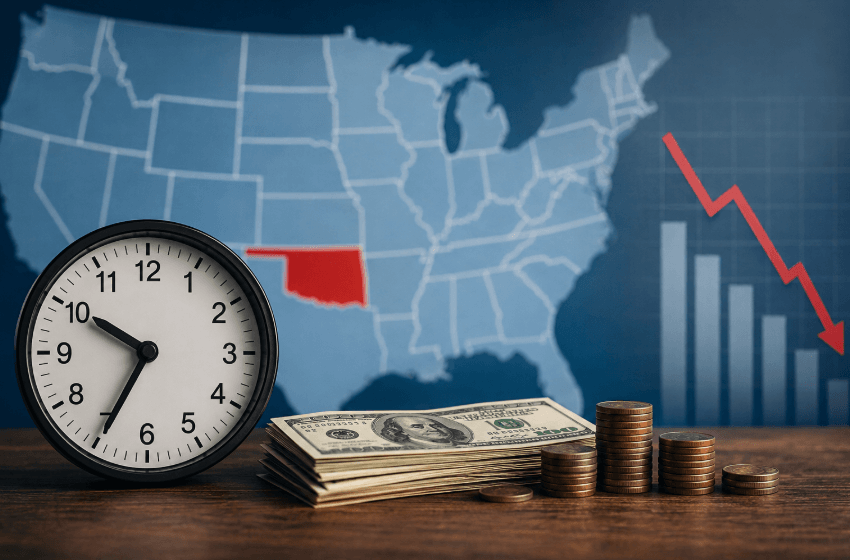
Oklahoma workers are putting in longer workweeks while earning less per hour than the national average, according to a new study examining differences in wages and working hours across the United States.
The research, conducted by FundedFast using data from the U.S. Bureau of Labor Statistics, ranked Oklahoma seventh among states where employees work comparatively long hours while receiving lower hourly earnings. The study calculated a national average workweek of 34.05 hours and average hourly earnings of $34.70.
Oklahoma Workers Average 35.3 Hours Per Week
According to the study, Oklahoma employees earn an average of $30.97 per hour, nearly 11% below the national figure.
Workers in the state average 35.3 hours per week, about 3.7% more than the U.S. average cited in the research. Over a year, that difference amounts to approximately 65 additional working hours, or slightly more than eight eight-hour workdays.
Andrea Faleburle, Founder and CEO of FundedFast, commented:
“Ultimately, this study presents a worrying reality in that the states that are working some of the longest hours in America are actually the ones taking home the lowest salaries.
“The data suggests that the average American works for around 34.05 hours per week, which highlights just how many more hours some of the lowest-paid states are clocking in each week.
“The study also presents a clear regional divide. Out of the top 10 lowest-paid but hardest-working states, eight are located in the South.
“Meanwhile, several of the states where workers put in fewer hours but earn the highest hourly wages are located in the Northeast and West, including Massachusetts, California and Colorado.
“This highlights how different regions are being impacted by America’s ongoing cost-of-living crisis, with multiple states in the South working longer hours while still taking home some of the lowest hourly salaries in America.”
Mississippi Leads Ranking for Longer Hours and Lower Earnings
Mississippi ranked first in the study. Employees there work an average of 35.3 hours per week and earn an average of $28.08 per hour. The research placed their average annual salary at $51,543, more than 16% below the national figure of $61,425.
Arkansas ranked second, with average hourly earnings of $29.78 and a 34.8-hour workweek. Louisiana followed in third place at $29.80 per hour.
Louisiana stood out for its working hours, with employees averaging 36 hours per week. According to the study’s calculations, that translates into about 101 additional hours annually compared with the average U.S. worker.
West Virginia ranked fourth with average hourly earnings of $30.01 and a 35-hour workweek. Kentucky followed at $30.20 per hour, while Iowa ranked sixth at $30.55.
After Oklahoma in seventh place, Tennessee ranked eighth with hourly earnings of $31.07. Alabama was ninth at $31.44, while Wyoming completed the top 10 at $32.05 per hour.
Massachusetts Leads Among Higher-Paid States With Shorter Workweeks
The research also examined states where workers earn comparatively high hourly wages while working fewer hours than the national average.
Massachusetts led that ranking, with average hourly earnings of $42.32 and an average workweek of 33.3 hours. The hourly figure is nearly 22% above the national average cited by the study.
California ranked second, with workers earning an average of $41.32 per hour while working 33.2 hours per week. Colorado followed with average hourly earnings of $39.48 and a 33.3-hour workweek.
Minnesota, Connecticut, New York, New Jersey, Hawaii, Oregon and Virginia also appeared among the 10 states combining above-average hourly earnings with shorter-than-average workweeks.
Washington, meanwhile, recorded the highest hourly earnings cited in the broader research at $42.49. However, its average workweek of 34.7 hours exceeded the national benchmark used by the study, keeping it out of the shorter-hours ranking.
The findings highlight substantial differences in the relationship between working hours and hourly earnings across U.S. states. For Oklahoma, the study places the state on the side of that divide where employees work longer than the national average while receiving lower hourly compensation.