

Researchers from Vilnius University have unveiled a novel approach to charting the Milky Way that could reshape how scientists understand the Galaxy’s internal structure. Working in collaboration with colleagues in Italy, the team has demonstrated that the chemical composition of stars can be used to trace spiral arms from within the Galaxy itself—offering a perspective previously limited by dust, distance and stellar overcrowding.
Chemical cartography reveals hidden Galactic architecture
The study, led by Dr Carlos Viscasillas Vázquez and published in Astronomy & Astrophysics, focuses on the emerging field of chemical cartography. Rather than mapping the Milky Way using the positions or movements of stars, the researchers analyse the detailed chemical signatures locked inside them. These patterns, they argue, offer a clearer and more resilient indicator of large-scale structure, particularly in regions of the Galaxy that are difficult to observe through conventional methods.
Their findings show that chemical markers can be used to identify both the Scutum and Sagittarius spiral arms—two major structural components of the inner Milky Way. Significantly, the research also reveals evidence of a previously unrecognised spur linking these arms, a feature that helps refine our understanding of how spiral galaxies evolve and maintain their shape.
Overcoming dust and distance barriers
According to the team, this approach has the potential to overcome longstanding observational challenges. Dust clouds, high stellar density and the limitations of current imaging technologies have made it difficult for astronomers to form a coherent picture of the Milky Way’s structure from our position inside it. By shifting to chemical analysis, researchers gain access to a new layer of information that is less obscured and may hold the key to identifying features that have remained invisible until now.
A step toward clearer maps of our Galaxy
The work forms part of a wider effort to understand the Galaxy’s formation history and the processes that shaped its spiral architecture. Scientists have long sought methods to map the Milky Way with the same clarity achievable for external galaxies. However, because the Sun lies embedded within the Galactic disc, obtaining a comprehensive view has been one of astronomy’s most persistent challenges. The new chemical-based method offers an alternative that could begin to bridge this gap.
Supporting imagery from Tenerife Observatory
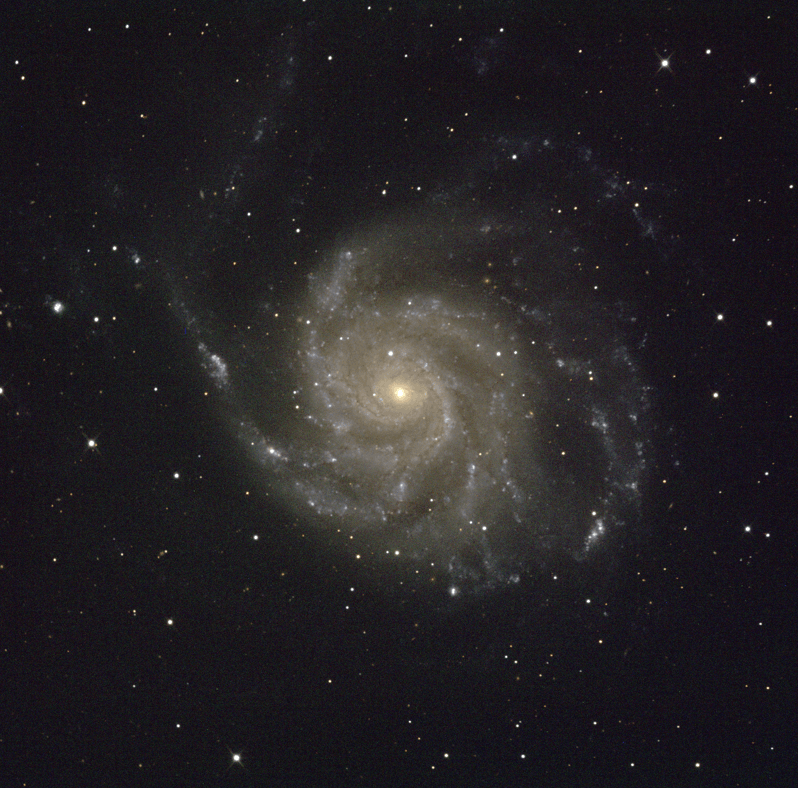
An image accompanying the research, depicting the grand-design spiral galaxy Messier 101, was captured using the 1-metre telescope at the Tenerife Observatory. The photograph, taken by Carlos Viscasillas Vázquez and Rytis Babianskas, formed part of a broader investigation into the chemical composition of stars in external galaxies. Although Messier 101 lies far beyond the Milky Way, its clear spiral structure underscores the kind of features the researchers aim to detect within our own Galaxy using chemical techniques.
Implications for wider galactic research and industry
For the scientific community, the implications extend beyond the Milky Way. Spiral galaxies are common throughout the Universe, yet many of them face similar observational barriers when studied from particular angles or distances. Chemical cartography, as demonstrated in this study, may offer a transferable tool for mapping structure in a wide range of galactic environments. By establishing a clearer link between chemical patterns and large-scale architecture, the method could help refine theoretical models of spiral formation and evolution.
For institutions and businesses involved in astrophysical instrumentation, data analytics and space research, the findings highlight an emerging area of demand. As chemical mapping grows in scientific importance, investment in high-resolution spectrographs, data-processing platforms and machine-learning techniques for stellar classification is likely to accelerate. The study underscores how new methodologies can create opportunities for technology providers across Europe’s expanding space-science sector.
Looking ahead
While the research represents an early step in a larger programme of investigation, its authors suggest that chemical cartography has strong potential to become a standard approach in galactic studies. By revealing structures hidden from traditional observation, it could help create the most detailed internal map of the Milky Way to date and offer a template for analysing spiral galaxies more broadly.
As interest in the technique grows, further projects are expected to deepen the chemical survey of the inner Milky Way and validate the newly proposed spur. For now, the study provides a compelling demonstration of how stellar chemistry can be used not only to understand the life cycle of individual stars but also to illuminate the structure of the Galaxy they inhabit.