


AUSTIN, Texas — Astronomers in Texas have uncovered an extraordinary black hole lurking inside one of the faintest galaxies known to science, a finding that could overturn long-held theories about how small galaxies form and evolve.
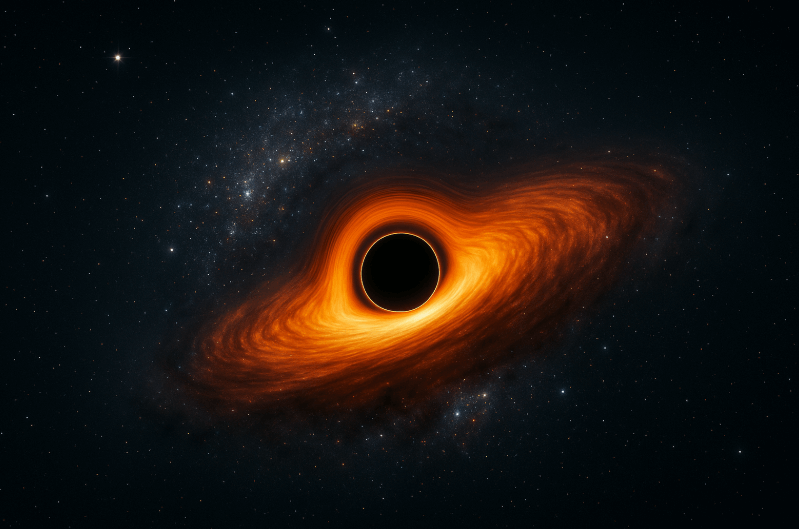
The discovery, made by researchers from The University of Texas at Austin and The University of Texas at San Antonio (UTSA), suggests that a colossal black hole — rather than dark matter — is responsible for holding together the tiny galaxy known as Segue 1.
Segue 1, located around 75,000 light-years from Earth, contains only a few dozen visible stars, far too few to generate the gravitational pull needed to keep it intact. Until now, astronomers assumed that invisible dark matter provided the missing mass. But according to the new research, recently published in The Astrophysical Journal Letters, a supermassive black hole may instead be acting as the galaxy’s anchor.
“Our work may revolutionize the modeling of dwarf galaxies or star clusters to include supermassive black holes instead of just dark matter halos,” said Nathaniel Lujan, a graduate student at UTSA who led the research.
Collaboration Between Universities Leads to Major Breakthrough
The study was the culmination of an innovative astronomy course jointly run by UT Austin and UTSA. Co-taught by astrophysicists Karl Gebhardt (UT Austin) and Richard Anantua (UTSA), the class gave students hands-on experience using some of the world’s most powerful computing tools to explore galactic dynamics.
“We designed this course to foster collaboration between our two universities,” said Gebhardt. “Initially, the project was to model the gravitational dynamics inside Segue 1. That it resulted in a significant discovery is a real testament to the talent of these students and their determined, hard work.”
Using the supercomputers at UT Austin’s Texas Advanced Computing Center, the students ran hundreds of thousands of simulations. Each model tested different assumptions about Segue 1’s structure — including the presence of a black hole, varying levels of dark matter, and other hypothetical scenarios — to identify which most accurately matched real-world observations made by the W.M. Keck Observatory in Hawaii.
“Nate came into his first astronomy elective with a great work ethic and a penchant for learning new methodologies,” said Anantua. “Both were needed for this project, which combined a steep computational learning curve with a theoretical grasp of strong gravity in the vicinity of supermassive black holes.”
Evidence Points to an Enormous Black Hole
To separate Segue 1’s stars from those being drawn away by the Milky Way’s much stronger gravitational field — a process known as tidal stripping — the team measured the distribution of stars at the galaxy’s edges and filtered out those likely influenced by our own galaxy. The remaining stars revealed a surprising pattern: those near the centre were moving rapidly in tight orbits, a hallmark of a massive black hole.
Models dominated by dark matter failed to replicate this motion, while those centred on a black hole matched almost perfectly.
The results were even more striking once the black hole’s scale was estimated. At roughly 450,000 times the mass of the Sun, it outweighs all of Segue 1’s stars combined by nearly a factor of ten — an extreme ratio unseen in larger galaxies.
“There is a strong relation between the mass of the black hole and the mass of the host galaxy. The black hole in Segue 1 is significantly larger than what is expected,” explained Gebhardt. “If this large mass ratio is common among dwarf galaxies, we will have to rewrite how these systems evolve.”
Rethinking How Dwarf Galaxies Form
One hypothesis is that Segue 1 was once a larger galaxy whose stars were stripped away over billions of years by the Milky Way’s pull, leaving behind only a remnant core. Another theory suggests Segue 1 belongs to a newly identified class of objects known as Little Red Dots — ancient galaxies with enormous black holes and very few stars.
If so, astronomers may now have a nearby example that could provide fresh insights into the formation of early galaxies, previously visible only at the edge of the observable universe.
Alongside Lujan, co-authors of the study include UT Austin’s Owen Chase, Maya Debski, Claire Finley, Om Gupta, Alex Lawson, Zorayda Martinez, Connor Painter, and Yonatan Sklansky, and UTSA’s Loraine Gomez, Izabella Marron, and Hayley West. The research was supported by the Simons Foundation.
A Small Galaxy with a Big Story
Whether Segue 1 is a stripped remnant or a primordial “Little Red Dot,” the finding challenges long-standing assumptions about how dwarf galaxies are bound together — and serves as a powerful reminder that even the smallest corners of the cosmos can conceal the biggest surprises.