


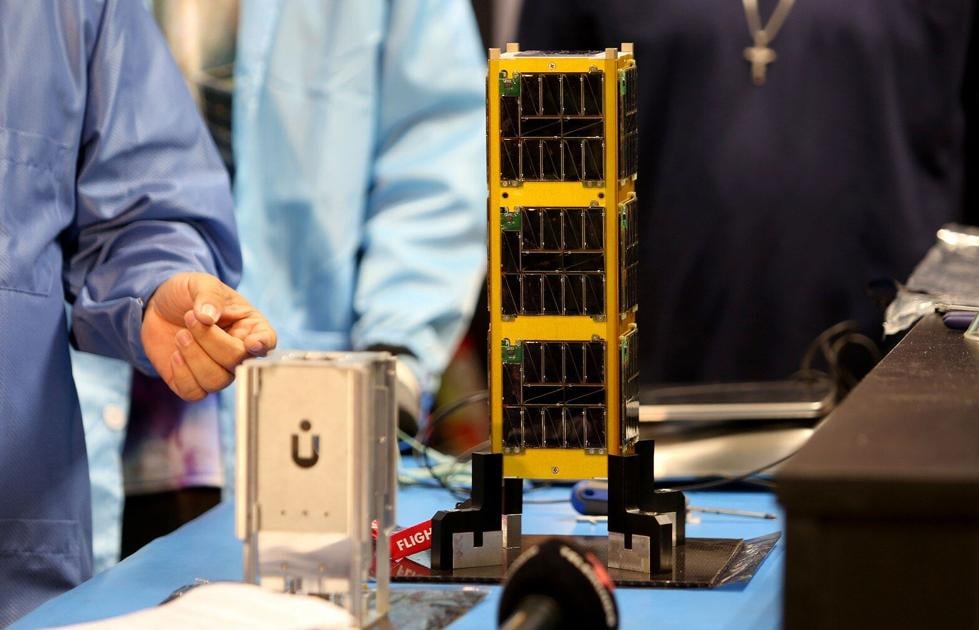
The president of the Inter-American University of Puerto Rico, Manuel J. Fernós, reported that the first Puerto Rican satellite, the Puerto Rico CubeSat NanoRocks-2 (PR-CuNaR2), will be launched into space at 3:37 a.m. on Saturday, August 28 from Cape Canaveral, Florida.
As part of Mission 23 of the SpaceX company, the satellite developed and built by students of the Engineering School of the Bayamón campus is part of the ElaNa 36 project of the National Aeronautics and Space Administration (NASA).
PR-CuNaR2 will be the first Puerto Rican satellite to be launched into space. The satellite, which weighs 5.6 pounds and measures four inches wide by four inches long and 12 inches high, completed its tests in July.
The PR-CuNaR2 will be transported and launched from SpaceX’s Falcon 9 rocket, and is constructed of aluminum, photovoltaic cells, batteries and other materials approved for use in space. In turn, PR-CuNaR2 will study the origin and development of planets and young stars, explained Professor Amílcar Rincón Charris, head of the project.
In the event that it cannot be launched on Saturday, NASA is scheduled for 3:14 in the morning the next day.
“On Saturday, all Puerto Ricans have an appointment with history. That day we will proudly celebrate the achievement of being able to take a satellite built by Puerto Rican hands into space, ”said the president of Inter.
Rincón Charris, meanwhile, invited the people to witness this event that positions us as one of the few countries that has been able to place satellites in space and study the formation of the universe.
“This is a good time to educate our children and young people in science-related issues, but parents and educators can also address issues such as the importance of setting goals, being persistent and working as a team,” said the educator.
Some 65 students, between women and men, have been part of the development of PR-CuNaR2, which began in March 2018, although the design and construction prototype began in 2013. The academic added that many of the students who have been part of this project have already graduated from university.
Inside, the satellite has stainless steel and silicon microparticles that emulate asteroids. As it orbits in space, the microparticles will be colliding. During this process, a camera will be taking photographs and videos of the microparticles to be sent to the Bayamón campus of the Interamericana.
Then, this content will be studied by the Florida Space Institute and the Physics Department of the University of Central Florida (UCF) entities that collaborate in the research.
PR-CuNaR2 will be launched in the Dragon capsule from SpaceX23 to the International Space Station. The tour, from takeoff to arrival at the International Space Station, will last approximately nine hours.
Once the satellite reaches the International Space Station, it will wait for the orbit of 51.6 degrees, to be launched into space through an extendable arm that the Nanoracks company has on the Space Station. The satellite is ready to orbit for two years, but it could be longer. Then it will be attracted by the atmosphere until it disintegrates.
The Inter-American team that developed the project chose the 56 ° orbit to place the PR-CuNaR2 so that it can pass over Puerto Rico twice a day for 10 minutes. In this way, the satellite will pass the island more times than in other orbits.
When the satellite passes over Puerto Rico, the team that is located in the Bayamón campus will know -through telemetry and videos- what is happening with the satellite and will collect the data provided for its subsequent analysis and publication.
This project has been sponsored and supported by the NASA Puerto Rico Space Grant Consortium, the Central Florida University, the University of Michigan, the Florida Space Institute, the Aerospace Corp. company and the local express Engiworks and Prescision Experts.
Once the satellite is launched, its trajectory can be seen from the University page (inter.edu) and from the satellite page (prcunar2.org).
On both Internet pages you will also be able to obtain additional information on the satellite, as well as on the Interamericana’s social networks on Facebook / interocs and on Twitter and Instagram at @interpuertorico.