


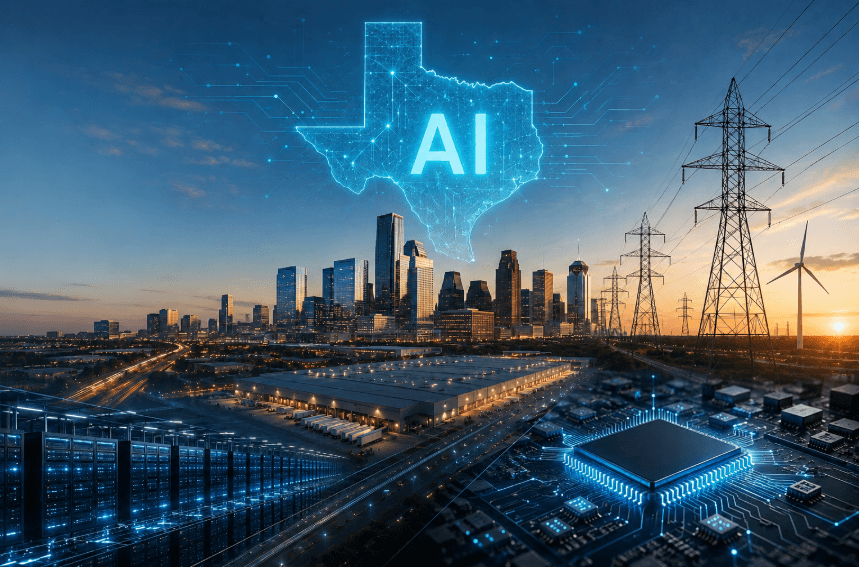
Texas is rapidly becoming the center of the United States’ physical artificial intelligence economy, with more than $140 billion in capital commitments fueling major infrastructure, manufacturing, energy, and technology projects, according to a new report released by Build American AI.
The report, published by the nonprofit organization dedicated to advancing U.S. leadership in transformative technologies, argues that artificial intelligence is driving a new era of industrial growth across Texas. Rather than focusing solely on software development, the state is investing heavily in the physical infrastructure needed to support the next generation of AI technologies, positioning itself as a cornerstone of America’s long-term competitiveness.
Massive Investments Fuel AI Infrastructure Growth
According to the report, more than $140 billion has already been committed across four major AI and infrastructure projects in Texas. These investments are helping expand data centers, semiconductor manufacturing, energy production, and transportation systems that are essential for supporting advanced artificial intelligence applications.
The report identifies Texas as uniquely positioned for this transformation because of its abundant energy resources, established manufacturing sector, and more than 3.5 million small businesses. Together, these strengths are attracting significant private capital while creating opportunities for businesses across multiple industries.
Among the state’s largest developments is the $47 billion Project Radiance data center expansion in Abilene. The report also highlights Samsung’s semiconductor investment of more than $37 billion in Central Texas, describing both projects as examples of how digital innovation is translating into long-term industrial development.
AI Adoption Accelerates Across Texas Businesses
Business adoption of artificial intelligence is also expanding rapidly across the state.
The report found that 59% of Texas businesses are now using either traditional or generative AI technologies, a significant increase from 38% reported just one year earlier. Texas also ranks second nationwide for AI-related job postings, accounting for 57,785 openings, or approximately 8.77% of all AI job listings in the United States.
In addition, nearly 1.9 million Texas small businesses are actively using AI-powered platforms to improve productivity, automate routine tasks, and increase operational efficiency.
Build American AI Executive Director Nathan Leamer said the state’s progress demonstrates that artificial intelligence is creating tangible economic opportunities beyond the technology sector.
“AI is fundamentally an industrial transformation, and Texas is proving that the future of tech is built with steel, power, and American labor,” said Nathan Leamer, executive director of Build American AI. “With over $140 billion committed to its physical AI economy, Texas is laying the groundwork to ensure our country leads the global innovation race. From Central Texas semiconductor plants to nearly two million small businesses using these tools to grow, Texas’s success demonstrates how technology can reindustrialize our nation.”
Building the Physical Foundation for Artificial Intelligence
The report emphasizes that artificial intelligence depends on far more than software innovation. Reliable electricity, advanced semiconductor production, large-scale computing facilities, and modern transportation networks are all essential components of the AI ecosystem.
Texas is emerging as a leader in each of these areas, according to the analysis.
From constructing new data center infrastructure in Abilene to expanding semiconductor manufacturing in Taylor and strengthening energy production in West Texas, the state is building the physical assets required to sustain future AI development.
The report also points to advances in autonomous freight transportation between Dallas and Houston, where AI-driven logistics are improving supply chain efficiency while reducing operating costs. These technologies are expected to enhance freight movement across one of the country’s busiest commercial corridors.
Small Businesses See Practical Benefits
While large infrastructure projects attract significant attention, the report notes that small businesses are among the biggest beneficiaries of expanding AI adoption.
Artificial intelligence tools are helping entrepreneurs automate customer service, prepare project estimates, improve administrative workflows, and streamline daily operations. These capabilities enable smaller companies to compete more effectively while supporting business growth without proportionally increasing staffing requirements.
According to the report, widespread adoption among Texas small businesses demonstrates that AI is becoming an accessible productivity tool rather than remaining limited to major technology companies.
Texas Positioned for Long-Term AI Leadership
The report concludes that the artificial intelligence revolution represents a broad industrial transformation supported by physical infrastructure, manufacturing capacity, and energy investment.
Backed by more than $140 billion in committed capital, expanding industrial projects, strong business adoption, and nearly 1.9 million AI-enabled small businesses, Texas is establishing itself as a key foundation for the next phase of American technological leadership. As investments continue to flow into the state, the report suggests Texas is helping shape the infrastructure that will support the future of artificial intelligence across the United States.