

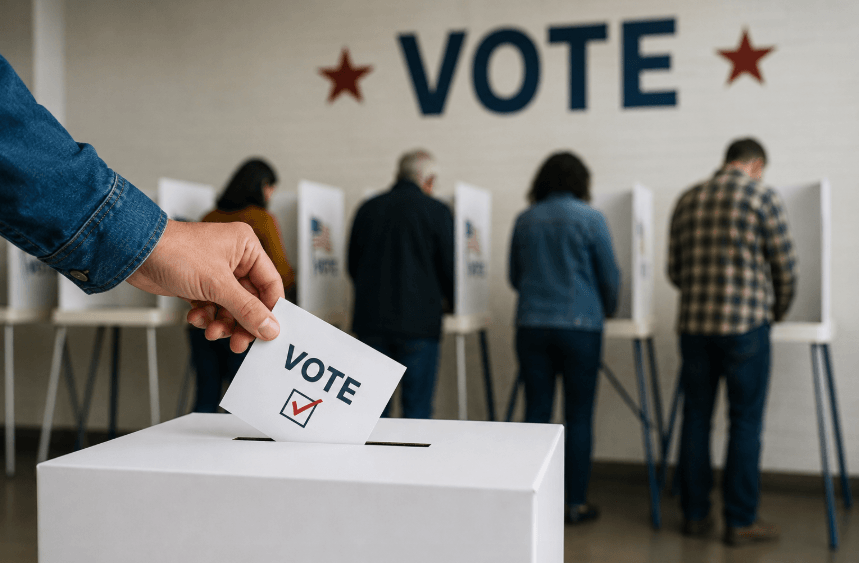
OKLAHOMA CITY — Concerns over historically low voter turnout in Oklahoma’s primary elections have prompted renewed calls for civic participation ahead of the state’s June 16 Primary Election, with advocacy groups warning that continued apathy could leave critical political and economic decisions in the hands of a minority of voters.
The latest appeal comes as Oklahoma prepares for a closely watched primary cycle that includes contested political races and a statewide ballot question on increasing the minimum wage. Campaigners argue the combination of high-profile contests and economic policy proposals could encourage stronger voter engagement than in previous election years.
“This is partly due to apathy or forgetfulness, but also from the negativity of campaign ads which suppress voter turnout due to frustration,” the statement said. “With a smaller turnout, fewer Oklahomans decide who will become their party’s nominees in November’s General Election.”
The organisation behind the statement, the Oklahoma Institute for Child Advocacy, said disengagement from the electoral process effectively weakens public representation.
“I sum it up like this for those who feel their vote does not count: if someone chooses not to vote, it becomes a self-fulfilling prophecy, ensuring their voice is silent because of their absence.”
Historical Turnout Data Highlights Persistent Participation Gap
Data cited in the statement shows Oklahoma has consistently recorded modest participation rates during non-presidential election cycles. According to figures referenced from Ballotpedia, registered voter turnout reached 39.6% in 2022, 42.1% in 2018, 30% in 2014 and 39.1% in 2010 during general elections.
Primary elections have historically attracted even fewer participants, partly because only registered Republicans and Democrats are eligible to vote in party nomination contests. The statement also noted that uncontested races in some districts reduce voter motivation further.
“In party primaries, only those registered as Republican or Democrat can vote to select nominees for the November election,” the release stated. “The fact that not every person has a fiery Primary Election in their area or even a choice for their nominee when only one candidate files drives voter participation down.”
The comparison with neighbouring Texas was also used to underline the potential for higher engagement. Texas recorded almost 4.5 million ballots cast during its March primary elections, representing one of the strongest midterm primary turnouts in the state’s recent history.
“To the south of us, nearly one in four registered voters in Texas cast a ballot in their high-profile March primaries with almost 4.5 million ballots cast, a high-water mark for midterm elections in the state’s recent history,” the statement said. “Will we see the same result next week with our own high-profile elections?”
Minimum Wage Ballot Question Could Influence Turnout
Election analysts and advocacy groups believe the statewide minimum wage question on this year’s ballot may significantly increase voter participation, particularly among younger and lower-income voters.
The statement noted that all registered voters in Oklahoma will be eligible to vote on the proposal regardless of party affiliation, potentially broadening turnout beyond traditional primary voters.
“This year, there is a state question on the Primary ballot for which every registered voter statewide may cast a ballot,” the release said. “This is regarding a minimum wage increase and will likely drive more Oklahomans than usual to vote.”
Campaigners drew parallels with the 2018 Oklahoma Primary Election, which also featured heavily contested Republican races alongside a statewide ballot initiative concerning medical marijuana legalisation.
According to figures included in the statement, voter turnout reached 43.57% that year. Approximately 848,100 voters cast ballots in gubernatorial contests, while 892,758 voted on the medical marijuana question.
“This 2026 Primary Election has a similar set up as the 2018 Primary, when there were heavily contested Republican races and a state question on the ballot,” the statement said. “Voters showed up that year at a rate of 43.57%, with 848,100 voters casting ballots for gubernatorial candidates, while 892,758 voted on the medical marijuana question; 44,658 more votes were cast on the question.”
However, the advocacy group also stressed that a majority of eligible voters still failed to participate during that election cycle.
“If we flip the data, 56.43% of eligible registered voters did not vote in the 2018 Primary,” the statement continued. “Instead, they left it up to those who did turn out. Again, the self-fulfilling prophecy of their votes not counting because they did not show up.”
The organisation concluded its appeal by encouraging residents to vote either on election day or through early voting at county election boards.
“Please vote on June 16 or vote early at your county election board,” the statement said. “Vote for the candidates who you believe will best serve our state. Also, assess what is best for our state with increasing the minimum wage.”
“We at the Oklahoma Institute for Child Advocacy ask that as you consider candidates and the minimum wage increase, and the impact each will have on the lives of children. This Primary Election is far too important to let someone make the decision for you by not voting.”