

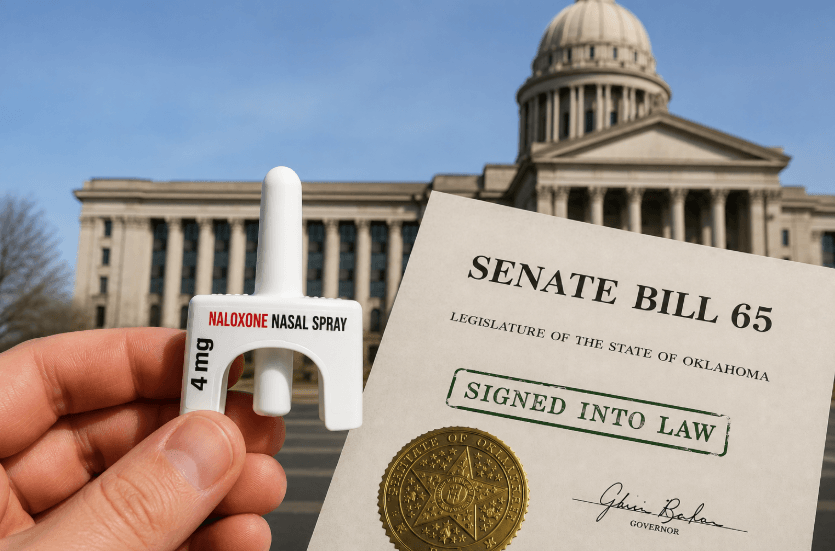
Oklahoma has enacted new legislation designed to widen public access to naloxone, the overdose-reversal medication commonly associated with the brand Narcan, in a move advocates say could significantly strengthen the state’s response to the opioid and fentanyl crisis.
Senate Bill 65, signed into law by Governor Kevin Stitt with an emergency clause, authorises individuals and organisations across Oklahoma to acquire, possess, distribute and administer emergency opioid antagonists, including naloxone. The measure applies to schools, universities, businesses, congregations, nonprofit organisations, tribal entities and government bodies.
The legislation was authored by Sen. Darrell Weaver, a Republican from Moore, and carried in the House by Rep. Tim Turner, a Republican from Kinta. In addition to expanding access, the law provides criminal and civil immunity for individuals and organisations acting in good faith when administering naloxone during an overdose emergency, except in cases involving gross negligence or wilful misconduct.
Supporters of the bill say the measure removes legal uncertainty that has historically discouraged wider placement of naloxone rescue kits in public and communal settings. Advocates believe the legislation will now allow overdose-response supplies to be positioned in schools, university halls of residence, workplaces, churches, gyms, music venues and other heavily used public spaces.
The bill has been welcomed by the FATE Foundation, HarborPath and law firm Whitten Burrage, organisations that have spent years involved in addiction awareness and public health advocacy across Oklahoma.
“I am so grateful this bill passed because Narcan saves lives,” said Reggie Whitten, founder of the FATE Foundation. “I lost one son to addiction and another to epilepsy, and my family has devoted itself to doing something meaningful about both. Through FATE, we have spent years educating young people across Oklahoma about the dangers of addiction. Senate Bill 65 means the next coach, pastor, teacher, coworker or stranger in a parking lot will not have to wonder whether they are allowed to save a life. They are. That is exactly what Oklahoma needs.”
Whitten founded Fighting Addiction Through Education (FATE) after losing his eldest son, Brandon, at the age of 25 to opioid addiction. Since then, the organisation has delivered addiction awareness presentations to more than 100,000 high school and university students across the state.
FATE also produced the documentary series Killing Pain, which explored the origins and development of the opioid epidemic before the issue gained broader national political attention in the United States.
HarborPath president Ken Trogdon said the legislation reflected years of advocacy work aimed at improving access to overdose-response medication and addressing the growing fentanyl crisis.
“Reggie Whitten has turned unimaginable personal loss into relentless advocacy for Oklahoma families,” said Ken Trogdon, president of HarborPath. “His willingness to speak openly about addiction and educate thousands of students has changed lives across this state. Leaders like Reggie helped build the momentum behind Senate Bill 65 because they understand that awareness alone is not enough — people need immediate access to lifesaving tools.”
Trogdon added that the new law places overdose intervention tools directly into community settings where emergencies are most likely to occur.
“Senate Bill 65 takes one of the most effective tools we have against the fentanyl crisis and puts it in the hands of the people most likely to use it: bystanders,” Trogdon said. “Most overdoses happen in front of someone who could help if they had naloxone within arm’s reach and the confidence to act. This law clears the way for naloxone rescue kits in schools, workplaces and communal areas while protecting the people who step in to save a life. This is a monumental step in making naloxone available when and where it is needed most.”
HarborPath, a nonprofit organisation focused on expanding access to essential medications, has worked with schools, universities, law enforcement agencies and public sector organisations throughout Oklahoma to improve naloxone availability.
In 2025, the organisation partnered with the University of Oklahoma on a public awareness initiative that used student-athletes to direct students towards free naloxone resources available on campus.
Hannah Whitten of Whitten Burrage said the legislation moves beyond public messaging and provides communities with practical emergency-response tools.
“This bill turns awareness into action,” said Hannah Whitten of Whitten Burrage. “Oklahomans do not need another pamphlet about fentanyl. They need naloxone where emergencies actually happen — in schools, dorms, gyms, churches, businesses and vehicles. SB 65 empowers ordinary people to act in a crisis without fear of legal consequences, and that will save lives.”
The organisations also praised Weaver and Turner for supporting the legislation, citing their law enforcement backgrounds and experience dealing directly with addiction-related issues in Oklahoma communities.