

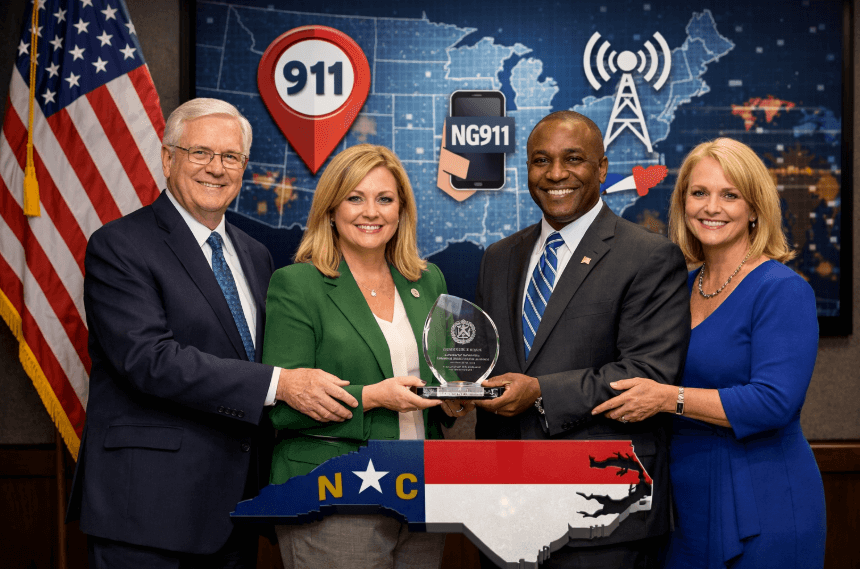
The North Carolina 911 Board has been recognised with a national award for its role in advancing awareness and implementation of Next Generation 911 technology across the United States.
The board, which operates administratively within the North Carolina Department of Information Technology, received the NG911 Awareness Award from the NG9-1-1 Institute. The honour recognises the organisation’s leadership in educating policymakers, emergency service professionals and state officials about the benefits of modernised emergency communication infrastructure.
The recognition comes as states across the country accelerate efforts to upgrade traditional emergency call systems to internet-protocol-based networks capable of handling voice, data and multimedia communications. Advocates say such upgrades are critical to maintaining reliable emergency services in the face of increasing population demands, climate-related disasters and evolving public safety requirements.
Officials in North Carolina say the state’s experience implementing Next Generation 911, commonly known as NG911, has provided a practical model for others seeking to modernise their systems.
“Receiving this award reflects the dedication of our staff to not only build a strong system for North Carolina, but also to help others understand what NG911 can do,” said Pokey Harris, Executive Director of the N.C. 911 Board. “By sharing our real-world experience during Hurricane Helene, we’ve been able to show how preparation and modern technology directly support first responders and the public during a crisis.”
Sharing real-world experience with national audiences
According to officials, the award specifically acknowledges the board’s efforts to share its experience through national conferences, technical briefings and peer-to-peer engagement with other state emergency communications authorities.
During these sessions, staff members presented operational insights into how North Carolina’s NG911 network performed during severe weather events, including Hurricane Helene. These presentations outlined how modern infrastructure supported continuous service during disruptions and helped emergency teams maintain communications during periods of intense demand.
Through such engagements, the board has sought to demonstrate the long-term value of sustained investment in emergency communications infrastructure.
“Modernizing 911 is about protecting lives,” said Teena Piccione, Secretary of the N.C. Department of Information Technology, who serves as the Chair of the N.C. 911 Board. “By educating policymakers and public safety leaders across the country, our team is helping advance resilient emergency communications nationwide.”
Emergency communication specialists note that traditional 911 systems were designed decades ago primarily for landline voice calls. By contrast, NG911 systems rely on internet-based architecture capable of routing calls dynamically, transferring data between agencies and supporting modern communication formats.
For emergency services, these capabilities can significantly improve operational flexibility during large-scale incidents or natural disasters.
Hurricane Helene case study demonstrates system resilience
North Carolina’s recognition also stems from a presentation titled “Validating the Implementation of NG911: 911’s Response to Hurricane Helene in North Carolina.” The presentation detailed how the state’s IP-based emergency network maintained continuity of service during severe weather conditions.
During Hurricane Helene, the system allowed emergency calls to be automatically rerouted when local call centres experienced heavy demand or operational disruption. This capability ensured that emergency calls continued to reach available operators elsewhere in the state.
The ability to redirect calls seamlessly between public safety answering points — commonly known as PSAPs — is considered a core feature of NG911 systems. It enables emergency response networks to remain operational even when individual centres are affected by infrastructure failures, extreme weather or other crises.
Officials say the hurricane response offered a practical demonstration of how digital infrastructure can strengthen emergency preparedness.
Statewide network supporting millions of emergency calls
North Carolina’s NG911 system now connects 124 public safety answering points across the state. Together, these centres handle millions of emergency calls each year.
By linking PSAPs through a shared IP-based network, the system allows call routing, data exchange and coordination between emergency services agencies. This interoperability is increasingly viewed as essential as emergencies grow more complex and cross jurisdictional boundaries.
The state’s network also provides the technical foundation for future capabilities, including the potential to receive text messages, images and video from callers, helping dispatchers gather more accurate situational information.
Officials say the North Carolina 911 Board intends to continue sharing lessons learned from its implementation with national audiences as other states advance their own modernisation efforts.
Through conference presentations, collaboration with policymakers and engagement with public safety organisations, the board hopes to contribute to the broader development of resilient emergency communication systems across the United States.
The NG911 Awareness Award from the NG9-1-1 Institute underscores the growing importance of modern digital infrastructure in supporting emergency response systems. For North Carolina, officials say the recognition reflects both operational achievements at home and a broader role in shaping the future of public safety communications nationwide.