


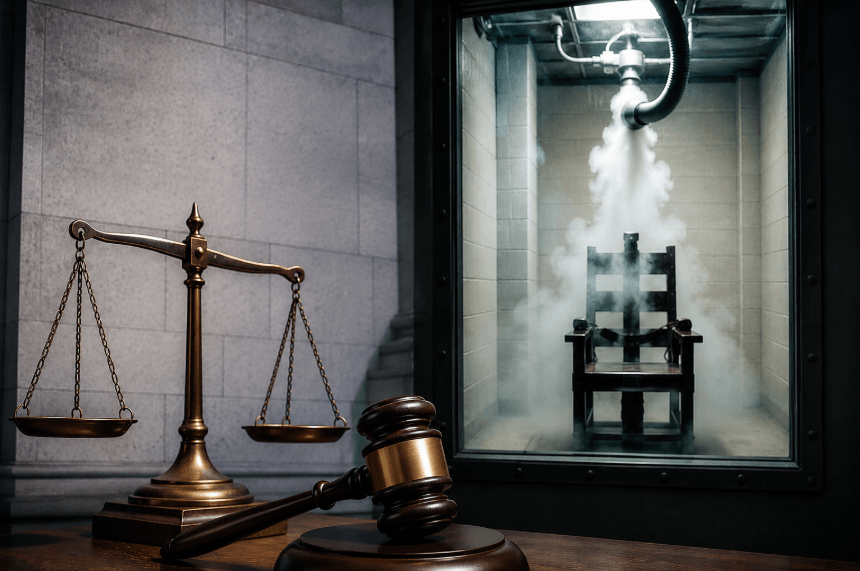
A federal appeals court has ruled that Alabama’s use of nitrogen hypoxia as a method of execution likely violates constitutional protections against cruel and unusual punishment, marking a major legal setback for the state and intensifying scrutiny over the controversial practice.
The United States Court of Appeals for the Eleventh Circuit reversed a lower court decision in the case of death row inmate Jeffrey Lee, whose execution is scheduled for June 11, 2026. The court concluded that Alabama’s nitrogen hypoxia protocol presents a substantial risk of severe suffering, raising serious concerns under the Eighth Amendment of the United States Constitution.
The ruling represents one of the strongest judicial criticisms to date of nitrogen-based executions, a method that has drawn mounting opposition from legal advocates, medical experts and anti-death penalty campaigners.
In its opinion, the Eleventh Circuit found that prisoners subjected to nitrogen hypoxia may consciously endure “severe air hunger…emotional distress…panic…physiological stress, and physical discomfort” lasting between one and three minutes.
The court further stated: “Counting to 60 or 180 seconds is not a quick exercise, and constitutionally speaking, that timeframe is intolerable given the suffering that would likely take place under Alabama’s nitrogen hypoxia protocol.”
The decision was welcomed by the Execution Intervention Project, an advocacy organisation that has campaigned extensively against the use of nitrogen executions in the United States. The group described the ruling as a landmark development in efforts to challenge the method through legal and public advocacy.
Rev. Dr. Jeff Hood, an activist, author and spiritual adviser to death row inmates who has witnessed two nitrogen executions, responded following the judgment.
“For the first time a court has acknowledged what I and so many others have seen with our own eyes…nitrogen executions are a unique form of horror.”
— Rev. Dr. Hood, on the Eleventh Circuit opinion issued today
The case is expected to have implications beyond Alabama, as several states continue to examine or defend alternative execution methods amid ongoing legal disputes surrounding lethal injection protocols.
The Eleventh Circuit did not outlaw nitrogen executions entirely, but it directed the matter back to the district court for further consideration. Judges instructed the lower court to immediately examine whether execution by firing squad could serve as a feasible alternative to nitrogen hypoxia.
Despite the ruling, no stay of execution has yet been granted for Lee. Legal observers note, however, that the appeals court decision could strengthen future requests to delay the execution while additional proceedings continue.
The ruling arrives amid heightened debate in the United States over the legality and ethics of newer execution methods. Alabama became the first state to carry out executions using nitrogen hypoxia, arguing the process was a lawful and efficient alternative after difficulties obtaining lethal injection drugs.
Critics have maintained that the process risks prolonged suffering and lacks sufficient medical and scientific validation. Advocacy groups have increasingly challenged the state’s descriptions of the procedure, citing witness accounts and expert testimony.
The Execution Intervention Project said its campaign had sought to bring attention to the realities of nitrogen executions through public demonstrations, publications and direct support for prisoners facing execution.
“The Execution Intervention Project has pursued this truth through every available means. We have put up billboards. We have published books. We have traveled the country. We have given countless interviews. We have made a film. We have stood with the condemned. We have named what is happening. today, a federal court named it too.”
The organisation also urged Alabama officials to halt Lee’s execution while legal proceedings continue.
“We call on the district court to act swiftly. We call on the state of Alabama to halt this execution. We call on Governor Kay Ivey to recognize that her state is employing a method that a federal court has now found likely produces conscious suffocation for minutes on end.”
Campaigners further appealed for intervention before Lee’s scheduled execution date.
“Most urgently, we pray this ruling is enough to save Jeffrey Lee’s life.”
The appeals court’s findings are expected to become central to future death penalty litigation involving nitrogen hypoxia. Legal analysts say the court’s detailed assessment of potential suffering may influence challenges in other jurisdictions considering similar methods.
The Execution Intervention Project signalled that it intends to continue campaigning against capital punishment and maintaining its advocacy work with death row prisoners.
“The Execution Intervention Project will continue to stand at the intersection of prophetic ministry, legal advocacy, and direct human presence with those the state seeks to kill. We will not stop.”