


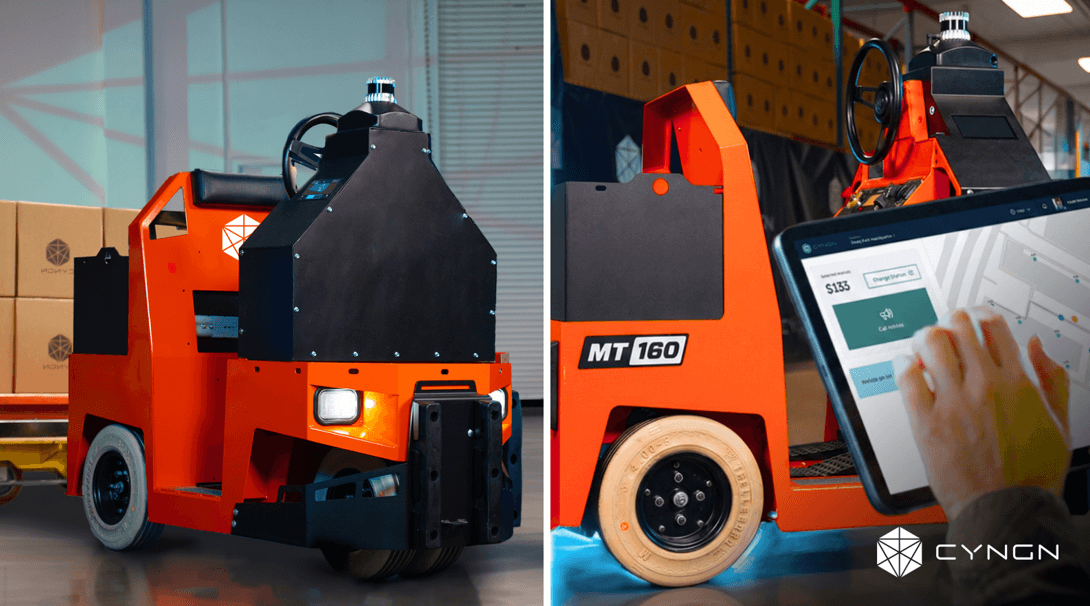
Autonomous vehicle technology company Cyngn has secured its 24th United States patent, reinforcing its strategy to expand vehicle-agnostic automation solutions for industrial fleets.
The Mountain View-based firm announced the formal grant of U.S. patent US-12530029-B2, titled “System and Method of Adaptive, Real-Time Vehicle System Identification for Autonomous Driving.” The patent covers a system designed to dynamically model vehicle behaviour in real time, enabling autonomous driving software to adapt to different vehicle platforms without the need for hardware-specific redesign.
Cyngn said the development marks a further step in strengthening its intellectual property portfolio as it scales its autonomous technology across sectors such as logistics, manufacturing and warehousing.
The newly granted patent introduces technology that builds gear-specific vehicle models in real time, allowing autonomous systems to generate precise control commands tailored to the vehicle’s current operating state. These commands are then validated through simulation before execution, reducing the likelihood of errors while the system continues to adapt as vehicle components experience wear.
By addressing differences between vehicles at the software level, the technology aims to enable operators to deploy autonomous capabilities across a range of industrial vehicle types without requiring bespoke engineering for each platform.
Intellectual property strategy supports commercialisation
According to the company, building a strong patent portfolio is central to protecting its approach to autonomous vehicle adaptability.
“As we continue to commercialize our technology, building a robust wall of intellectual property around our core innovations is essential,” said Lior Tal, CEO of Cyngn. “This patent represents another important layer in our defensive strategy, securing our rights to fundamental methodologies in vehicle adaptability. Expanding our patent portfolio ensures that we protect the long-term value of our technology stack as we scale.”
The announcement comes as competition in the autonomous mobility sector increasingly centres on software capabilities rather than hardware alone. Industrial operators are under pressure to improve productivity while controlling costs, prompting growing interest in technologies that can modernise existing vehicle fleets rather than replacing them entirely.
Cyngn’s technology is designed to address this shift by enabling autonomy to be deployed on a variety of vehicle platforms using adaptive modelling rather than fixed vehicle parameters.
Industry analysts have noted that solutions capable of integrating with older equipment could play a major role in accelerating adoption of automation in warehouses, factories and logistics facilities.
Responding to broader automation trends
The company said the newly patented system reflects a wider transformation taking place in industrial automation, where software intelligence is increasingly viewed as the primary driver of innovation.
Many organisations are now exploring ways to automate ageing vehicle fleets while preserving existing infrastructure investments. In this environment, platforms that can adapt to different vehicles and operational conditions may offer significant advantages.
By focusing on adaptable autonomy, Cyngn aims to position itself within what it describes as a structural shift toward software-led industrial transformation.
The patented technology introduces several operational capabilities intended to support this goal.
One key feature is vehicle-agnostic scalability, enabling trajectory commands generated by the autonomy platform to be translated into vehicle-specific control signals. This allows the same software system to operate across different vehicle models without extensive redesign.
Another capability focuses on gear-specific precision, in which the system builds a separate behavioural model for each gear configuration. By accounting for the vehicle’s current operating state, the system can generate more accurate commands to maintain precise trajectory tracking.
Safety is also addressed through pre-execution simulation, where control commands are validated before being carried out. This process helps identify potential issues before movement occurs.
The system also incorporates fleet intelligence, allowing data gathered from individual vehicles to be aggregated and shared across an entire fleet. As more vehicles operate under the system, the platform can refine its models using collective operational experience.
Finally, the technology includes proactive maintenance awareness, monitoring the condition of components such as tyres, brakes and suspension systems. As these parts degrade over time, the software adapts its control models to maintain accurate vehicle performance.
Cyngn said protecting these capabilities through patents helps ensure that the technology underpinning its autonomy platform remains defensible as the company expands its commercial deployments.
By securing additional intellectual property, the company aims to support its broader mission of delivering automation solutions capable of operating across diverse industrial vehicle fleets regardless of platform type.