


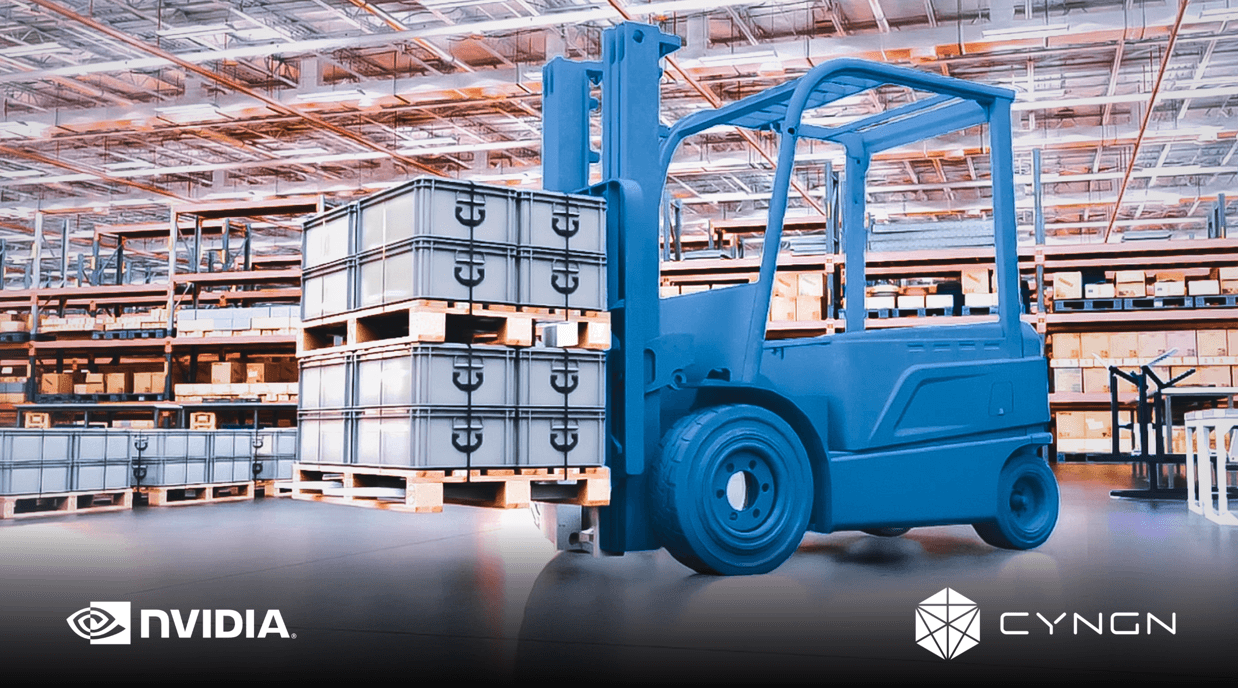
Autonomous vehicle technology company Cyngn has announced a new step in the development of its automated material-handling systems, integrating high-fidelity forklift vehicle models into NVIDIA Isaac Sim.
The California-based firm said the move will allow its engineering teams to simulate forklift behaviour in detailed digital environments before deploying the vehicles in real-world industrial facilities.
The development was unveiled during the annual NVIDIA GTC technology conference and represents a further stage in Cyngn’s work to refine autonomous industrial vehicles used in logistics and manufacturing operations.
Cyngn, listed on the NASDAQ:CYN exchange, said the integration is designed to strengthen its broader autonomous forklift programme. The company has previously disclosed an order commitment linked to forestry products firm Arauco, which pre-ordered 100 autonomous forklifts as part of its warehouse automation strategy.
Digital simulation to mirror real-world forklift performance
According to Cyngn, the integration follows a year-long collaboration between its engineers and teams from NVIDIA. The work focused on ensuring that Cyngn’s vehicle dynamics models could run within NVIDIA’s robotics simulation environment while maintaining accurate physical behaviour.
Cyngn explained that its forklift models were built using advanced engineering tools and exported as Functional Mock-up Units (FMUs), a widely used industry standard format for dynamic simulation models.
Through this approach, engineers established two-way communication between the forklift’s simulated tyre and vehicle dynamics systems and Isaac Sim’s digital environments. The interaction enables virtual surfaces within the platform to influence how the forklift moves, turns, and reacts under different conditions.
The company said this level of fidelity ensures that the behaviour of its simulated forklifts closely mirrors how the machines would perform in real operating environments such as warehouses or manufacturing facilities.
By testing vehicles inside the simulated environment first, Cyngn believes it can identify potential operational issues earlier in the development cycle.
Reducing risk and speeding up deployment
Cyngn said the ability to run validated vehicle dynamics models inside a digital factory environment could significantly improve the efficiency of its autonomous vehicle development process.
Simulated testing allows engineers to explore how forklifts interact with various floor materials, warehouse layouts and operational scenarios before the vehicles are deployed to customer facilities. The company said this process reduces risk while accelerating development timelines.
The approach also supports the broader trend in robotics development toward using large-scale simulation environments to train and validate autonomous systems before real-world deployment.
“Combining NVIDIA Isaac Sim’s large-scale, GPU-accelerated simulation environment with our high-fidelity forklift models allows us to develop and validate autonomy more efficiently,” said Lior Tal, chief executive of Cyngn. “By strengthening the connection between simulation and real-world deployment, we can move faster, reduce risk, and bring autonomous industrial vehicles to customers with greater confidence.”
Industry analysts note that simulation has become an increasingly important tool in robotics development, particularly as companies seek to scale autonomous systems in complex environments such as factories, ports and distribution centres.
Simulation seen as key to future physical autonomy
Cyngn said the integration with Isaac Sim reflects its alignment with NVIDIA’s longer-term vision for simulation as a foundational technology for physical AI systems.
The platform is widely used by robotics developers to train and validate autonomous machines in virtual environments that replicate real-world physics and operational constraints.
For Cyngn, incorporating its own high-fidelity vehicle models into the system represents a step towards bridging the gap between simulation and operational deployment.
The company argues that accurate digital testing environments will be critical as autonomous industrial vehicles become more common across logistics, manufacturing and supply-chain operations.
NVIDIA has been investing heavily in robotics and simulation technologies designed to support this shift, positioning platforms such as Isaac Sim as development environments for next-generation autonomous systems.
By integrating its vehicle models into the platform, Cyngn aims to refine how its autonomous forklifts behave in complex operational settings while shortening the time required to deliver systems to customers.
The move also highlights the growing role of simulation tools in industrial automation, as companies seek safer and more efficient ways to test advanced robotics before introducing them into live production environments.