


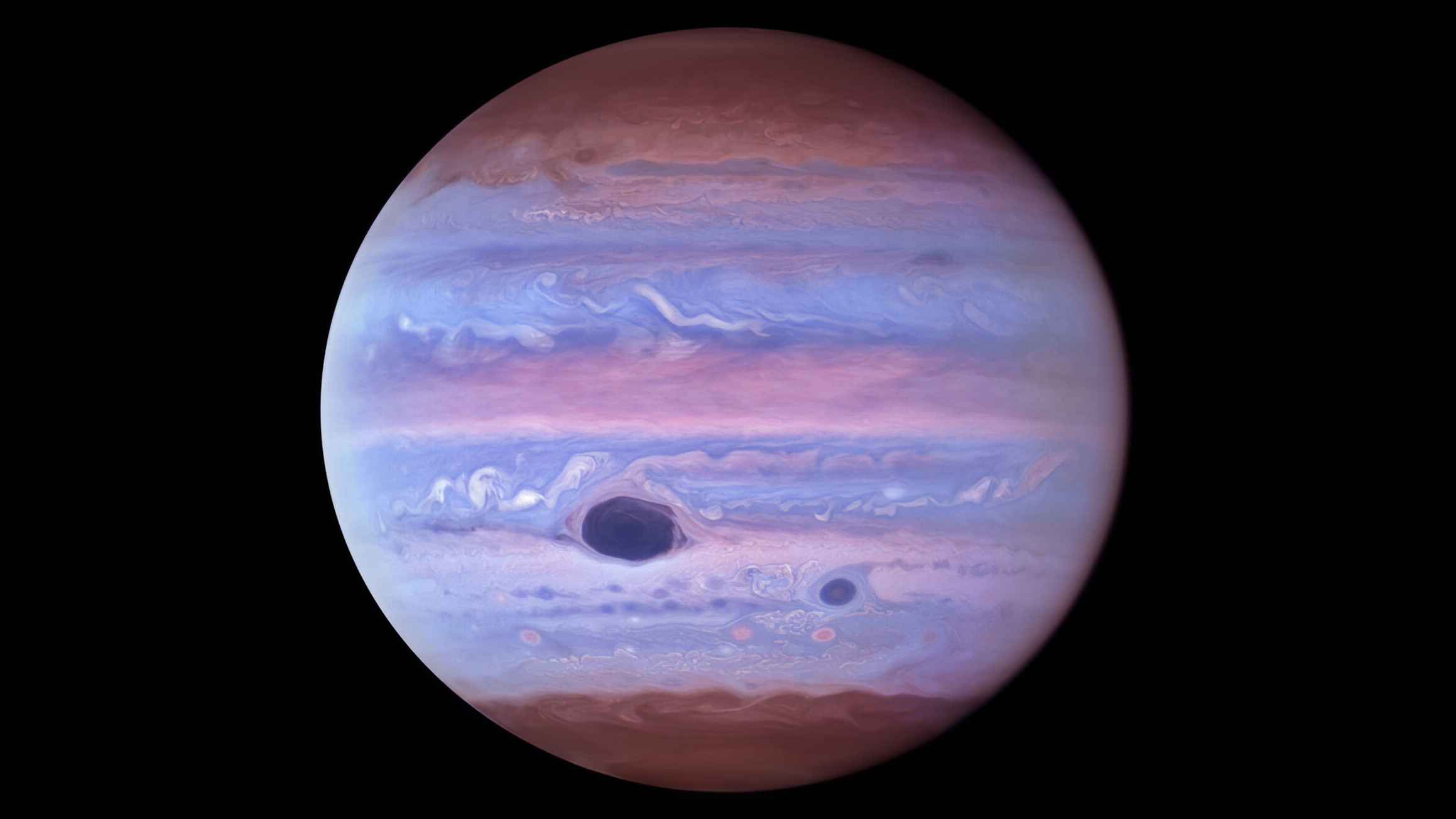
(CNN) – Images from two different telescopes show Jupiter, the largest planet in our solar system, in new light.
The Gemini Northern Telescope and Hubble Space Telescope in Hawaii captured Jupiter in visible, infrared and ultraviolet light, revealing in detail the atmospheric features of the gas giant. These include super storms, massive hurricanes and of course the Great Red Spot, which will orbit the Earth for centuries in Jupiter’s atmosphere.
It is multi-wavelength astronomy in operation. Observing a planet through different wavelengths of light can reveal invisible features and features. Their comparison allows us to better understand the gas giant, its atmosphere, its particles and its fog.
“Gemini North observations are made possible by the telescope’s location within the Monacoya Science Reserve, located on the summit of Monacoya,” said Mike Wong, a team leader and planetary scientist at the University of California, Berkeley. “We owe it to the privilege of observing Kaula (Jupiter) from a unique place for its astronomical quality and cultural significance.”
The near-infrared imager of Gemini North provided an infrared wavelength image of Jupiter, while Hubble performed dual duty using its wide-field camera 3.
All three films were simultaneously compared on January 11, 2017.
In all three films, Jupiter appears to be completely different. The Great Red Spot almost disappears at infrared wavelengths, but a dark area within the storm appears larger than the visible light image. This is because different wavelengths of light show different structures within the storm.
Combining the visible light images of the Hubble-received storm with infrared observations from Zebini revealed that the dark features were holes in the cloud layer. In visible light, these appear dark. But in the thermal infrared, researchers were able to observe Jupiter’s heat escaping into space through holes. Typically, this process is blocked by Jupiter’s largest clouds.
See the comparison between the bright infrared image of Jupiter against the very soft visible light image in the slider below.
Credit: AURA / NSF / NOIRLAB / ESA / NASA / GEMINI INTERNATIONAL OBSERVATORY
In the infrared, Jupiter’s hot layers below the clouds appear to glow through gaps in the clouds.
Wong compared the infrared image of Jupiter to a pumpkin lamp, which he decorates himself on Halloween.
Meanwhile, the planet’s famous clouds are visible at all three wavelengths.
Red Spot Jr., also known as Oval BA by scientists, is a storm located below the Great Red Spot that appears in visible and ultraviolet images. It was created in 2000 from a combination of three storms.
What differences do you notice in the UV and visible light film?
La Manza Rose Jr. has been fading in white in recent years. This is the original color of the place before it turned red in 2006. But the center of this storm is dark red, which means that the Junior Red Spot will turn red again like the Great Red Spot in the future.
Above this turbulent area in the visible picture, there is also a super storm.
The other is visible in the infrared image of Jupiter’s northern hemisphere. This particular streak is believed to be a hurricane or continuous cyclone that stretches approximately 45,000 miles from east to west. In visible light, it appears dark brown. When NASA’s Voyager 1 spacecraft showed up on Jupiter in 1979, scientists called these features “brown rocks”. In ultraviolet light, these loops almost disappear.
Below them, the big hot spots in the infrared film are visible.
Storm Thursday
Combined, three different perspectives help scientists understand the mysterious clouds of Jupiter in the layers of its atmosphere.
These images can also be compared to the observations made by the Juno Mission around Thursday since 2016.
The planet is known for its major storms, but trying to get inside requires the teamwork of the Juno spacecraft, Hubble and Gemini North. The collective observations of this dream team have created impressive images and revealed what is going on inside Jupiter’s vast and continuous storms.
Jupiter’s storms are terrible. Its storm clouds can extend up to 40 miles above the ground, five times the height of storm clouds. Jupiter’s lightning bolts are also very powerful because they triple the energy of the so-called “super rays” of the Earth.
Wong and his team used this integrated data to understand how thunderstorms form on Jupiter, to explore holes in the clouds of the Great Red Spot, and to see deeper layers of the planet’s atmosphere that are not commonly seen.
“Juno detected a lot of lightning impacts on radio wavelengths associated with hurricanes,” Wong said. «This particular situation occurs when there is convection in the process of generating more lightning, in which three types of clouds are mixed in one place: really high convection towers, in which the Gemini detects bright emission and deep ocean clouds. ‘
Lightning is more likely to occur in deep water clouds caused by humid convection. Jupiter’s lightning bolts and large storms form in and around large convection cells located above deep clouds.
Although many robotic space missions have visited Jupiter, researchers still have many questions about how this gas giant formed and the processes that occur on the planet.
Hubble and Gemini’s support during the Juno mission provided researchers with a window into Jupiter’s climate, typically wind patterns, atmospheric waves and hurricanes, as well as its gases and heat.
This database is also the basis for future research by Wong to determine how and why the Great Red Spot Seems to be shrinking.
Although scientists do not know why, the reduction in the size of the storm has been going on since astronomers began noticing it and recording measurements in the early 1930s.
The gas giant has a constantly moving atmosphere, so long-term observation allows it to follow Jupiter’s changes over time. Scientists are eager to know what surprises Jupiter will have in the future.