


A historic residence in Florence, closely associated with Galileo Galilei, has been brought to market with an asking price of €12.5m, highlighting continued international demand for culturally significant luxury assets in one of Europe’s most established property markets.
The property, marketed by Lionard Luxury Real Estate, is located on Costa San Giorgio in the Oltrarno district, an area widely regarded as one of the city’s most desirable residential enclaves. Positioned just 300 metres from Ponte Vecchio, the residence combines proximity to key landmarks with a level of privacy rarely found in Florence’s historic centre.
The sale is notable not only for its location but also for its historical significance. Adjacent to the so-called “House of Galileo,” the property features a tower from which, according to historical sources, the scientist conducted astronomical observations in the early 17th century. A plaque within the residence reads: “From this house Galileo Galilei, contemplating the motion of the stars, divined that of the Earth”.
Heritage features and panoramic views drive value
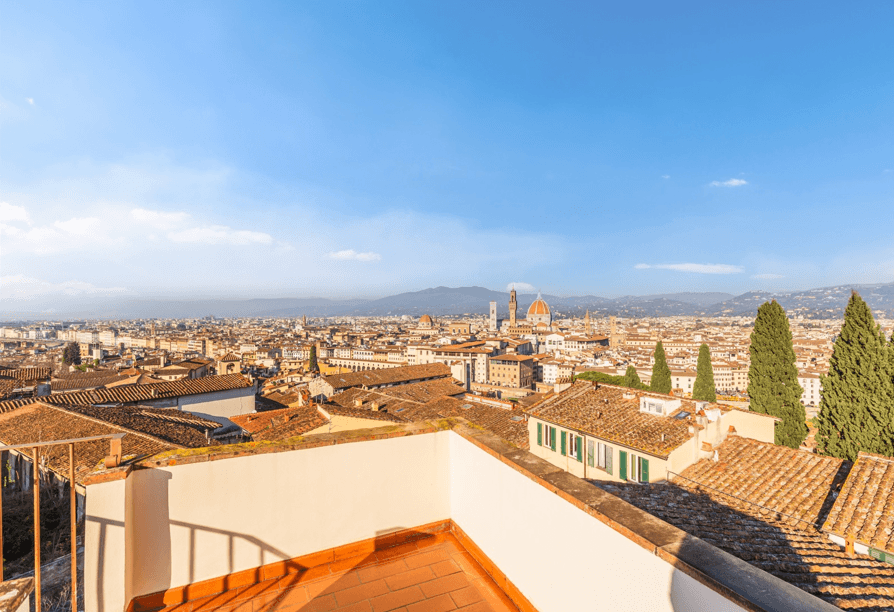
The tower remains the focal point of the residence, incorporating two terraces, one of which provides uninterrupted 360-degree views across Florence. These vistas include the River Arno and several of the city’s most recognised landmarks, such as the Florence Cathedral, Palazzo Vecchio, Basilica of Santa Croce and Forte di Belvedere.
Spanning approximately 642 square metres of internal space and 350 square metres externally, the residence offers scale that is uncommon in the city’s tightly preserved historic core. A private garden of around 330 square metres further distinguishes the asset, providing outdoor space capable of hosting gatherings of up to 120 guests—an unusual feature in central Florence.
The location also places the property within walking distance of key cultural and green spaces, including the Villa Bardini Gardens and the Boboli Gardens, reinforcing its appeal to both lifestyle buyers and investors seeking long-term value.
International ownership reflects global demand
The residence is currently owned by an American entrepreneur and spouse, who originally acquired it as a family home. Its listing reflects a broader trend of international buyers entering Florence’s high-end property market, drawn by the city’s combination of heritage, lifestyle, and relative stability compared with other global destinations.
The decision to sell is understood to be driven by personal circumstances, with the owners seeking to relocate closer to family members studying abroad. Nonetheless, the property’s positioning suggests continued interest from overseas buyers, particularly those seeking unique, historically significant residences.
Modern living within a historic framework
Internally, the property has been adapted to support contemporary living while retaining its architectural character. Natural light and spacious layouts define the interiors, which include a mix of formal reception areas and functional living spaces.
The ground floor comprises a sitting room, gym and kitchen that opens onto a large veranda designed as an outdoor living area. This space is capable of accommodating up to 20 guests and serves as a central feature during warmer months. Additional elements include a cloakroom and direct access to the garden via a central corridor.
On the first floor, a principal living room with fireplace anchors a series of interconnected spaces intended for entertaining. This level also incorporates a dining room, a two-level kitchen with breakfast area, pantry and laundry facilities, alongside a guest bathroom.
The second floor is dedicated to a master suite, which includes two en-suite bathrooms—each with its own anteroom—and a private study. Decorative elements throughout the suite reflect the stylistic language found in the home’s formal dining areas.
Investment potential underpinned by redevelopment plans
The property is further supported by a restyling project designed to enhance its long-term value. The proposed updates aim to align the residence with modern international standards while preserving its historic identity, an approach increasingly favoured in prime European markets.
From an investment perspective, the combination of provenance, location and adaptability positions the asset as a rare offering. Opportunities to acquire residences directly linked to figures such as Galileo remain limited, particularly within a city where strict preservation rules constrain supply.
More broadly, Florence continues to attract a high-net-worth international community, supported by its cultural standing and quality of life. Against this backdrop, the sale underscores the enduring appeal of heritage properties that successfully integrate history with modern usability.
As the market for distinctive real estate assets evolves, properties such as this—blending scientific legacy, architectural character and prime location—are likely to remain at the forefront of investor interest.




:quality(85)/cloudfront-us-east-1.images.arcpublishing.com/infobae/45OXD2PP2VAWTFEPJZPEDWSDC4.jpg "The Ortega regime is closing embassies in cities with high immigrant populations, leaving thousands of Nicaraguans homeless.")