


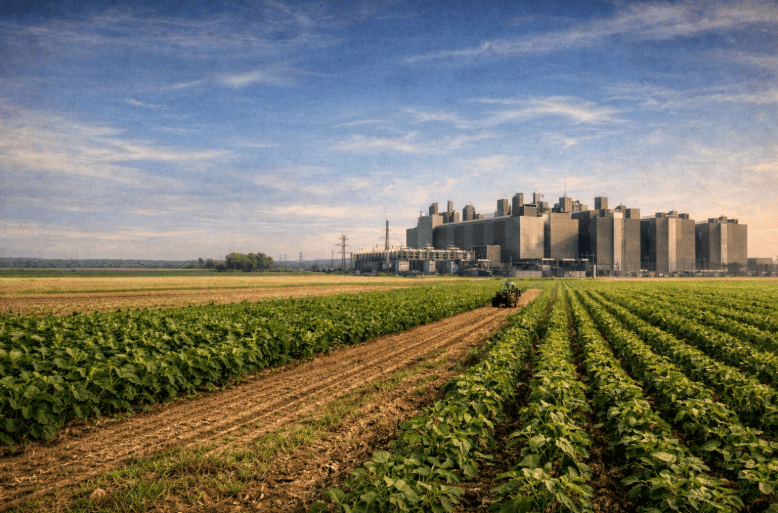
Texas Agriculture Commissioner Sid Miller has called on state and federal lawmakers to establish new “Agriculture Freedom Zones” aimed at limiting the expansion of data centres onto high-quality farm and ranchland, as competition for land and water intensifies across the United States.
Speaking in Austin, Miller outlined a policy framework designed to direct data centre development — and other resource-intensive projects — towards less productive land, using targeted tax incentives rather than restrictions. The proposal is positioned as a way to safeguard food production capacity while still enabling growth in digital infrastructure, renewable energy development and urban expansion.
Miller’s plan centres on the creation of federally or state-designated Agriculture Freedom Zones (AFZs), which would encourage investment in locations such as marginal land, brownfields, arid regions or areas with existing grid access. In doing so, the scheme aims to preserve fertile soils and protect critical water resources for agricultural use.
“The unchecked spread of data centers onto prime farm and ranchland is a real and growing threat to our food supply,” Miller said. “But America also needs data, innovation, and technology infrastructure to stay competitive. America will continue to lead the world in both agricultural production and technology innovation, but only if we do it the right way. Agriculture Freedom Zones are the tool we need to protect vital farmland while supporting technological advancement.”
The announcement comes as data centre development accelerates nationwide, driven by growing demand for cloud computing, artificial intelligence workloads and digital services. While the facilities can provide construction activity and long-term tax revenues, they are also increasingly scrutinised for their large power requirements, water usage and land footprint — especially in regions already facing infrastructure strain.
Under Miller’s proposal, state governments would play a central role in identifying and nominating eligible AFZ sites. Once approved by state authorities or relevant federal agencies, designated zones could qualify for property tax or other state-level incentives intended to make these locations more attractive to developers.
At the federal level, Miller said further incentives could be introduced through legislation, including capital gains tax deferral, reduced taxes on long-term investments and tax-free appreciation for assets held over an extended period. The goal, he argued, is to shape development patterns through financial signals rather than direct regulation.
“Once you pave over good farmland, it is gone for good,” Miller said. “That means less food, higher grocery prices, and more pressure on the land and water farmers depend on. It is already happening. My plan uses targeted tax incentives, not mandates or handouts, to guide private investment where it makes sense.”
The proposal frames agricultural land as strategic infrastructure and highlights concerns that the conversion of farmland to industrial or commercial use can be difficult — if not impossible — to reverse. Miller warned that the pace of land loss is accelerating and that farmers and ranchers may struggle to compete against better-capitalised buyers.
The commissioner also linked the issue to water access, suggesting that agricultural operations are increasingly being squeezed by non-farming uses that can pay more for limited supply. In many parts of Texas, water availability is a growing political and commercial issue, with drought risk, population growth and industrial demand placing pressure on shared resources.
“Farmers and ranchers cannot outbid data centers or municipalities for water,” he said. “Agriculture Freedom Zones would make sure food production comes first while still giving tech companies the certainty they need to build and grow. If we do not act now, we will lose land we can never get back. Agriculture Freedom Zones are how we protect our future without sacrificing innovation.”
While Miller’s proposal is presented as a compromise between agriculture and technology expansion, it could raise questions over how “prime” agricultural land would be defined, how zoning boundaries would be enforced, and whether incentives would be sufficient to offset developers’ preference for locations close to major population centres.
However, the commissioner argued that the approach would provide clearer planning signals for industry while reinforcing the long-term importance of domestic food production. By combining state-nominated zones with federal tax benefits, the framework seeks to create a predictable pipeline of suitable development sites, potentially reducing conflicts between rural communities, farmers and infrastructure developers.
Miller said the next step is for lawmakers at both levels to consider legislation that would enable the designation of Agriculture Freedom Zones and implement the proposed incentives.