

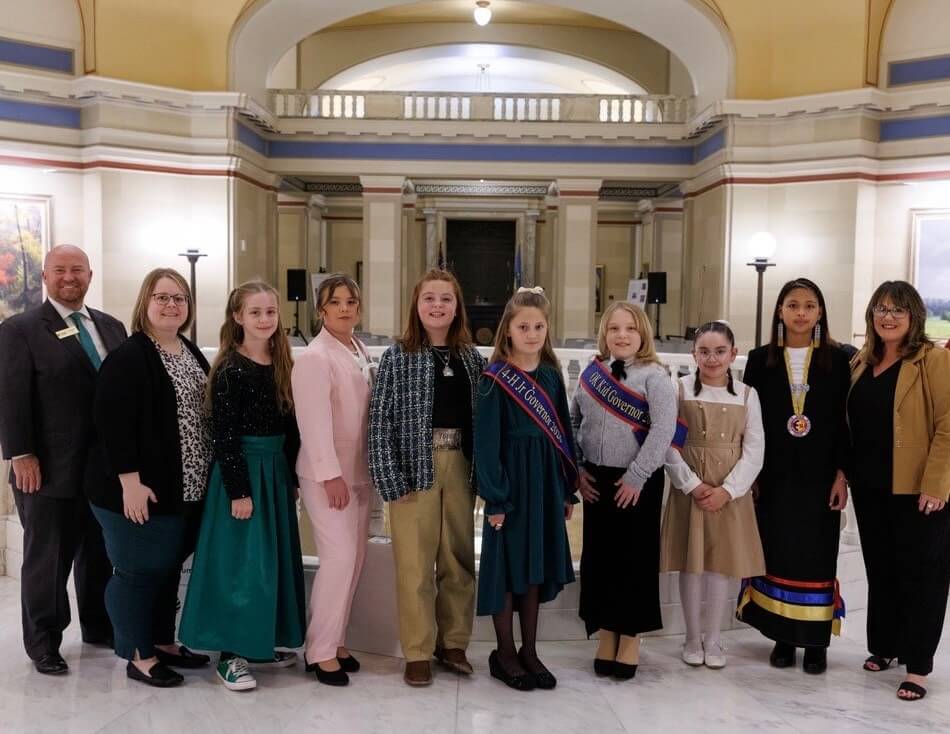
While political focus at the Oklahoma State Capitol on Monday, 2 February, centred on the opening of the second session of the 60th Legislature, a parallel ceremony highlighted a different but strategically important investment in the state’s future leadership. Two youth governor initiatives, sponsored by the Oklahoma Institute for Child Advocacy (OICA), formally administered oaths of office to their newly elected 2026 youth leaders.
The programmes — the Oklahoma Kid Governor initiative and the Oklahoma 4-H Junior Governor scheme — form part of a structured civic education effort designed to familiarise young students with democratic processes, leadership responsibility, and public policy development. Though educational in nature, the initiatives reflect a broader commitment by civic organisations to strengthening long-term civic engagement and institutional trust, themes that increasingly resonate with policymakers and community stakeholders alike.
OICA coordinates year-long activities for both programmes. The Kid Governor scheme operates in partnership with the Connecticut Democracy Center and targets fifth-grade students statewide, while the 4-H Junior Governor programme serves fourth-, fifth- and sixth-grade students enrolled in 4-H clubs across Oklahoma.
The Kid Governor programme follows a structured, election-style process that mirrors real-world democratic systems. Students engage with lesson plans on governance and voting before participating in a classroom-based election to select candidates. From those classroom winners, one student ultimately serves a one-year term as Kid Governor. This year’s governor was chosen from a pool of 1,187 participating students across the state.
Each candidate selected a campaign issue of personal concern, with classmates voting to determine a classroom winner. Those winners then recorded two-minute campaign videos submitted for statewide consideration. A review panel composed of former Oklahoma governors David Walters, Frank Keating, Brad Henry, and Mary Fallin, alongside OICA board members, narrowed the submissions to a shortlist of finalists.
Finalist videos were distributed to 37 participating classrooms and school library programmes across Oklahoma. The statewide vote was timed to coincide with the November general election, with students casting ballots designed to closely resemble official Oklahoma voting papers, reinforcing procedural familiarity and civic realism.
For 2026, the role of Oklahoma Kid Governor will be held by Katelyn Talley, a fifth grader from Valliant in southeastern Oklahoma, who campaigned on a platform focused on animal abuse prevention. Supporting her administration, Sophia Chavarria Rivera, a fifth grader from Bethany, was elected Kid Lieutenant Governor with a platform centred on bullying prevention. The role of Kid Secretary of State will be filled by Daphne Tanequodle, a fifth grader from Lawton, who advocated policies addressing homelessness.
Alongside the Kid Governor programme, OICA also co-sponsored a leadership conference with 4-H in October, bringing together 72 students in Stillwater. The conference introduced participants to the structure and function of state government before culminating in the election of a Junior Governor and Junior Cabinet.
Riley Braden of Bristow in Creek County was elected Junior Governor for 2026. Homeschooled, Riley campaigned on a platform promoting the sanctity of life. The Junior Lieutenant Governor position went to Whitlee Moser of Perkins in Payne County, a student at Perkins Tryon Intermediate School, whose campaign focused on education. Junior Secretary of State Riley Rudder, from Fort Towson and a student at Rattan Elementary in Pushmataha County, was elected on a platform dedicated to turtle conservation. Completing the cabinet, Victoria Justice of Depew in Creek County, who is homeschooled, was appointed Junior Cabinet Member with a platform aimed at reducing spam calls from debt collectors.
Educational support underpins both programmes. Participating teachers and 4-H leaders receive toolkits containing custom-designed lesson plans aligned with Oklahoma’s state government structure, voting history, and civic participation principles. Students independently choose their campaign issues with guided support, reinforcing both autonomy and informed decision-making.
Participants also received a complimentary comic book, Mighty Mia and Dyna-Bit Save Democracy, produced with editing and artwork by Literati Press in Oklahoma City. OICA underwrites programme costs, including educational materials, mileage reimbursement for families attending official events, and book distribution funded through donations.
OICA plans to host the newly sworn-in youth leaders at the State Capitol later in the legislative session, offering opportunities to engage with lawmakers. The students are also scheduled to attend the organisation’s annual Heroes Ball in July, continuing a year-long programme that blends education, civic awareness, and leadership development — an approach increasingly recognised as a foundational investment in the future of democratic participation.