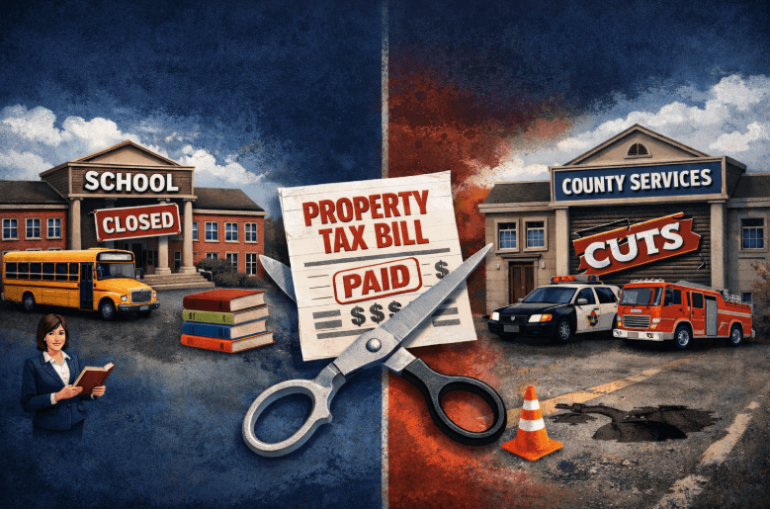
OKLAHOMA CITY – A campaign to eliminate property taxes for homeowners in Oklahoma is prompting renewed scrutiny of how public services are funded across the state, with local officials warning that schools and county operations could face significant shortfalls if replacement revenue is not secured.
The debate comes as supporters of a proposed ballot initiative circulate a petition that would phase out property taxes on homesteads over three years. Under the plan, homeowners’ property taxes would be cut by one-third in 2027, reduced by another third in 2028, and eliminated entirely by 2029, removing an estimated $1.2bn from local government budgets.
The proposal has become a flashpoint in a state where funding responsibilities are divided sharply between state and local authorities. Advocates of the petition argue that homeowners should be relieved of property tax burdens, while critics say the move would weaken the core financing mechanism that supports public education and essential county services.
The wider issue, as the press release framing the debate argues, is that taxes underpin public provision. Supreme Court Justice Oliver Wendell Holmes Jr. famously stated, “Taxes are what we pay for civilized society.” The statement is frequently used to highlight the role of taxation in supporting infrastructure, public services and the functioning of government.
State revenues rely on income and sales taxes
Oklahoma’s tax structure differs from many US states in that state government does not levy property taxes, relying instead on other streams to fund state-level operations. The press release notes that total state tax collections reached $12,180,552,061.03, with individual income tax representing the largest component.
In Fiscal Year 2025, individual income tax collections were estimated at $5,199,756,734.11. General sales tax was the second-largest contributor, with $2,788,283,516.29 collected in the last fiscal year.
However, lawmakers recently adjusted the sales tax base by eliminating the state’s 4.5% levy on groceries, a move expected to reduce state revenue by $418m per year. While the policy change was aimed at easing cost-of-living pressures for households, it has also sharpened attention on the trade-offs involved in reducing tax receipts.
Other state tax sources include alcohol and cigarette taxes, which generated $271,221,152.24, and gross production tax — a severance levy on oil and natural gas extraction — which brought in $1,041,709,252.19 in FY-2025.
The release directs readers to Oklahoma’s tax reporting resources for a breakdown of collections and allocations, including revenues that flow outside the General Revenue Fund and are earmarked for specific purposes.
Local services depend heavily on property tax receipts
While the state relies largely on income and sales taxes, local government funding is built on a different mix. Counties, cities, towns and school districts depend on local sales taxes, user charges and intergovernmental transfers, alongside property taxes.
Local sales taxes, set above the state rate, often form the backbone of municipal funding. The press release notes that Oklahoma is unusual in the extent to which many municipalities rely on sales tax as their primary source for general operations.
User charges — including water, electricity and sewer fees — also play a major role in supporting local services, while intergovernmental revenue includes state-shared motor vehicle and fuel taxes as well as federal funding. Some local jurisdictions also have agreements with Native American tribal governments to fund improvements and services.
Property taxes, however, are described as being used “almost exclusively by school districts and counties”, with cities generally limited to using their share for servicing voter-approved bonded debt.
That reliance is central to concerns about the proposed ballot question. In FY 2024, overall property taxes — including payments from homeowners, businesses, rental properties, commercial enterprises and farming operations — raised $3.9bn for schools and county governments. The release states that property taxes made up at least half of the budget in 62 of Oklahoma’s 77 counties.
Canadian County highlights schools’ exposure
Local officials have begun to quantify the potential impact. Last week, Canadian County officials stated that about 85 percent of their property tax collections went to fund schools in their county.
The share directed to education can vary by county depending on property composition and local budgeting structures, but the warning underscores how exposed school districts could be to a rapid decline in property tax revenue. The release argues that each county would face a significant shortfall in providing public schools and services if the ballot question passes.
Supporters of the petition contend that alternative funding could be secured through legislative action if voters wish to maintain services. One of the petition organizers questioned whether Oklahomans would even want these services, saying the Legislature would need to approve other funding if Oklahomans wanted to continue the services.
The press release concludes by urging voters to weigh the consequences of reducing a major revenue source without a clear replacement plan. As Justice Holmes puts it, consider what parts of services provided do you want eliminated should this pass, and what other taxes you would want raised to not see a decline in our society.

:quality(85)//cloudfront-us-east-1.images.arcpublishing.com/infobae/WTPDE54MLJGDTI6C6V3RZY6ANQ.jpg "El Salvador’s parliament has demanded the removal of the Supreme Court’s constitutional judges")