


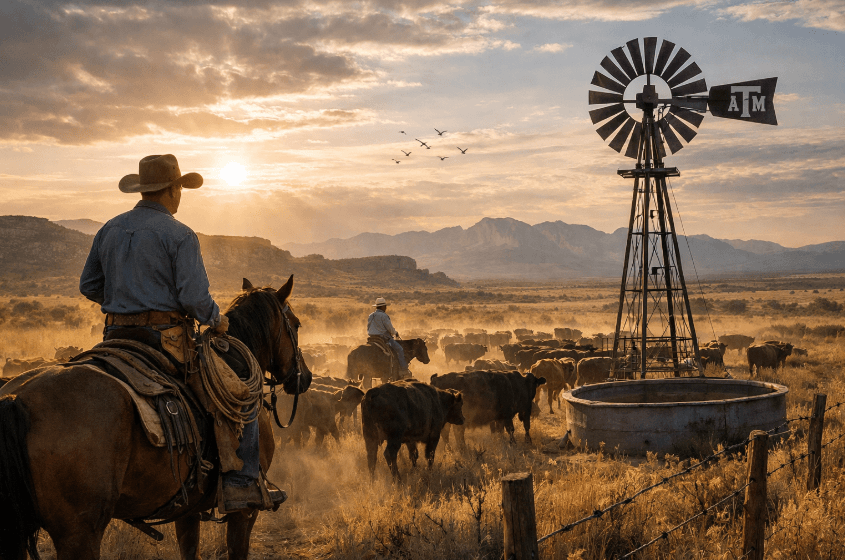
Ranchers across the United States are facing intensifying pressures from shifting weather patterns and volatile market conditions, placing both land health and long-term profitability under strain. In response, Texas A&M AgriLife’s Center for Grazinglands and Ranch Management (CGRM) is expanding a research-led approach designed to improve resilience at both the ecological and business levels of ranching operations.
The centre is working to bridge the gap between scientific research and on-the-ground agricultural practice by bringing together researchers and livestock producers. Its core objective is to better understand how grazing strategies influence the sustainability and financial performance of rangeland systems across the country.
Over the past four years, CGRM has partnered with 420 ranches spanning 17 states, collectively covering more than 9 million acres of grazing land. This large-scale collaboration reflects a growing emphasis on producer-led, real-world data to address modern challenges in rangeland management.
“Soil is the foundation of every acre of grazing land in the country,” said Jeff Goodwin, Ph.D., director of the CGRM and Texas A&M AgriLife Research assistant professor in the Texas A&M Department of Rangeland, Wildlife and Fisheries Management. “By ensuring ranchers have access to science-based management tools and practices that support soil health and regeneration, we are helping promote long-term grazing land productivity while promoting operational and economic resiliency.”
Producer-led research tackles operational and environmental challenges
Texas remains the leading beef-producing state in the U.S. and contains the largest area of privately owned grazing land, underlining the economic significance of the sector. However, these landscapes are increasingly exposed to a range of pressures, including soil degradation, woody plant encroachment and land conversion.
According to CGRM, such challenges are not only environmental but also economic and social, affecting the long-term viability of ranching businesses.
“Ranching operations face increasingly complex ecologic, economic and social challenges impacting the ability to maintain or enhance grazing land and operational health,” Goodwin said.
To address these issues, the centre focuses on collecting ranch-level data and conducting applied research directly on working lands. This approach allows researchers to evaluate practical management strategies in real conditions rather than controlled environments.
Key performance indicators such as grazing duration, rest periods and stock densities are closely monitored. These variables are treated as management “levers” that influence ecological function, livestock productivity and financial outcomes.
The aim is to identify adjustments that can deliver measurable improvements in forage production, water retention and overall ranch performance.
“We prioritize ranch-scale research,” said Jenna Likins, Ph.D., CGRM research program manager. “Our focus is to understand the management actions taking place on working rangelands and how they correlate with ecological and economic outcomes for producers.”
Expanding knowledge-sharing networks across the sector
Beyond data collection and analysis, CGRM is also focused on ensuring that insights are shared widely across the ranching community. The centre sees knowledge transfer as critical to scaling best practices and improving outcomes across the broader industry.
“We want that knowledge to cross the ranch gate and benefit all producers and the grazing lands they steward,” Goodwin said.
One key initiative is its collaboration with the American Farmland Trust to support a statewide Grazing Network Mentor programme. This initiative promotes peer-to-peer learning through workshops and virtual sessions, enabling producers to exchange practical experience and strategies.
In parallel, the Ranchworthy YouTube channel serves as a digital platform for knowledge dissemination. Managed by CGRM, the channel features ranchers from across the U.S. sharing insights into the techniques and technologies that have proven effective in their operations.
The centre has also strengthened links between producers and supply chain stakeholders through the Resilient Ranch Network. Developed in partnership with the Texas Grazing Land Coalition and the Texas A&M AgriLife Extension Service, the network facilitates dialogue on sustainability practices across the beef supply chain.
“Giving producers a seat at the table to share their perspectives has been very meaningful to us and the ranchers involved,” Likins said.
Focus on proactive decision-making in a dynamic market
Looking ahead, CGRM is expected to deepen its focus on delivering actionable, data-driven insights that enable ranchers to adapt to an increasingly unpredictable operating environment.
The centre emphasises the importance of proactive management strategies that account for both environmental variability and market fluctuations, positioning ranchers to respond effectively to future challenges.
“Ranching is inherently complex and dynamic — from weather conditions to markets,” Goodwin said. “Our efforts focus on helping producers make proactive decisions that promote ecologic and economic adaptability and foster long-term productivity and profitability — we want to keep them ahead of the curve.”