
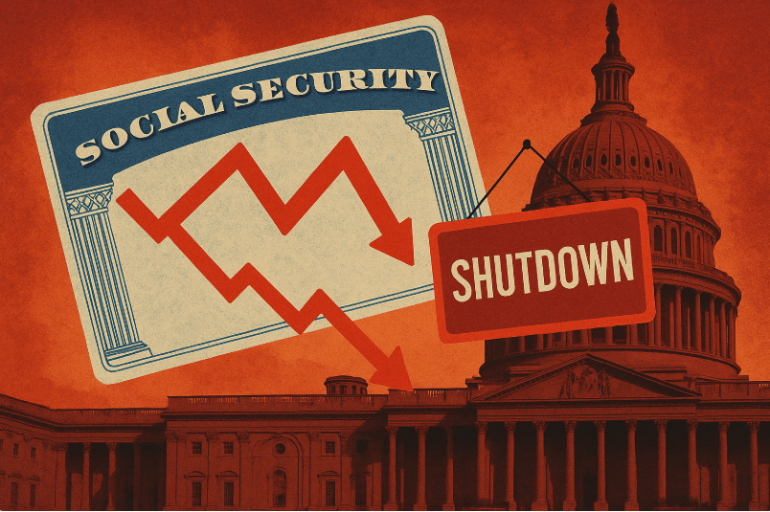
The ongoing US government shutdown has pushed the Social Security Administration (SSA) to what union representatives describe as “the verge of collapse”, as mounting pressure on unpaid staff threatens to disrupt services relied upon by hundreds of thousands of Americans.
Union Raises the Alarm
The American Federation of Government Employees (AFGE), which represents Social Security employees in Oklahoma, has issued a stark warning that the agency’s ability to function is deteriorating rapidly. According to the union, more than 853,000 Oklahomans receive Social Security benefits, worth in excess of $1.5 billion, but those payments and services are increasingly at risk due to staff shortages and financial strain among employees.
Workers Without Pay
The shutdown, now entering its twenty-fourth day, has forced a significantly reduced workforce to continue operations without pay. The union argues that the situation is untenable and that employees should be permitted to work remotely until normal government funding resumes.
“Social Security is at risk of collapse as an already small workforce is being forced to work without pay during the government shutdown,” the AFGE said. “The union has argued that employees should be allowed to telework during the shutdown, as employees are not being paid but are expected to perform their duties in the office.”
In Oklahoma, the financial burden is already biting. The union estimates that the average employee could be spending around $120 each week on commuting costs, despite not receiving a salary. In other states, workers have reportedly begun quitting due to the impossibility of sustaining such costs without income.
“The union warns that without adequate staff, the mission of SSA will be compromised,” the statement continued.
Long-Standing Staff Shortages
The crisis is the latest in a series of challenges for the SSA, which has faced persistent staffing shortages in recent years. According to the union, these shortages have contributed to longer waiting times for claimants and reduced service quality.
“For years, the union has warned that the agency is understaffed, explaining that long wait times were driven by too-small staff numbers,” the AFGE said. “Since March, more than 7,000 positions have been eliminated.”
The current shutdown has exacerbated the problem, as those who remain are under pressure to keep critical services running. Many employees, according to the union, are struggling to balance their duties with the practical realities of working without pay, including travel expenses and family responsibilities.
Call for Remote Work Flexibility
The AFGE is now urging the Social Security Administration to offer immediate relief by allowing teleworking arrangements for employees whose roles can be performed remotely. Such a measure, the union says, would enable staff to maintain essential services while avoiding unnecessary financial hardship.
“The union is calling on the agency to allow employees with portable work to work from their approved offsite location during the shutdown, arguing that no employee should have to choose between spending money on driving to work and feeding their family,” the statement read.
Broader Economic Implications
The potential collapse of Social Security services could have significant economic repercussions. With over 853,000 beneficiaries in Oklahoma alone, any disruption in payments or administrative support could ripple through local economies that depend heavily on these funds.
Analysts suggest that prolonged disruption could also undermine public confidence in federal institutions and increase political pressure in Washington to resolve the standoff. For the thousands of federal workers still turning up to work unpaid, patience is wearing thin.
While the union’s call for telework is intended as a temporary fix, the underlying issues—staffing shortages, budget constraints, and the long-term underfunding of key agencies—remain unresolved. Unless a resolution to the shutdown is reached soon, the AFGE warns that both employees and beneficiaries could face escalating hardship.


:quality(75)/cdn.jwplayer.com/v2/media/yT89C0UR/poster.jpg "Cole Juan Fernando Quintero Colombia Vs. Honduras Live: Midfielder casually defined 1-0 in international friendly | Florida | Video | NCZD | Colombia")
:quality(85)//cloudfront-us-east-1.images.arcpublishing.com/infobae/4TJ3ESFXLFDWHBUY273HJ6RRLI.jpg "George Floyd’s family to receive $ 27 million in compensation for his death at the hands of Minneapolis police")
