


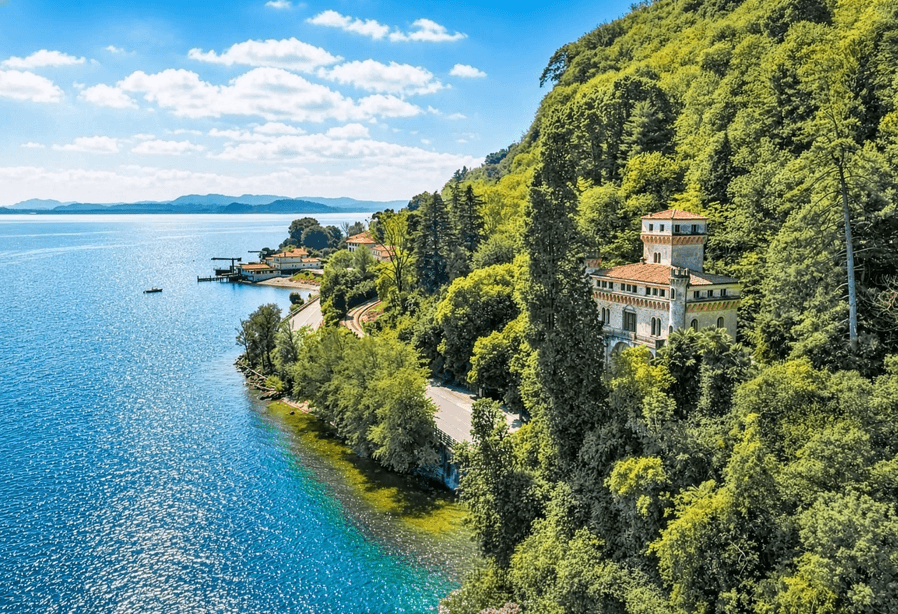
Nearly two decades after the death of renowned Italian fashion designer Gianfranco Ferré, Castello Pellegrini on Lake Maggiore has returned to international attention as the historic estate is brought to market with an asking price of €5.8 million.
Located in the northern Italian resort town of Stresa, the property has been recognised as a cultural landmark by Italy’s Ministry of Culture due to its architectural and historical significance. The estate is being marketed through Lionard Luxury Real Estate amid renewed interest in Italy’s high-end hospitality and luxury property sectors.
Stresa has long been associated with European aristocratic tourism and lakeside retreats. The town, which overlooks Lake Maggiore and sits close to the Borromean Islands, has historically attracted writers, artists and affluent international visitors. Ernest Hemingway famously used the area as a backdrop for parts of “A Farewell to Arms”.
Against this backdrop, Villa Castello Pellegrini is emerging once again as one of the region’s most distinctive historic residences. Positioned on elevated ground overlooking the lake, the estate combines historic architecture with substantial grounds and private waterfront access, features that remain rare along Lake Maggiore’s shoreline.
Ferré’s Vision Left Unfinished
Ferré acquired the estate in the early 2000s from the Pellegrini Foundation. At the time, the designer had already owned the neighbouring Villa Vignolo and reportedly intended to transform Castello Pellegrini into a refined lakeside retreat for international guests connected to his fashion house.
The project, however, was never completed following Ferré’s death only months after the acquisition.
Ferré remains one of Italy’s most influential fashion figures and served as Creative Director of Christian Dior between 1989 and 1996. Often referred to as “the architect of fashion” because of his structured and disciplined design approach, Ferré reportedly viewed the property as an extension of his own aesthetic sensibilities.
The estate comprises more than 1,000 square metres of interior space and includes the main castle building alongside a guest house and a rustic cottage. The additional buildings provide flexibility for private hospitality, staff accommodation or other ancillary uses.
Neo-Medieval Architecture Overlooking Lake Maggiore
Constructed in the early twentieth century, Castello Pellegrini was designed in a neo-medieval style characteristic of several grand residences built around Italy’s lakes during the Belle Époque era.
The structure extends across three principal floors, together with a lower-ground level containing service areas and wine cellars. Architecturally, the building is distinguished by a central square tower flanked by two corner turrets, creating a commanding presence above the lakefront.
The façade incorporates neo-medieval detailing, arched loggias and decorative Baveno marble elements, reflecting the elaborate style associated with elite lakeside estates of the period.
Inside, one of the property’s defining features is a monumental staircase constructed from white Carrara marble, leading to the piano nobile where the principal reception rooms overlook Lake Maggiore.
The surrounding estate extends across approximately 12,000 square metres of terraced parkland. Among its most unusual features is a fully private beach with direct lake access. According to the listing, the waterfront area is privately owned and not subject to state concession arrangements, an uncommon characteristic on Lake Maggiore.
Historic Gardens Reflect Romantic Lakeside Tradition
The grounds were designed according to the romantic “walking garden” tradition associated with Italy’s historic lakeside estates. Panoramic terraces, stone stairways, water features and scenic viewpoints were intended to create a continuous visual dialogue between the gardens and the lake.
The landscape also includes rocaille grottos decorated with mythological statues, reflecting the theatrical style popular among aristocratic residences during the late nineteenth and early twentieth centuries.
Historic planting across the estate includes magnolias, palms, cedars, lindens, camelias and azaleas, alongside other ornamental species commonly found in prestigious Italian lakeside gardens of the era.
The sale comes at a time when demand for heritage properties and luxury hospitality assets across northern Italy continues to attract international buyers, particularly in destinations combining historic significance with waterfront locations.
For Stresa, Castello Pellegrini’s return to the market marks the re-emergence of one of Lake Maggiore’s most historically distinctive private estates, while also reviving interest in an unfinished chapter connected to one of Italian fashion’s most celebrated designers.