


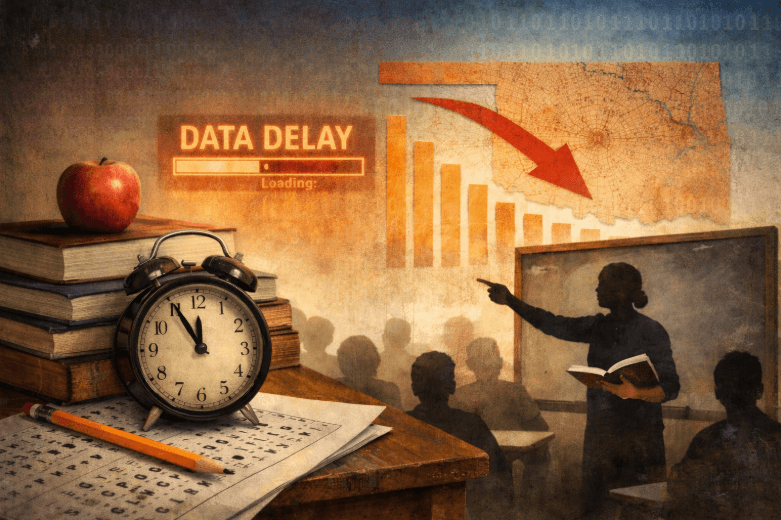
A growing debate over how student assessment data is collected and used in Oklahoma is drawing attention beyond the classroom, with implications for public accountability, workforce readiness, and long-term economic performance. The discussion has been sharpened by a recent article from veteran educator Dr. John Cox, who argues that the state’s current testing model may be undermining its own objectives.
Dr Cox, a former classroom teacher, superintendent and education administrator, recently published “From Testing to Teaching: What Oklahoma Must Get Right”, an opinion piece examining how assessment timing affects instructional decision-making, early intervention, and parental confidence in public schools. The article has prompted renewed scrutiny of whether Oklahoma’s reliance on end-of-year testing aligns with the practical needs of educators and students.
Delayed test results and missed intervention opportunities
At the centre of the argument is timing. Oklahoma, like many US states, relies heavily on standardised assessments administered at the end of the academic year. Results are often returned weeks or months later, well after students have progressed to the next grade.
According to educators cited in the discussion, this delay significantly reduces the usefulness of the data. By the time results are available, opportunities for timely intervention have passed, particularly for younger pupils who are still developing foundational skills in reading and mathematics.
From a systems perspective, the issue raises questions about efficiency and return on investment. Substantial public funds are allocated to assessment regimes designed to improve outcomes, yet if the data arrives too late to inform instruction, the economic value of that information is diminished. For school leaders, it also complicates resource allocation, as staffing and support decisions must be made without up-to-date performance indicators.
National assessments underscore early literacy concerns
The timing problem is further highlighted by Oklahoma’s performance on national benchmarks. Results from the National Assessment of Educational Progress have consistently shown the state struggling with early-grade reading outcomes compared with national averages.
Education professionals argue that these results are not simply a reflection of classroom practice, but of a data pipeline that prioritises accountability reporting over instructional support. Without access to real-time or near-real-time assessment information, teachers are less able to identify learning gaps as they emerge.
In economic terms, early literacy is closely linked to long-term productivity and employability. Research consistently shows that students who fall behind in the early years are more likely to require remedial education later, increasing costs for school systems and, ultimately, taxpayers. Late-arriving data, critics argue, increases the likelihood of such downstream costs.
Accountability versus instructional value
A key question raised by Dr Cox’s analysis is whether Oklahoma can recalibrate its assessment framework without weakening transparency. Standardised testing plays a central role in public accountability, providing parents, policymakers and taxpayers with comparable measures of school performance.
The challenge, however, is balancing that role with instructional usefulness. Education administrators note that accountability metrics are often designed for reporting rather than teaching, which can distort priorities inside schools. When assessments are primarily backward-looking, they offer limited guidance for improving outcomes in the current academic cycle.
From a governance standpoint, the debate mirrors issues seen in other publicly funded sectors, where performance measurement can drift away from operational improvement. The education sector’s equivalent is a system that measures learning accurately but too late to influence it.
Implications for trust and long-term outcomes
Beyond classroom impact, the article also touches on trust. Parents rely on assessment results to understand their children’s progress and the effectiveness of schools. When data arrives long after instruction has ended, its relevance to day-to-day learning decisions is reduced, potentially weakening confidence in the system.
Dr Cox argues that a more responsive assessment approach could strengthen that trust while maintaining public oversight. Interim assessments, faster reporting cycles, or better integration of classroom-level data are among the options discussed in education policy circles, though each carries cost and implementation considerations.
Dr Cox has made himself available for interviews to expand on these issues, drawing on experience that spans multiple testing regimes over four decades. He says classroom-level context is essential if policy discussions are to move beyond headline scores and address the practical realities faced by teachers and school leaders.
As Oklahoma continues to assess how best to improve student outcomes, the debate underscores a broader business-like question for public education: how to ensure that performance data is not only accurate and transparent, but also timely enough to drive meaningful improvement.