


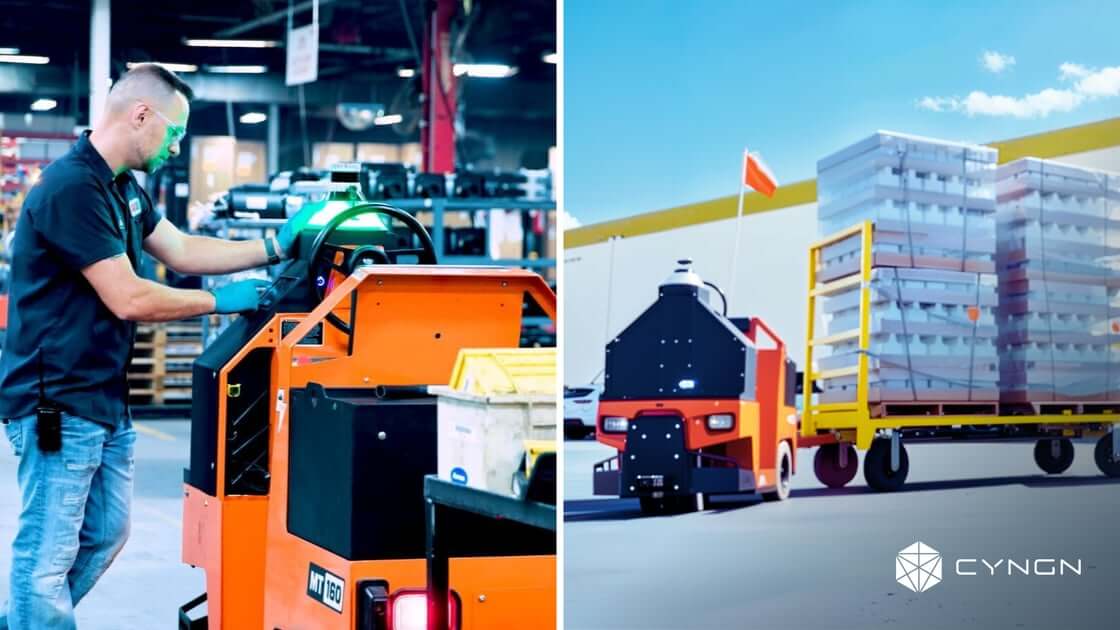
Cyngn Inc. has reported continued expansion of its DriveMod Tugger deployments across large, interconnected industrial facilities, as manufacturers and logistics operators seek broader automation solutions that extend across entire sites rather than isolated workflows.
The California-based autonomous vehicle technology company said the latest deployments reflect growing customer demand for site-wide autonomy capable of supporting end-to-end material movement across multiple buildings and outdoor transit corridors. As industrial campuses increase in scale and complexity, Cyngn argues that automation must evolve to match these more expansive operational footprints.
Warehouses and manufacturing sites are increasingly designed as multi-structure campuses, often exceeding 200,000 square feet and incorporating separate zones for storage, production, assembly, and distribution. While many facilities have automated individual processes within these zones, transport between them has remained a persistent source of inefficiency. Manual handling, vehicle congestion, and inconsistent transfer times can create bottlenecks that undermine gains made elsewhere in the operation.
Cyngn’s DriveMod Tugger is designed to address these challenges by automating repetitive material movements across an entire facility. According to the company, the system is now being used to support workflows that span multiple buildings, enabling smoother transitions between operational areas and reducing delays associated with inter-zone transport.
The company says this broader deployment approach helps improve throughput consistency and allows businesses to redeploy labour away from routine transport tasks and towards higher-value activities. Rather than focusing on single aisles or confined use cases, DriveMod is positioned as a scalable automation layer that can support growing sites over time.
“Customers are increasingly looking for autonomy that fits into their entire operation, not just a single aisle or point solution,” said Marty Petraitis, Cyngn’s VP of Sales. “As industrial sites grow larger and more interconnected, the ability to move materials reliably across a full facility becomes a meaningful lever for efficiency and scale.”
Industry analysts have noted that while automation adoption has accelerated across manufacturing and logistics, many organisations remain constrained by fragmented systems that do not communicate effectively across site boundaries. Autonomous mobile robots and automated vehicles have often been deployed in limited areas, delivering localised efficiency gains but failing to address wider operational friction.
Cyngn’s approach aims to bridge this gap by supporting connected operations across entire campuses, including outdoor corridors that link separate buildings. This capability is increasingly important as companies consolidate production and warehousing into large, multi-use sites designed to support higher volumes and more complex supply chains.
The company positions DriveMod as a long-term capability rather than a short-term productivity tool, emphasising its suitability for real-world production environments. By integrating autonomy into core transport workflows, Cyngn believes customers can build a foundation for sustained automation expansion as their operations evolve.
“DriveMod is built to perform in real production environments and support site-wide automation as a long-term capability,” Petraitis added. “This broader deployment scope strengthens the foundation for sustained customer expansion as organizations scale autonomy across multiple workflows and facilities.”
Cyngn’s update comes as manufacturers and logistics operators face continued pressure to increase efficiency amid rising labour costs, space constraints, and demand for faster, more reliable throughput. Automation is increasingly viewed not only as a means of reducing costs but also as a strategic tool for improving resilience and scalability across complex operations.
By focusing on site-wide material movement, Cyngn is targeting an area that has traditionally lagged behind other forms of industrial automation. If successful, such deployments could help organisations unlock further productivity gains by addressing inefficiencies that sit between, rather than within, individual processes.
For Cyngn, the expansion of DriveMod Tugger deployments also signals an opportunity for deeper customer relationships, as companies look to extend autonomy across additional workflows and facilities over time. As industrial sites continue to grow in size and complexity, demand for automation solutions that can operate seamlessly across entire campuses is likely to increase, placing site-wide autonomy firmly on the agenda for the next phase of industrial transformation.