


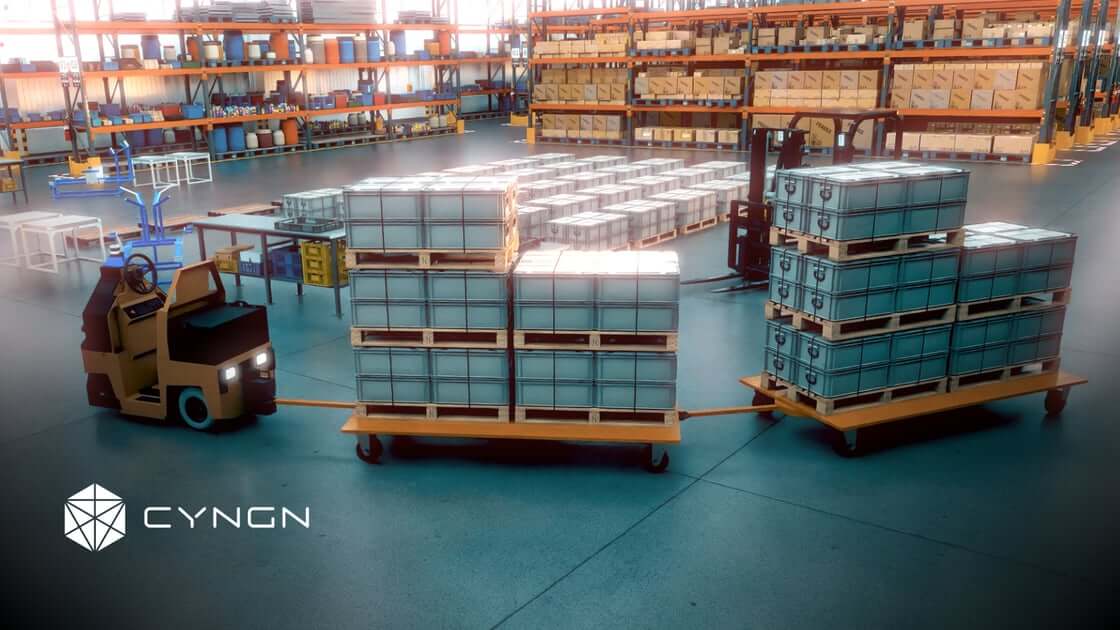
Cyngn, the US-based autonomous vehicle software company, has announced further progress in its collaboration with NVIDIA as it seeks to accelerate the commercial deployment of physical artificial intelligence across industrial environments. The company has developed a new simulation environment built on NVIDIA Isaac Sim that allows its autonomous vehicle software to be tested, validated and refined in highly realistic digital warehouses before deployment in the real world.
The announcement, made from Mountain View, California, highlights how Cyngn is increasingly relying on advanced simulation as a core part of its engineering and commercial strategy. By running its full autonomy and fleet management stack inside a persistent, high-fidelity virtual environment, the company aims to reduce development risk, improve software quality and speed up the path from concept to revenue-generating deployment.
The simulation platform is built using NVIDIA Isaac Sim, an open-source robotics simulation framework developed by NVIDIA. The environment mirrors real operational workflows found in warehouses and industrial facilities, enabling Cyngn’s engineers to test scenarios that would be costly, time-consuming or impractical to recreate at scale in physical locations.
Within the digital warehouse, Cyngn can execute its autonomy software, mission creation tools and telematics systems as though its vehicles were operating in a live customer facility. According to the company, this capability allows it to simulate larger fleets, introduce more complex layouts and evaluate a wider range of operational edge cases than would typically be feasible in real-world testing.
The approach is designed to accelerate quality assurance cycles and expand regression testing, while also enabling new features to be evaluated much earlier in the development process. For industrial customers, where downtime and safety are critical concerns, the ability to validate performance in advance is increasingly seen as essential.
“Simulation is becoming a critical lever for how we bring new autonomous products to market,” said Felix Singh, VP of Engineering Services at Cyngn. “By using NVIDIA Isaac Sim to run our autonomy and fleet software in realistic, full-scale environments, we can validate new forklift use cases faster, reduce development risk, and shorten the timeline from concept to commercial deployment. This capability directly supports our ability to scale into more complex applications and accelerate revenue-generating programs.”
As part of the collaboration, Cyngn is also contributing a detailed industrial-vehicle dynamics model into the Isaac Sim framework. The model is designed to capture the physical characteristics of heavy material-handling vehicles, such as forklifts, with greater accuracy. By improving how vehicle dynamics are represented in simulation, the company expects closer alignment between virtual testing outcomes and real-world performance.
This contribution is intended to support Cyngn’s longer-term ambition to scale its autonomy software across a broader range of vehicle platforms. As industrial operators look to automate not only forklifts but also other forms of heavy equipment, accurate simulation of vehicle behaviour is becoming a key enabler of commercial adoption.
Beyond internal development, Cyngn plans to use the new simulation environment for customer demonstrations and early-stage training workflows. Digital replicas of customer facilities can be used to showcase autonomous operations, helping prospective clients visualise how the technology would integrate into their existing processes.
The company is also exploring opportunities with existing partners whose facilities are being represented inside the simulation environment, suggesting potential use cases in collaborative development, pre-deployment planning and operator training.
Additional video materials demonstrating the Isaac Sim-based simulation capabilities are expected to accompany the announcement, underlining the growing role of visual, simulation-driven tools in the industrial automation sector.
For Cyngn, the move reflects a broader industry shift towards simulation-first development as autonomous systems become more complex and commercial expectations increase. By combining high-fidelity digital environments with real-world deployment experience, the company is positioning itself to scale its physical AI offerings more rapidly while maintaining the reliability demanded by industrial customers.