


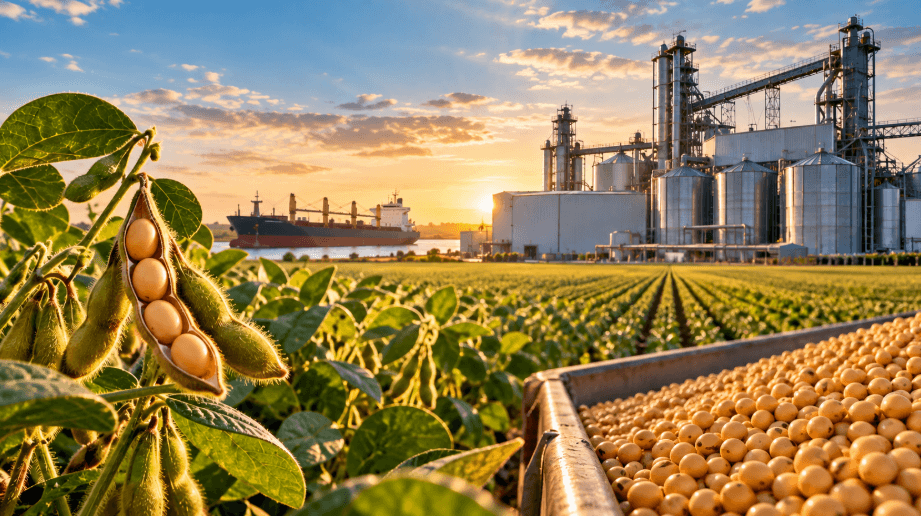
U.S. soybean farmers are paying closer attention to yield potential as expanding domestic processing capacity creates additional demand for the crop. Across the Midwest, new soybean crush facilities and demand connected to renewable fuels are encouraging growers to examine planting strategies and in-season crop management.
International demand also remains an important part of the soybean market. Producers continue to follow U.S.-China trade discussions because China has historically represented a significant destination for American agricultural exports.
“That means working toward a durable trading relationship,” Ohio farmer Scott Metzger, current president of the American Soybean Association (ASA) said in a recent ASA news release.
The association has expressed interest in maintaining substantial Chinese purchases of U.S. soybeans. At the same time, investment in domestic processing infrastructure is creating additional markets closer to American farms.
Domestic Soybean Crush Capacity Continues to Grow
New soybean processing projects are being developed across several states as companies respond to demand associated with biofuels, renewable diesel and aviation fuel.
Among the recently announced projects is a planned CHS, Inc. soybean processing facility in Evansville, Wisconsin. The $700 million investment is expected to establish the state’s first large-scale soybean crush plant, with planned capacity to process approximately 80 million bushels annually.
“For farmers, this is about more than a new processing plant; it is a new market for their soybeans,” said Devin Mogler, National Oilseed Processors Association president and CEO. “Our industry has expanded at a remarkable pace, and we are on a path toward processing two out of every three rows of soybeans grown in the U.S.”
Domestic soybean crush volumes have remained above year-earlier levels for 17 consecutive months, according to information provided in the original announcement. The trend reflects continued investment in processing capacity and a growing emphasis on domestic soybean utilization.
For farmers, additional processing plants can potentially provide more regional marketing opportunities while increasing demand for locally produced soybeans.
Growers Examine Ways to Increase Soybean Productivity
The changing market environment is also encouraging greater attention to soybean agronomy. Some growers and crop advisers are examining planting populations, nutrient management and other in-season practices intended to support yield potential.
“You can push soybeans throughout the season based off what they’re dealing with,” said Robert Phillips, agronomist with Integrated Seed Solutions of Flanagan, Ill. “You can find ways to get them to set more nodes and add another cluster of pods through foliar feeding and different bio stimulants.”
Larry Fiene, founder and CEO of Planet Earth Agronomy, said higher plant populations can create competition among soybean plants as farmers pursue greater production per acre.
“The main stress that’s created in the soybean field is by the farmer, and it’s by design,” he smiles. “If we wanted stress-free beans, we’d plant 60,000 seeds per acre. But we plant them at 100,000 to 120,000 (seeds per acre) to get the maximum amount of production, so that brings stress from competing with other bean plants in the field. As farmers we’re growing the maximum amount of yield based on the carrying capacity of our soil. We know where we need to be, and we run it right to the edge.”
Fiene and his team have evaluated biological products, nutrients and biostimulants as part of soybean production systems. Planet Earth Agronomy developed Big Bean™, a formulation containing boron, nitrogen, potash and seaweed extract. The company says the product is designed to support nutrient availability, plant metabolism and stress management. Those descriptions represent claims associated with the product rather than independently verified performance guarantees.
Farmer Reports Yield Increase Within Management Program
Mike Robbins, a fifth-generation farmer south of Chicago, said the product was included in his management program during a record soybean crop.
“We set a record yield with our soybeans last year with BIG BEAN as a part of that. I’m excited to see what it does this year,” Robbins says. “We saw about a four bushel per acre increase across 2,000 acres over our previous record, which is pretty incredible.”
Robbins said the product could be incorporated into field applications already being made during the growing season.
“We put it in with our post- herbicide pass and we put it in with our fungicide pass. It’s as simple as measuring it and dumping it in the tank.”
Phillips, meanwhile, said his focus remains on improving the number of productive pods that soybean plants can support.
“Each node on a soybean plant has the potential to put 12 pods on,” he says. “I’ve never seen it personally, yet, but I’m working on it. I’m going to get there. I had nine pods last year, and that’s unheard of. It’s been a lifetime goal to get there, but there’s still a lot of that mountain to climb.”
With additional soybean crushing infrastructure being developed and international markets continuing to influence demand, producers are giving greater attention to maximizing productivity. The expansion of domestic processing could provide farmers with additional marketing opportunities while reinforcing soybeans’ importance within the U.S. agricultural economy.



:quality(85)/cloudfront-us-east-1.images.arcpublishing.com/infobae/45OXD2PP2VAWTFEPJZPEDWSDC4.jpg "The Ortega regime is closing embassies in cities with high immigrant populations, leaving thousands of Nicaraguans homeless.")