

OKLAHOMA CITY — Oklahoma’s latest primary runoff elections drew participation from just 22% of registered voters, renewing concerns about civic engagement as the state prepares for its November 2 General Election and prompting organizations such as the Oklahoma Institute for Child Advocacy to focus on building voting awareness among younger generations.
The runoff elections, held August 24 following Oklahoma’s June 15 Primary Elections, determined nominees in races where no candidate secured a majority during the initial vote. The ballot also included two proposed amendments to the Oklahoma Constitution.
The reported 22% statewide turnout included registered Democrats, Republicans, Libertarians and independent voters. Libertarians and independents were eligible to participate only on the two state questions, while Democratic and Republican voters also had party contests to decide.
Party Turnout Shows Significant Gap
Democratic turnout reached 21% in a statewide U.S. Senate primary runoff between N’Kiyla Jasmine Thomas and Jim Priest. Thomas emerged as the winner.
About 616,000 Oklahoma residents are registered Democrats, according to figures cited from the state Election Board, with 129,439 Democratic voters participating in the runoff. Thomas is set to face Republican Kevin Hern, Libertarian Sevier White and independent candidates Ron Meinhardt and Curtis Stinnett in November.
Republican participation was higher. More than 371,000 Republican voters cast ballots, representing 28.7% of registered party members.
In the gubernatorial runoff, Mike Mazzei narrowly defeated Gentner Drummond. The original account described the margin as equivalent to just over one vote for each of Oklahoma’s 1,984 precincts. Three additional statewide Republican runoff contests were also held.
The General Election ballot for governor is expected to include Mazzei, Democratic nominee Cyndi Munson and independent candidates Robert Brooks, Orlando Lynn Bush and Jerry Griffin.
Political Advertising Seen as One Factor in Participation
Differences in campaign advertising were cited as one possible explanation for the turnout gap between the two major parties. Republican candidates in four races reportedly invested significantly in television and online advertising, while Democratic campaigns made less use of those traditional promotional channels.
Oklahoma’s earlier Primary Election attracted 26% of registered voters, meaning participation declined by approximately four percentage points in the runoff.
The relatively modest decline contrasts with some previous election cycles. The original analysis noted that 2018 was an exception because the ballot included a medical marijuana referendum, which contributed to heightened voter interest.
Texas was also cited as a regional comparison. About 24% of voters reportedly participated in that state’s primary, while turnout subsequently fell to 9% for the runoff.
Low participation remains a broader concern because relatively small portions of the electorate can ultimately determine which candidates advance to general elections and, in some cases, who holds public office.
Oklahoma Kid Governor Program Promotes Early Civic Education
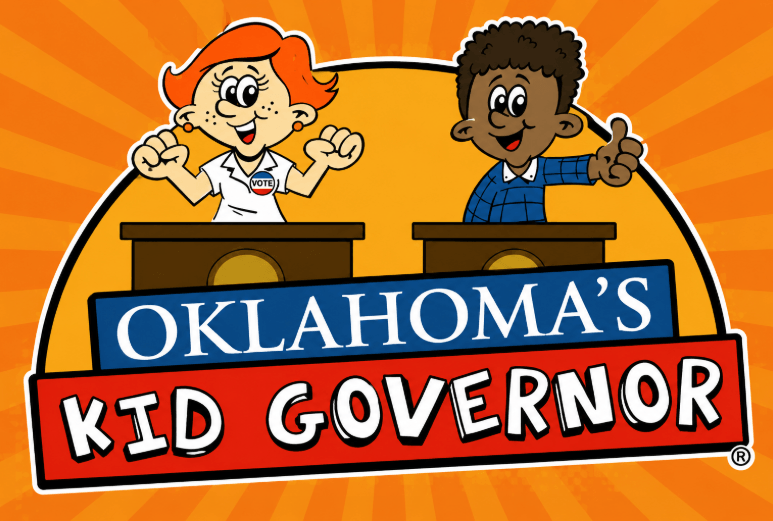
The Oklahoma Institute for Child Advocacy, or OICA, is seeking to address the long-term challenge by introducing fifth-grade students to voting and civic participation through its Oklahoma Kid Governor® program.
Public, private and charter school fifth-grade classrooms can receive free lesson plans designed to help teachers explain the responsibilities of elected officials and the importance of voting when students reach adulthood.
Participating teachers can also conduct an optional classroom election. Students may campaign for Kid Governor® based on an issue or platform they select. Each classroom votes for a candidate, with the winner submitting a video explaining the importance of their chosen issue.
OICA then narrows the statewide candidate pool to seven finalists. Participating classrooms receive ballots and candidate videos, allowing students to review the platforms before voting for their preferred candidate.
Program Seeks Long-Term Increase in Voter Participation
OICA acknowledges that the initiative is still too new to determine whether participation will translate into higher voter registration or turnout when students become eligible to vote.
The organization nevertheless views students’ enthusiasm for classroom elections as an opportunity to establish voting habits and an understanding of civic responsibility well before adulthood.
Fifth-grade classrooms still have several weeks to enroll in the program. OICA is encouraging educators and community members to consider participation as part of broader efforts to strengthen civic education and address Oklahoma’s persistently low election turnout.
By introducing students to candidates, campaigns, ballots and the responsibilities associated with voting, the Kid Governor® initiative represents a long-term approach to an immediate challenge: increasing participation in the democratic process across Oklahoma.