

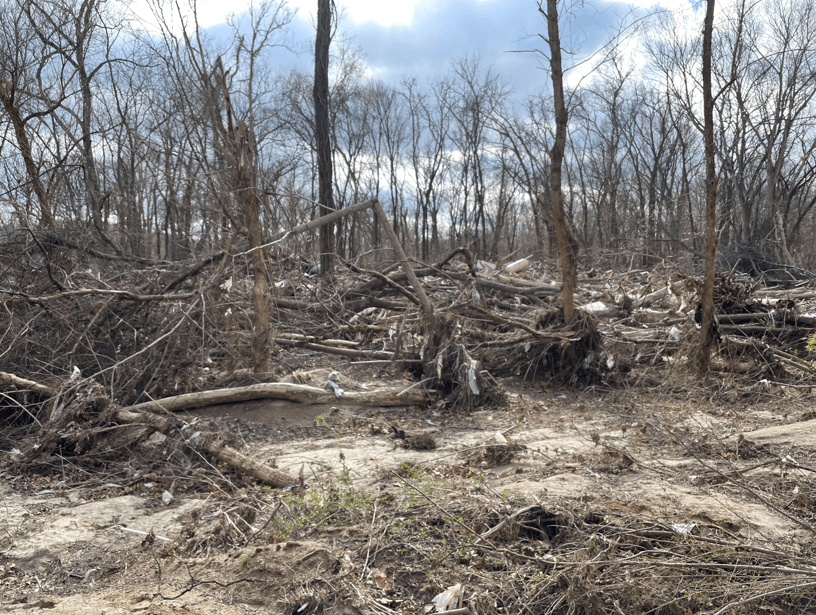
NASHVILLE, Tenn. — The U.S. Army Corps of Engineers (USACE) Nashville District has awarded a $33.76 million contract to begin a major debris removal project in the Cherokee National Forest, marking a significant step in Tennessee’s ongoing recovery from Hurricane Helene. The initiative will focus on removing hazardous storm debris from federally owned lands and waters, with cleanup operations on Jackson Island expected to begin in early September after required permits are secured.
The contract was awarded on July 24 to DRC Emergency Services, a pre-approved emergency response contractor operating under an active standby agreement with the Corps of Engineers. The project is authorized through an Economy Act interagency agreement with the U.S. Department of Agriculture’s Forest Service, allowing USACE to apply its engineering and contracting expertise to restore federally managed public lands affected by the storm.
Officials said the cleanup will target non-recoverable debris, including construction and demolition materials as well as vegetative debris that obstructs water flow or poses risks to public health and safety.
Jackson Island, located adjacent to the Nolichucky River in Tennessee, is the primary location for the operation. The area serves as an important public recreation site within the Cherokee National Forest and sustained extensive storm damage during Hurricane Helene, leaving large amounts of debris that have limited safe public access.
The contract includes a 240-day performance period covering every phase of the project, including permitting, mobilization, active debris removal, demobilization, and project closeout. Before field operations begin, the contractor must obtain all necessary local, state, and federal permits. On-site debris removal is tentatively scheduled to start on Sept. 7, 2026.
“Through our strong partnership with the U.S. Forest Service, we are bringing our specialized engineering and contracting capabilities to bear on this critical recovery effort,” said Lt. Col. Guillermo Guandique, commander of the U.S. Army Corps of Engineers Nashville District. “We are ready to begin clearing hazardous debris to restore public safety and protect the sensitive Cherokee National Forest ecosystem. Our team understands how much this recovery means to the community, and we have planned every phase of our operations to be respectful, deliberate and highly focused on safety until the job is done.”
Federal and state agencies said the debris removal effort represents an important milestone in the region’s broader disaster recovery strategy. Officials noted that close coordination among multiple agencies remains essential to restoring public lands while protecting environmental resources.
“The start of this project marks another important step in Tennessee’s long-term recovery from Tropical Storm Helene,” said Patrick Sheehan, commissioner of the Tennessee Emergency Management Authority. “Strong partnerships are essential to helping disaster-impacted communities recover. We are grateful for the continued collaboration between the U.S. Army Corps of Engineers, the U.S. Forest Service, and our federal, state, and local partners to safely remove hazardous debris, protect our natural resources, and help restore these Tennessee communities.”
Forest Service leaders said the project will help reopen one of the last major storm-damaged areas within the Cherokee National Forest while ensuring that cleanup activities protect the area’s natural and cultural resources.
“Hurricane Helene left a lot of debris across the Cherokee National Forest, especially in places where families come to enjoy time outside. Jackson Island is the last large area we still need to clear, and this work will help make the river safer and healthier for everyone,” said Michael Wright, forest supervisor for the Cherokee National Forest. “We’ve been working hard to clean up storm damage across the forest, and this next step lets us finish the job safely and efficiently. It will be a massive undertaking, but by partnering with the U.S. Army Corps of Engineers, we can clear this debris quickly and safely, while ensuring natural and cultural resources are protected.”
Project planners have incorporated several environmental safeguards into the cleanup effort to minimize impacts on sensitive ecosystems. Crews will use low-impact equipment and protective matting when working in environmentally sensitive habitats to reduce ground disturbance. Hazardous trees, including those uprooted during the storm, will also be removed where necessary to improve safety.
Wildlife monitoring teams will remain on-site throughout the project to observe for bats and endangered species, documenting tree removals and reporting findings directly to Forest Service biologists. Archaeologists will oversee all ground-disturbing work to protect cultural resources, while contractors will stabilize disturbed areas with native seed mixes following cleanup activities to reduce erosion and support long-term ecosystem recovery.
The Nashville District oversees civil works operations across a 59,000-square-mile region covering Tennessee, Kentucky, Alabama, Georgia, North Carolina, Mississippi, and Virginia. Its responsibilities include flood risk management, commercial navigation, hydropower production, recreation, water supply, and water quality management throughout the Cumberland and Tennessee River basins. The district also operates 10 dams within the Cumberland River Basin and maintains 14 navigation lock projects across the Cumberland and Tennessee River systems as part of its broader water resource management mission.