


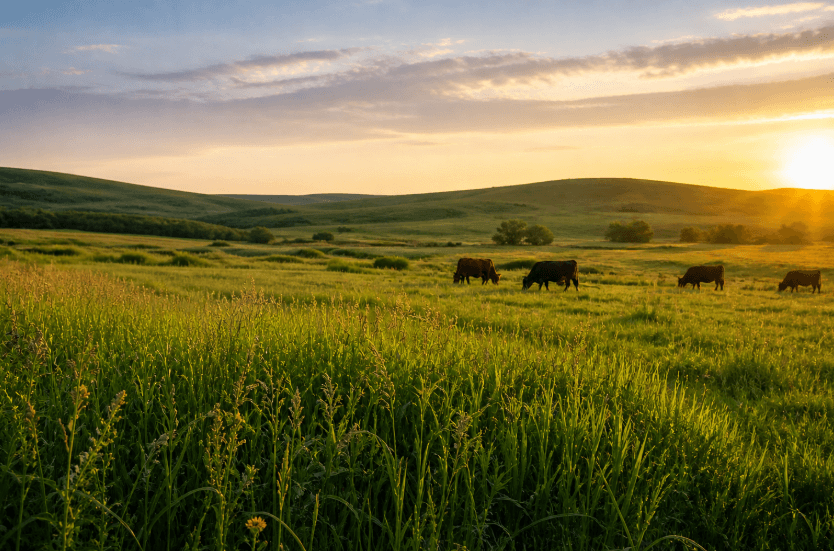
The U.S. Department of Agriculture has opened a new enrollment window for its Grassland Conservation Reserve Program (Grassland CRP), offering agricultural producers and private landowners a limited opportunity to secure federal support for land conservation while maintaining active grazing operations.
Applications are being accepted from 4 May through 29 May 2026, with the programme administered by the Farm Service Agency (FSA). The initiative forms part of the wider Conservation Reserve Program (CRP), a long-standing federal scheme aimed at improving environmental outcomes across U.S. agricultural land.
Grassland CRP is positioned as a “working lands” programme, allowing participants to continue most grazing and haying activities while committing to conservation practices. The scheme is designed to balance agricultural productivity with environmental stewardship, particularly in areas facing pressure from land-use conversion.
The programme places a strong emphasis on supporting grazing operations alongside enhancing plant and animal biodiversity. It also targets grasslands, shrubs, and forbs considered most at risk of being converted to other uses, reflecting broader concerns about habitat loss and ecosystem degradation.
CRP itself remains the USDA’s flagship conservation initiative. It provides both financial incentives and technical assistance to landowners who agree to remove environmentally sensitive or marginal cropland from active production. In return, participants enter contracts typically lasting between 10 and 15 years and commit to establishing vegetative cover that improves water quality, reduces soil erosion, and supports wildlife habitats.
The programme’s continuation into 2026 has been enabled by federal legislation, specifically the Continuing Appropriations, Agriculture, Legislative Branch, Military Construction and Veterans Affairs, and Extensions Act, 2026. This legislation extends the authority of the FSA to administer CRP through to 30 September 2026, ensuring continuity for participants and policymakers alike.
Current participation levels highlight the scale of the programme. More than 26.2 million acres are presently enrolled in CRP nationwide, with nearly 10.3 million acres allocated to the Grassland CRP component alone. These figures underline the programme’s significance within U.S. agricultural and environmental policy frameworks.
However, capacity constraints remain a defining feature of the 2026 enrollment cycle. A statutory cap limits total CRP enrollment to 27 million acres, leaving only 1.9 million acres available for new or renewed contracts this fiscal year. This restriction is expected to intensify competition among applicants, particularly given the recent closure of enrollment periods for both General CRP and Continuous CRP earlier in the year.
The FSA has confirmed that it is currently reviewing offers submitted under those earlier enrollment rounds, with successful applicants to be notified at a later date. The overlap in timelines places additional importance on the Grassland CRP window, which may represent one of the final opportunities for landowners to secure participation in 2026.
From a policy perspective, the programme reflects a broader shift towards integrating environmental objectives within agricultural systems rather than separating conservation from production. By allowing continued grazing, Grassland CRP seeks to maintain rural economic activity while delivering measurable ecological benefits.
For landowners, the financial and technical support offered under CRP can provide a degree of income stability, particularly for marginal or less productive land. At the same time, the environmental requirements align with increasing regulatory and market pressures around sustainability and land use.
Producers and landowners considering participation are advised to engage directly with their local FSA county offices ahead of the 29 May deadline. Given the limited acreage available and the competitive nature of the programme, early engagement may prove critical in securing a place within this year’s allocation.
As the USDA continues to balance agricultural productivity with environmental priorities, the 2026 Grassland CRP enrollment period underscores the growing importance of conservation-focused land management within the U.S. farming sector.