


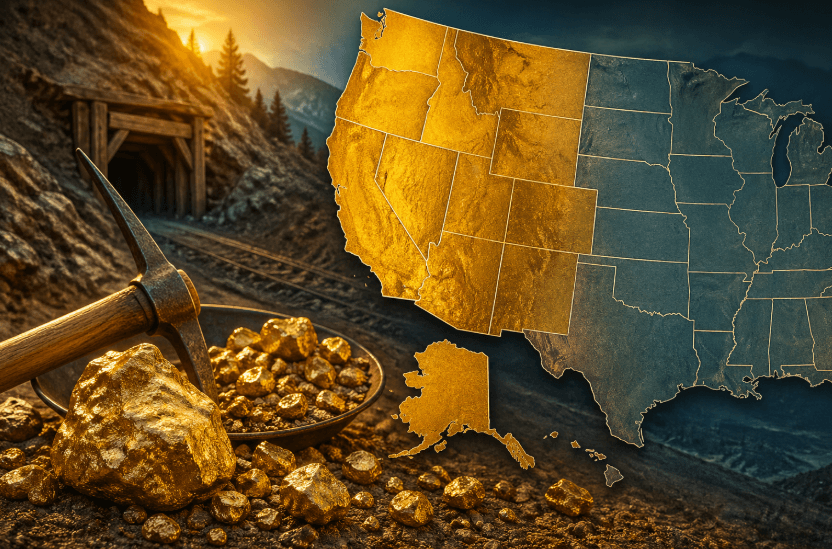
A new data-led study has identified the US states where gold is most likely to be found, with California emerging as the clear leader by a significant margin.
The analysis, conducted by Coinfully, examined nationwide geological data to determine the density of gold locations relative to land area. Drawing on figures from the United States Geological Survey, the study highlights a strong concentration of gold-rich areas across western states, particularly along the Pacific coast.
California tops the ranking with 66.59 gold locations per 1,000 square miles, more than double the density of any other state included in the top ten. In total, the state accounts for 10,373 recorded locations where gold has either been discovered or produced commercially.
The findings reinforce California’s long-standing association with gold mining, while also underlining the continued geological significance of the region.
Washington and Oregon follow in second and third place, with 34.17 and 31.41 gold locations per 1,000 square miles respectively. Although Washington has a comparatively smaller number of total gold sites at 2,271, its more compact land area of 66,455 square miles increases its relative density, securing its position near the top of the ranking.
Oregon, meanwhile, records 3,015 gold locations spread across nearly 96,000 square miles, maintaining a strong position among the leading states.
Nevada ranks fourth, with 30.91 gold locations per 1,000 square miles and a total of 3,393 sites. The state has long been a major player in US mining output, and the data further reflects its mineral-rich landscape.
Idaho completes the top five, with 28.44 gold locations per 1,000 square miles. The state has 2,350 identified gold sites within its 82,643 square mile area, placing it firmly among the most promising regions for prospecting activity.
Further down the list, Arizona, Colorado, and Montana occupy sixth, seventh, and eighth positions respectively. Arizona reports 17.40 gold locations per 1,000 square miles, followed by Colorado at 14.89 and Montana at 13.21. Each state maintains a substantial number of recorded sites, though their larger land areas reduce overall density compared to higher-ranked regions.
Alaska presents a notable contrast. Despite having 5,264 gold locations — the second-highest total in the dataset — its vast land area of over 570,000 square miles significantly dilutes its density, placing it ninth with 9.22 locations per 1,000 square miles.
Utah rounds out the top ten, recording 7.46 gold locations per 1,000 square miles and a total of 613 sites.
The study’s methodology focused on comparing the number of known gold occurrences with the geographical size of each state, offering a more balanced view of where gold is most concentrated rather than simply where the highest totals exist.
Commenting on the findings, Wyatt McDonald, president of Coinfully, said:
“All of the top-ranking states share similar geological landscapes and environments, which are ideal for finding gold, and even if you’re in a state that isn’t in the top ten, it’s still worth looking for environments within your state that are similar to those in the top ten.”
He added:
“What surprised us was how dominant the Pacific coast states are in this data, with California’s density of gold locations nearly double that of any other state. Alaska is also fascinating because it has the second-highest number of gold locations in raw terms, but its sheer size pushes it down to ninth. If you are serious about prospecting, the Western states from California to Montana are your best bet.”
The results point to a clear regional trend, with western states consistently outperforming others due to favourable geological conditions. Mountain ranges, historic mining activity, and mineral-rich terrains all contribute to higher concentrations of gold deposits.
For investors, prospectors, and industry observers, the findings offer a data-driven snapshot of where gold resources are most densely located in the United States, reinforcing the enduring importance of the western mining corridor.



:quality(85)/cloudfront-us-east-1.images.arcpublishing.com/infobae/45OXD2PP2VAWTFEPJZPEDWSDC4.jpg "The Ortega regime is closing embassies in cities with high immigrant populations, leaving thousands of Nicaraguans homeless.")