


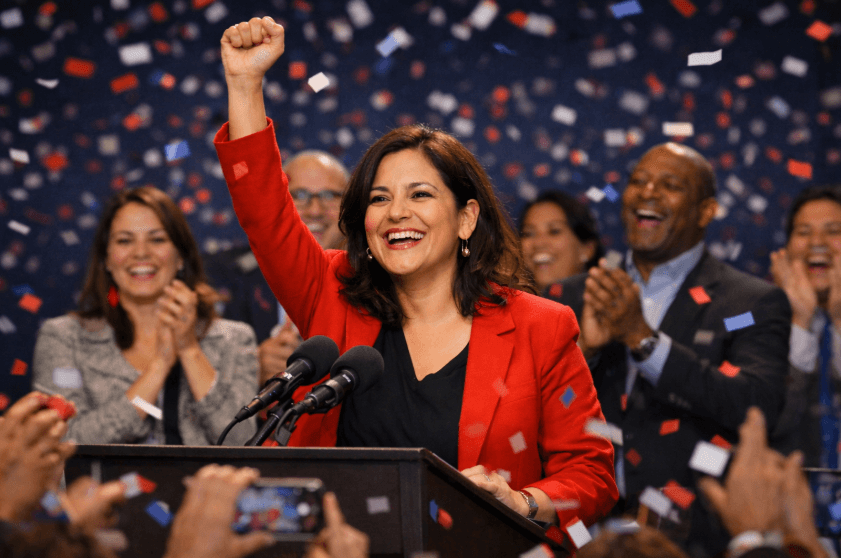
Analilia Mejia has secured a historic victory in New Jersey’s 11th congressional district, becoming the first Latina to represent the constituency, following a campaign defined by grassroots mobilisation and a strongly pro-immigrant policy platform.
The result marks a significant political shift in the district, with Mejia’s campaign drawing substantial organisational support and voter engagement over a four-month period. Backed by the advocacy group Make the Road Action, the campaign reached more than 169,731 voters across the district since early December 2025, underscoring the scale of its outreach operation.
Campaign organisers reported conducting 151,571 phone calls and 18,160 door-to-door visits, reflecting a highly coordinated ground effort aimed at mobilising traditionally underrepresented voters. This level of engagement is widely seen as a decisive factor in securing Mejia’s win.
Mejia, the daughter of immigrants from Colombia and the Dominican Republic, centred her campaign on immigration reform, economic equity, and access to public services. Her platform included calls to abolish Immigration and Customs Enforcement (ICE), introduce universal healthcare, increase corporate accountability, expand affordable housing, and reduce household costs such as utilities and groceries.
Her candidacy also drew attention for its direct engagement with immigration-related issues. Mejia participated in ICE watch training initiatives and supported grassroots efforts assisting detainees at Delaney Hall, one of the largest ICE detention centres on the East Coast. These activities formed a core part of her campaign narrative, positioning her as both an advocate and organiser within immigrant communities.
The campaign unfolded amid heightened political debate around immigration enforcement in the United States, with Mejia’s messaging reflecting a clear departure from more centrist approaches. Her positioning appears to have resonated with a segment of voters seeking structural reforms and a stronger emphasis on social protections.
Make the Road Action, which played a central role in the campaign, framed the outcome as evidence of growing progressive political influence at both state and national levels. The organisation, which has approximately 7,000 members in New Jersey, highlighted its voter engagement strategy as instrumental in delivering the result.
Nedia Morsy, Director of Make the Road Action New Jersey, said in a statement:
“Tonight, we are sending one of our own to Congress. Together, we have done the steady work of organizing to grow a movement that delivers for all of us. With Analilia, we not only forcefully called the question of whether or not we should spend billions on a masked paramilitary that separates our families while we cut healthcare funding but we also articulated a vision of what a country that welcomes immigrants can do. That’s the strength, clarity of purpose and muscle that beats back the influence of big money and builds the power needed to shape our future.
Tonight’s victory is more than a testament – it is a call to action to do away with outdated playbooks that favor the billionaire class and power the authoritarianism regime. Progressive power is building every day in New Jersey and across this country. We look forward to ushering in a New Jersey and a country alongside our new Congresswoman where we guarantee the rights and protections of all people including immigrants, strengthen our shared economic and civic life, lifts wages, and counter corporate exploitation.”
From a business and economic perspective, Mejia’s policy agenda signals potential shifts in regulatory and fiscal priorities, particularly in areas such as corporate oversight, labour conditions, and public spending. Proposals aimed at lowering living costs and increasing wage growth may have broader implications for regional economic policy and private sector operations.
Her emphasis on corporate accountability and wealth inequality also aligns with a wider trend in progressive politics that seeks to recalibrate the relationship between government, large corporations, and consumers. Businesses operating in the region may face increased scrutiny under such an agenda, particularly in sectors linked to housing, utilities, and essential goods.
While the full policy impact of Mejia’s tenure remains to be seen, her victory highlights the growing influence of grassroots campaigning and issue-driven voter engagement in shaping electoral outcomes. It also reflects a broader shift in political dynamics, where local organising efforts are increasingly capable of delivering measurable results at the national level.
Mejia’s win is likely to be closely watched by political analysts and business leaders alike, as it may signal evolving priorities among voters and a changing policy environment in key congressional districts.



:quality(85)/cloudfront-us-east-1.images.arcpublishing.com/infobae/45OXD2PP2VAWTFEPJZPEDWSDC4.jpg "The Ortega regime is closing embassies in cities with high immigrant populations, leaving thousands of Nicaraguans homeless.")