

OKLAHOMA CITY — The Oklahoma National Guard has opened a major training exercise to media observers, offering a closer look at how uncrewed aircraft systems (UAS) are reshaping modern emergency response and operational coordination.
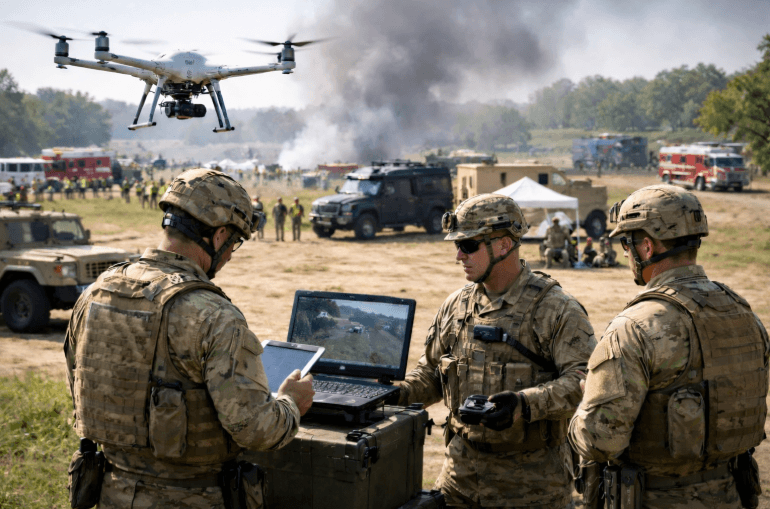
The exercise, known as Lightning Strike, is being conducted at Camp Gruber Training Center and brings together a range of participants, including military personnel, emergency management officials and first responders. The initiative reflects a broader push to integrate advanced drone technology into domestic operations, with a focus on improving responsiveness and situational awareness during complex incidents.
Organised by the Oklahoma National Guard Office of Public Affairs, the exercise provides a structured environment to test how aerial systems can support coordinated, multi-agency responses. Media representatives have been invited to observe proceedings both from the ground and, in limited cases, from the air via military transport helicopters.
Attendance has been carefully managed, with prior registration required due to operational constraints and security protocols within the training area. Journalists travelling to the site have been advised to follow specific access procedures, ensuring that the exercise can proceed without disruption while maintaining safety standards.
The physical environment of the training grounds underscores the realism of the exercise. Much of the activity takes place outdoors across uneven terrain, mirroring the conditions that emergency teams may face during real-world deployments. Observers have been encouraged to wear practical attire suited to field conditions, reflecting the operational nature of the event.
At the centre of Lightning Strike is the use of UAS technology to enhance decision-making in time-critical scenarios. By deploying drones alongside traditional response units, participating agencies are able to gather aerial intelligence, monitor developments in real time and share data across command structures.
This capability is increasingly viewed as essential in managing incidents that require rapid assessment and coordinated action. From natural disasters to complex security situations, the ability to obtain a comprehensive aerial perspective can significantly improve the effectiveness of response efforts.
The exercise also places strong emphasis on interoperability between agencies. Ensuring that military units, civil authorities and emergency services can communicate and operate seamlessly remains a key priority, particularly as operational environments become more complex and interconnected.
By simulating realistic scenarios, the training allows participants to evaluate both technological performance and organisational coordination. The integration of real-time data sharing is a central component, enabling faster decision-making and more unified responses across multiple teams.
In addition to its operational objectives, Lightning Strike serves as a demonstration of evolving capabilities within the Oklahoma National Guard and its partner agencies. Opening the exercise to media observers provides transparency and offers insight into how modern tools are being incorporated into public safety frameworks.
The growing reliance on drone technology reflects wider global trends across both public and private sectors. UAS platforms are increasingly used in areas such as disaster relief, infrastructure inspection and security operations, driven by their ability to access challenging environments and deliver timely, actionable information.
Within the context of emergency response, these systems offer clear advantages. They can reduce risk to personnel, extend the reach of operational teams and provide continuous situational awareness in dynamic conditions. As such, their integration into training exercises is seen as a critical step in building future readiness.
Lightning Strike illustrates how technological innovation and inter-agency collaboration are converging to strengthen domestic response capabilities. By testing these systems in a controlled yet realistic setting, participating organisations are better positioned to refine their strategies and improve overall effectiveness.
For stakeholders across defence, emergency management and technology sectors, the exercise provides a valuable case study in how advanced tools can be deployed in support of public safety. It also highlights the importance of ongoing investment in both technology and training to ensure preparedness for a wide range of potential scenarios.
As emergency response frameworks continue to evolve, initiatives such as Lightning Strike demonstrate the practical benefits of integrating new capabilities into established systems—offering a clearer view of how future operations may be conducted.