


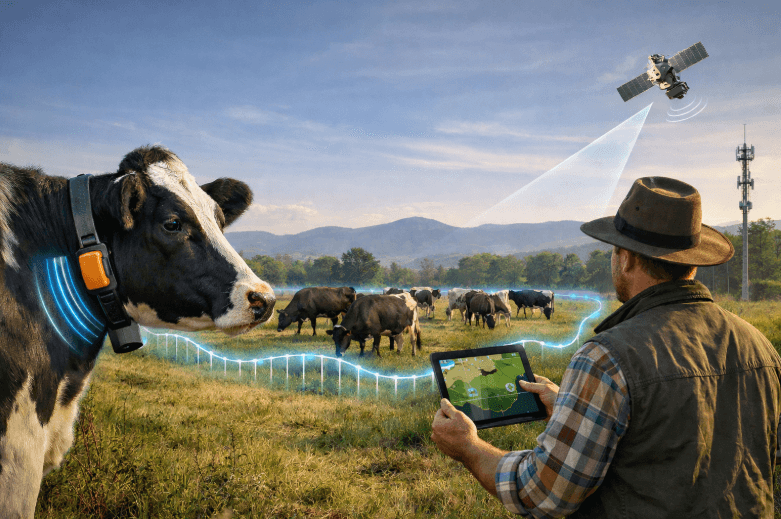
A pilot programme led by the University of Missouri is testing whether digital technology can remove one of the most labour-intensive tasks in livestock farming: the constant building, dismantling and relocation of physical fencing. Early trials suggest that so-called virtual fencing could reshape grazing management while delivering measurable productivity and environmental benefits.
At the centre of the initiative is the University of Missouri’s Center for Regenerative Agriculture, which is overseeing a beta trial involving five livestock producers across the state. The project is supported by a $900,000 grant from the National Fish and Wildlife Foundation, reflecting growing interest from conservation bodies in technologies that align agricultural productivity with land stewardship.
Virtual fencing replaces traditional posts and wire with GPS-enabled collars worn by cattle. The collars are connected to a mobile application that allows farmers to define grazing boundaries digitally. When animals approach the virtual boundary, they receive an audible cue followed, if necessary, by a mild electrical stimulus designed to redirect movement rather than cause harm. Over time, livestock learn to respond to the sound cue alone.
Supporters of the system argue that the technology addresses several longstanding challenges in grazing management. Physical fencing requires significant upfront investment in materials and labour, and ongoing maintenance is particularly demanding in large or uneven landscapes. Seasonal adjustments, rotational grazing and pasture recovery often involve hours of manual work that can limit flexibility and efficiency.
By contrast, virtual fencing allows boundaries to be adjusted instantly through a smartphone or tablet, enabling more precise control of grazing patterns. Advocates say this supports regenerative agriculture practices by preventing overgrazing, protecting sensitive areas such as waterways, and promoting more even pasture utilisation.
From a business perspective, the trial is being closely watched for its potential to reduce operating costs and improve time efficiency. Labour shortages remain a pressing issue for agricultural producers in both the United States and the United Kingdom, and technologies that streamline daily operations are increasingly viewed as strategic investments rather than optional upgrades.
The involvement of the National Fish and Wildlife Foundation underscores the project’s environmental dimension. Conservation groups have long sought ways to balance agricultural output with habitat protection, particularly in regions where livestock farming overlaps with ecologically sensitive land. More controlled grazing can reduce soil erosion, improve water quality and support biodiversity, outcomes that align with broader sustainability goals.
While the technology is still in the testing phase, the Missouri producers participating in the trial are providing real-world data on animal behaviour, system reliability and cost effectiveness. Researchers at the Center for Regenerative Agriculture are analysing how quickly cattle adapt to the collars, how accurately GPS boundaries perform in varied terrain, and whether the system delivers consistent results across different herd sizes.
There are also regulatory and market considerations. As virtual fencing systems become more widely adopted, questions may arise around animal welfare standards, data ownership and technology interoperability. Ensuring that systems meet welfare expectations will be critical to public acceptance, particularly in markets where consumer scrutiny of farming practices is increasing.
For now, the Missouri project represents a controlled but significant step towards digital transformation in livestock management. If the trial demonstrates sustained benefits, the model could be scaled to other regions and potentially influence grazing practices well beyond the United States.
For UK agribusiness leaders and investors, the project offers a glimpse into how precision agriculture technologies may evolve. As pressures mount to improve efficiency, reduce environmental impact and adapt to changing labour dynamics, virtual fencing could emerge as a commercially viable tool rather than a niche innovation.
The results of the Missouri trial are expected to inform future funding decisions and may shape how universities, conservation organisations and producers collaborate on technology-driven solutions. Should the findings prove favourable, tearing down and rebuilding fences may indeed become a practice of the past, replaced by digital boundaries and data-led grazing strategies fit for a modern agricultural economy.