

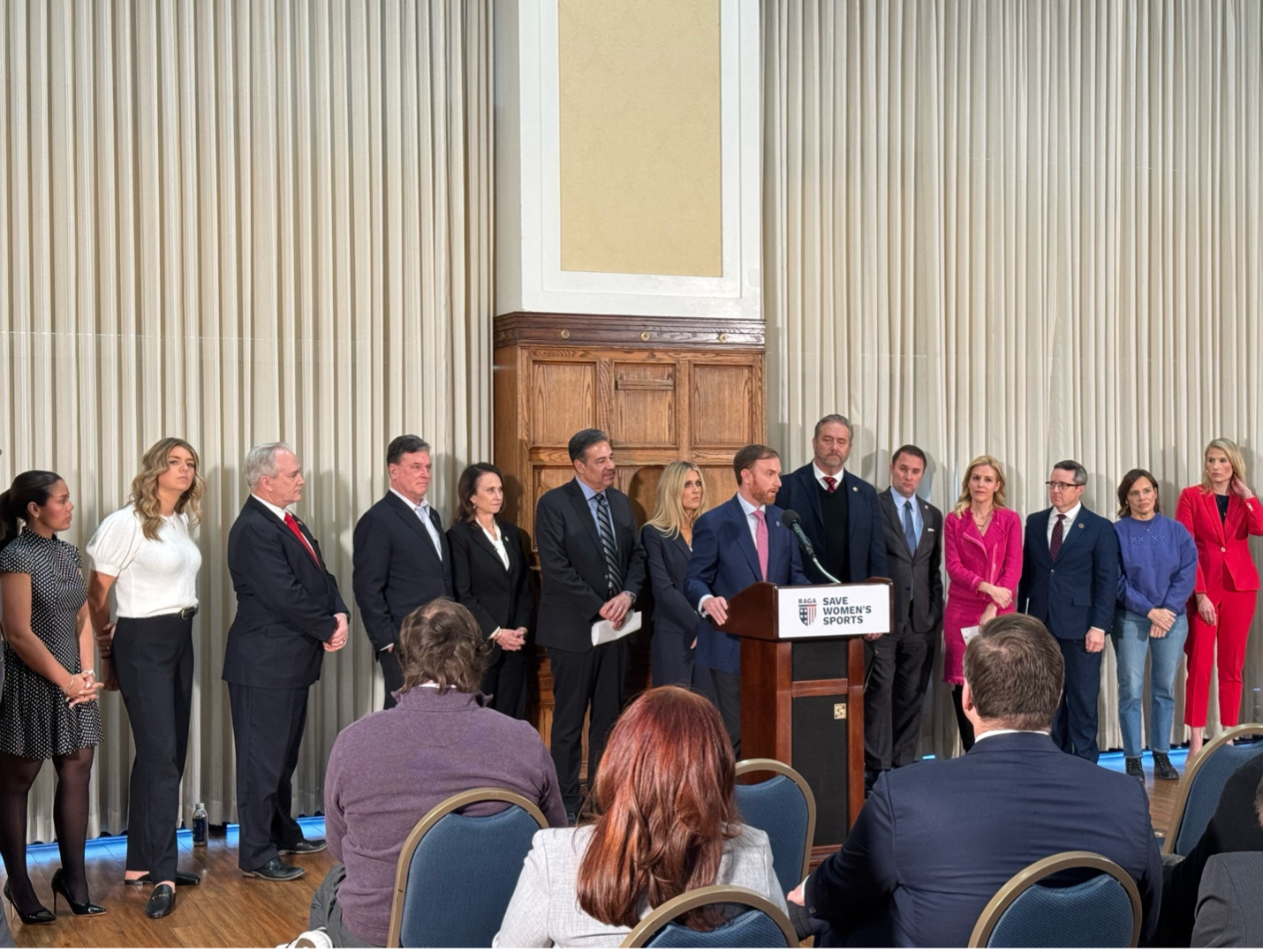
Washington, D.C. — The Republican Attorneys General Association (RAGA) has brought together a group of high-profile female athletes and state attorneys general to support two state laws that restrict participation in girls’ and women’s sports, as the measures face review at the US Supreme Court.
At a press conference held yesterday in the US capital, RAGA presented the appearance as a coordinated effort to defend the Fairness in Women’s Sports Act in Idaho and the Save Women’s Sports Act in West Virginia. Both laws are being challenged in court by students who identify as female and argue the legislation violates constitutional protections and federal civil rights provisions.
RAGA framed the dispute as a national test of how states can define eligibility for women’s sports, with implications extending beyond school athletics and into broader questions of regulatory authority, compliance frameworks, and the legal boundaries of Title IX, the federal law prohibiting sex-based discrimination in education.
The event featured several athletes with experience in elite collegiate and international competition. Those attending included twelve-time NCAA All-American swimmer Riley Gaines; former NCAA soccer player Sophia Lorey; former NCAA volleyball star Macy Petty; former all-around gymnastics national champion and CEO of XX-XY Jennifer Sey; Olympic silver medalist and former NCAA national champion MyKayla Skinner; Lainey Armistead; Madison Kenyon; and Mary Kate Marshall.
RAGA said the athletes were advocating in support of the two laws as they proceed through the Supreme Court process. The association also stated that the legal actions against the states were brought by “biological boys who identify as girls,” and that the plaintiffs claimed the laws were unconstitutional.
State attorneys general unite behind litigation strategy
Alongside the athletes, attorneys general from multiple US states attended, signalling a wider coalition approach to the litigation and the policy debate around sports participation rules.
The attorneys general in attendance were West Virginia Attorney General JB McCuskey, Idaho Attorney General Raúl Labrador, Montana Attorney General and RAGA Chairman Austin Knudsen, Indiana Attorney General Todd Rokita, Utah Attorney General Derek Brown, Ohio Attorney General Dave Yost, Virginia Attorney General Jason Miyares, and Chief Council of Alabama Katherine Robertson.
RAGA noted that the two attorneys general leading the cases were present as the matters move closer to a Supreme Court hearing schedule. The organisation is positioning the cases as pivotal to whether states can implement eligibility standards based on sex classifications in school and collegiate sports.
RAGA Executive Director Adam Piper used the press conference to contrast state-level legal action with legislative debate in Washington, arguing the association’s members were taking direct steps to defend the laws.
“Congress talks. Republican attorneys general act. RAGA is on the offense not only at the statewide level but the national level to preserve the fairness of women’s sports from being poisoned by transgender males.”
Idaho case centres on Fairness in Women’s Sports Act
One of the two cases highlighted by RAGA is Little v. Hecox in Idaho, which relates to legislation passed in March 2020. According to the association’s case summary, the Fairness in Women’s Sports Act was designed to ensure “only biological girls could compete on women’s sports teams.”
The law was challenged the following month by Lindsay Hecox, whom RAGA described as “a biological male that identifies as female.” The lawsuit claimed the legislation violated the Equal Protection Clause and Title IX.
RAGA said the District Court granted a preliminary injunction blocking enforcement, and that decision was upheld by the Ninth Circuit Court of Appeals. Idaho subsequently requested Supreme Court review of the Ninth Circuit ruling, which RAGA said was granted in July 2025.
In a further development, the association stated that “Since then, Lindsay Hecox has requested the case be dismissed.” The request introduces uncertainty around the procedural posture of the dispute and could affect how the Supreme Court addresses the legal questions presented.
West Virginia law faces Title IX and Equal Protection challenge
The second case, B.P.J. v. West Virginia, concerns a state law enacted in 2022. RAGA said the Save Women’s Sports Act requires “biological males to compete on boys only or co-ed teams.”
The lawsuit was filed by a student identified as BPJ, described by RAGA as “a then 11-year-old biological male student who identifies as female.” The legal challenge argued the law violated Title IX and the Equal Protection Clause.
RAGA said the District Court initially found in favour of West Virginia and granted summary judgment. However, after an appeal, the Fourth Circuit Court ruled for BPJ in a split decision, reversing the earlier outcome. West Virginia then appealed that ruling to the Supreme Court.
With both cases now positioned for Supreme Court consideration, the disputes are likely to be closely watched by state governments, school districts, sports governing bodies, and advocacy organisations, given the potential for nationwide implications in how participation rules are written and enforced.
RAGA has encouraged the public to view the full press conference online, as the group continues its push to frame the issue as a question of fairness and regulatory clarity for women’s sport.