


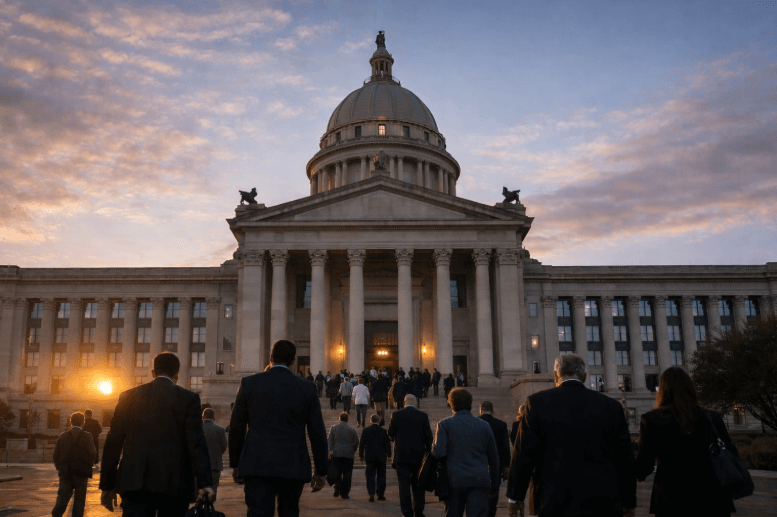
OKLAHOMA CITY – As the Second Session of the 60th Oklahoma Legislature gets under way, lawmakers have begun the formal process that will shape Oklahoma’s policy environment for the year ahead. While the early days of a legislative session can appear procedural, policy advocates and observers emphasise that these initial steps are fundamental to how quickly, transparently, and effectively legislation moves through the statehouse.
“I told someone the other day that this time of year is when I am most optimistic for our state to see better, but that I am also highly concerned about what direction Oklahoma will go through policy.” The remark captures a familiar sentiment at the opening of a legislative session, where hope for progress is tempered by uncertainty over legislative priorities and outcomes.
The session opened with the “first reading” of bills, a formal announcement of the bill numbers associated with legislation that has been filed. This step marks the official start of legislative consideration and signals that proposals are now part of the public record. Although it may seem administrative, the first reading is a constitutional requirement that sets the timeline for all subsequent legislative action.
Under Oklahoma’s Constitution, every bill must receive three readings, with no more than one reading allowed within a 24-hour period. This structure is intended to protect public participation by ensuring there is sufficient time for citizens, advocacy organisations, and other stakeholders to review legislation and organise support or opposition before a measure can reach the governor.
From historical practice to modern process
The concept of “readings” has its roots in earlier legislative traditions, when the full title, number, and content of a bill were read aloud to lawmakers. This practice originated at a time when literacy was less widespread and when reproducing documents was impractical. Reading bills aloud ensured that legislators were aware of the measures under consideration.
Today, technological advances have transformed that process. Rather than reading each bill in full, lawmakers submit a motion declaring that bills are considered read, reflecting the ease with which legislation can now be accessed and distributed. Despite these efficiencies, the constitutional requirement for multiple readings remains unchanged and continues to influence the pace of lawmaking.
The next stage in the process is the “second reading,” during which each bill is assigned to a legislative committee. Committees play a central role in shaping legislation, as they examine proposals in detail, hear testimony, and decide whether a bill should advance. Many measures stall or are significantly amended at this stage, making committee assignments a critical moment in the legislative journey.
If a bill clears committee review, it proceeds to the full chamber in which it originated. House bills are considered by the House of Representatives, while Senate bills move to the Senate. At this point, the legislation reaches the “third reading” and is eligible for a vote by the entire membership of that chamber.
Timelines, negotiation, and fiscal pressures
Once approved by its chamber of origin, a bill must then undergo the same process in the opposite chamber. If the House and Senate cannot agree on the final language, the legislation may be referred to a conference committee later in the session. There, lawmakers attempt to resolve differences before presenting the bill for a “fourth reading,” during which it can no longer be amended and must either be approved or sent back for further negotiation.
In theory, a bill can pass through the entire process in as few as five calendar days. This calculation reflects the three required readings in each chamber, spaced at least 24 hours apart, with some overlap between chambers. In practice, such rapid passage is uncommon, particularly for measures involving complex policy or significant fiscal implications.
Looking ahead, several key issues are expected to dominate the session. These include education policies aimed at improving early learning outcomes, as well as challenges linked to the federal “One Big Beautiful Bill,” which shifts certain programme costs to state governments. Lawmakers are also facing the prospect of reduced expendable revenue compared with the previous year, driven by tax cuts and broader economic pressures, alongside rising costs across multiple state agencies.
Advocacy organisations are closely tracking developments, particularly legislation aligned with a “Children’s Legislative Agenda” developed through stakeholder engagement and policy forums. In total, more than 350 newly submitted bills are being monitored, with nearly the same number carried over from the previous session under rules allowing legislation to span a two-year legislative period.
With hundreds of proposals in play and limited time for debate, understanding the mechanics of bill readings has become essential for effective civic engagement. Observers note that the procedural calendar often determines which ideas gain momentum and which fail to advance. Further analysis in the weeks ahead is expected to examine both the policy implications of the session and related civic initiatives, including youth leadership programmes connected to legislative activities.