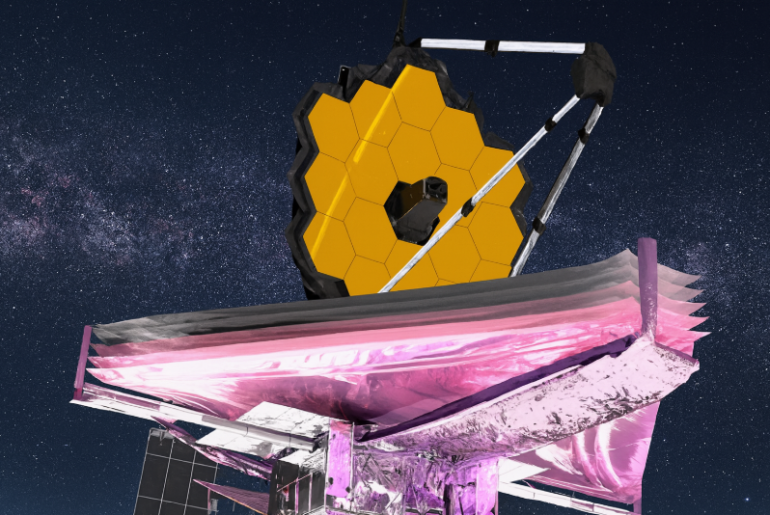
Two young researchers from Sydney have helped sharpen the universe’s clearest eye without leaving the ground. In a world-first feat of digital engineering, PhD students Louis Desdoigts and Max Charles have developed a software fix that restored the full imaging precision of NASA’s James Webb Space Telescope (JWST) — solving a distortion problem that once threatened one of its most advanced instruments.
The pair, working within the University of Sydney’s School of Physics and Sydney Institute for Astronomy, achieved what once would have required a costly space repair mission. Their innovation restored focus to the telescope’s Aperture Masking Interferometer (AMI) — the only piece of Australian-designed hardware aboard the $10 billion observatory.
As a personal reminder of their success, Desdoigts, now a postdoctoral researcher at Leiden University in the Netherlands, and Charles have each had tattoos of the instrument’s “Non-Redundant Mask” design etched on their arms.
Fixing Focus from 1.5 Million Kilometres Away
After JWST began operations, scientists noticed subtle image degradation from the AMI. The issue stemmed from electronic distortions in its infrared camera detector, which caused faint blurring — reminiscent of the early days of the Hubble Space Telescope, when astronauts had to carry out an expensive optical correction in orbit.
Rather than designing a new lens or sending astronauts to perform repairs, Desdoigts and Charles created a purely digital solution. Their system, called AMIGO (Aperture Masking Interferometry Generative Observations), uses simulations and neural networks to model how the telescope’s optics and electronics behave in deep space.
By analysing a phenomenon known as the “brighter-fatter effect” — where electrical charge spills into neighbouring pixels — the researchers built algorithms that could digitally “de-blur” the images, recovering the instrument’s full resolution and sensitivity.
“Instead of sending astronauts to bolt on new parts, they managed to fix things with code,” said Professor Peter Tuthill, who led the AMI’s design. “It’s a brilliant example of how Australian innovation can make a global impact in space science.”
Results That Rival a Spacewalk
Since the software’s implementation, JWST’s imaging of faint celestial objects has surpassed even its original calibration. Using AMIGO, the telescope has produced sharper detections of distant worlds — including the direct imaging of a dim exoplanet and a red-brown dwarf orbiting HD 206893, around 133 light years from Earth.
A companion study, led by Charles, further demonstrated the renewed precision by capturing detailed views of a black hole jet, the volcanic surface of Jupiter’s moon Io, and the dusty stellar winds of WR 137. These results showcase the revived power of the AMI system, extending JWST’s scientific reach into previously unattainable territory.
“This work brings JWST’s vision into even sharper focus,” said Dr Desdoigts. “It’s incredibly rewarding to see a software solution extend the telescope’s scientific reach – and to know it was possible without ever leaving the lab.”
Australian Innovation at the Forefront
The achievement adds a new chapter to Australia’s growing role in global space research. Professor Tuthill’s AMI remains the country’s only hardware contribution to JWST — a project operated by NASA in collaboration with the European and Canadian space agencies. Now, Australian-developed software has further enhanced the telescope’s performance.
Both studies have been published on the arXiv pre-print server, with Dr Desdoigts’ paper soon to appear in the Publications of the Astronomical Society of Australia. The University of Sydney timed the announcement with the latest round of JWST’s General Observer and Survey Research programs.
Associate Professor Benjamin Pope of Macquarie University, who collaborated on the project, is set to present the findings at SXSW Sydney this week. He said the team’s priority is to make the new code available to the international astronomy community. “The research team was keen to get the new code into the hands of researchers working on JWST as soon as possible,” he said.
From Sydney Labs to the Stars
The AMIGO system represents a triumph of data-driven problem solving, highlighting how computational science can substitute for physical intervention in complex environments like space. It also underscores how collaborative research between Australian institutions can yield breakthroughs with global impact.
With their software now embedded in the operational toolkit of the world’s most advanced space observatory, Desdoigts and Charles have cemented their names among the next generation of astrophysicists — and marked their achievement permanently in ink.
As Professor Tuthill summed up, the project is “a brilliant example of how Australian innovation can make a global impact in space science.”