


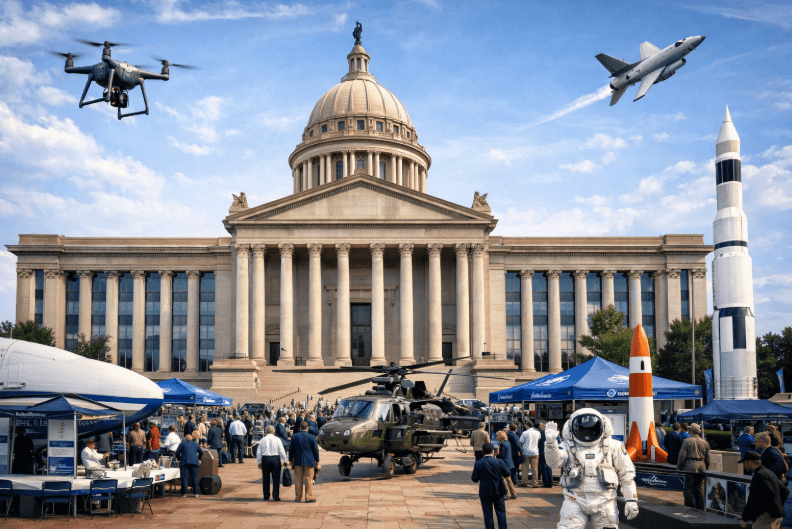
Oklahoma’s aerospace sector, valued at nearly $44 billion annually, will take centre stage at the State Capitol on 1 April as more than 1,000 industry professionals convene for AERO Oklahoma, a day-long showcase aimed at reinforcing the state’s position as a global aviation and defence hub.
Organised by the Oklahoma Department of Aerospace and Aeronautics (ODAA), the event is being led by Executive Director Grayson Ardies in partnership with Kratos Defense & Security Solutions and a coalition of more than 50 industry stakeholders.
Branded “AERO Oklahoma: Launching Into The Future,” the event will bring together major aerospace companies, government officials, military leadership and students under one roof, reflecting the breadth and economic significance of the sector within the state.
The showcase will be held from 9 a.m. to 2 p.m. in the Second Floor Rotunda of the Oklahoma State Capitol in Oklahoma City, with attendance free to the public, though advance registration has been encouraged.
High-profile speakers underline strategic importance
The event will feature a number of prominent speakers, including Oklahoma Governor Kevin Stitt and former NASA Administrator Jim Bridenstine, both of whom are scheduled to headline a major industry rally at 10:00 a.m.
The gathering is expected to provide strong visual and political momentum, with hundreds of industry professionals, legislators and military personnel assembling among exhibits showcasing drones, aircraft engine components and emerging aerospace technologies.
A student-focused town hall will follow at 11:45 a.m., led by Bridenstine, where high school students will participate in a question-and-answer session and be recognised as Aerospace Students of the Month.
Other notable speakers include Tim Gatz, Matt Pinnell, and senior military leaders from Tinker Air Force Base, alongside executives such as Steve Fendley and Chris Pearson.
Broad industry representation on display
More than 60 exhibitors are expected to participate, ranging from global aviation firms such as American Airlines and Northrop Grumman to regional innovation players including Tulsa Innovation Labs and Vigilant Aerospace Systems.
Exhibits will span a wide spectrum of aerospace disciplines, including engineering, robotics, drone development, aircraft maintenance and defence systems. Interactive displays, including flight simulators, are expected to provide a hands-on dimension to the event.
Organisers have positioned the gathering as a platform for collaboration and advocacy, bringing together industry executives, educators, students and policymakers in a unified effort to demonstrate the sector’s strategic value.
“Oklahoma’s aviation, aerospace, and defense industry is a cornerstone of our economy. This event offers a unique platform to speak with a unified voice, bringing together industry executives, military leaders, educators, and students. Join us to demonstrate to our state’s elected officials why Oklahoma remains a global leader in aerospace innovation.”
Economic impact and infrastructure strength
The aerospace and aviation sector remains Oklahoma’s second-largest economic engine, generating just under $44 billion in annual activity. The industry also offers some of the highest wages in the state, with an average salary of $73,300.
Infrastructure plays a central role in sustaining this growth. Oklahoma operates 108 publicly owned airports, forming an extensive statewide network. Notably, more than 96% of the population lives within a 30-minute drive of one of the 44 airports equipped with jet-capable runways of at least 5,000 feet.
The ODAA’s mission centres on maintaining and advancing this ecosystem, ensuring that aviation infrastructure continues to meet the needs of commerce and local communities while supporting long-term industry viability.
Strategic positioning for future growth
AERO Oklahoma comes at a time when states across the US are competing aggressively for aerospace investment, talent and federal defence contracts. By showcasing its integrated ecosystem — spanning commercial aviation, defence, education and innovation — Oklahoma aims to reinforce its competitive standing.
The presence of senior political figures alongside industry and military leadership highlights the sector’s importance not only as an economic driver but also as a strategic priority.
With strong attendance expected and broad representation across the aerospace value chain, the event is likely to serve as both a networking platform and a public demonstration of the state’s ambitions in aviation and defence.
As global demand for aerospace capabilities continues to expand, Oklahoma’s coordinated approach — combining infrastructure, workforce development and industry collaboration — positions it to remain a significant player in the sector’s future growth trajectory.