


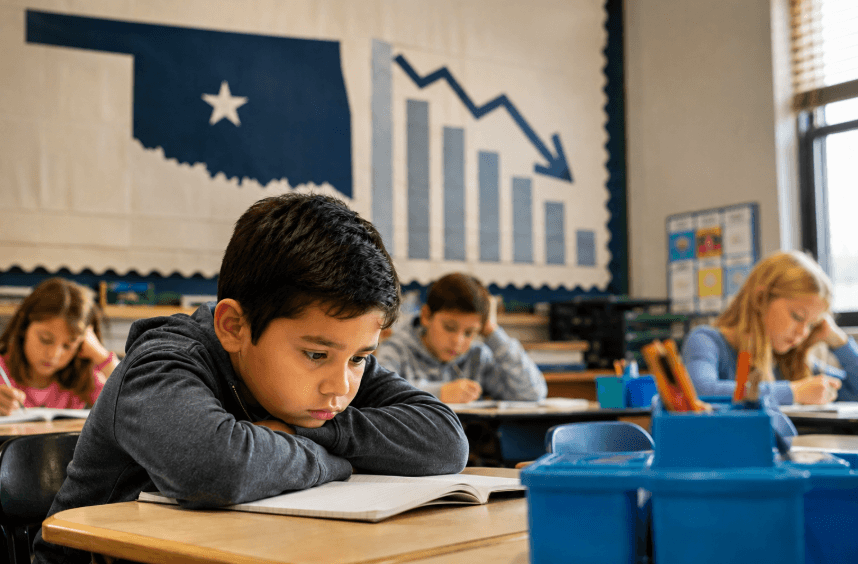
Oklahoma has once again ranked among the lowest-performing states for child wellbeing in the United States, according to the latest KIDS COUNT® Data Book released by the Annie E. Casey Foundation (AECF), with advocates warning that long-term investment in education and family support remains critical to reversing the trend.
The report placed Oklahoma 44th nationally for overall child wellbeing in 2026, tied with Texas and ahead of only Nevada, Alaska, Louisiana, New Mexico and Mississippi. While the state improved slightly from last year’s ranking of 46th, child advocacy leaders said the progress remains limited against a backdrop of persistent educational and health challenges.
The Oklahoma Institute for Child Advocacy (OICA), which uses the annual report to support policy recommendations and legislative engagement, said the findings highlight ongoing structural issues affecting families across the state.
“AECF just released their latest report; it shows that Oklahoma continues to lag in child wellbeing,” the organisation stated. “The data AECF collected placed Oklahoma in the bottom 10 of the 50 states. With rank of 44th, we move up two spots from last year’s ranking of 46th, but that is nothing to cheer about.”
The KIDS COUNT® Data Book measures state performance across four broad categories: Economic Well-Being, Education, Family and Community, and Health. Each section is assessed through four separate indicators using data collected between 2019 and 2024.
For the first time since the publication began 37 years ago, states also received a comprehensive score out of 1,000 alongside their national ranking. Oklahoma received a score of 425, significantly below the national average of 547. New Hampshire achieved the highest score at 838, while Mississippi ranked last with 271.
Oklahoma’s weakest performance came in education, where the state ranked 48th nationally. Family and Community indicators placed Oklahoma 43rd, while Health ranked 37th and Economic Well-Being ranked 30th.
Several education-related indicators continued to perform poorly. According to the report, 77% of fourth-grade pupils scored below proficient reading level, placing Oklahoma 48th nationally. Mathematics outcomes were weaker still, with 83% of eighth-grade pupils below proficient level, ranking the state 49th.
The report also found that 18% of secondary school students failed to graduate on time, placing Oklahoma 41st nationally.
Economic pressures affecting households also remained a concern. The study reported that 19% of children in Oklahoma were living in poverty in 2023, defined for a family of four as income below $30,900 annually. That figure placed the state 42nd nationally.
Health outcomes highlighted further areas of concern. Around 9% of children in Oklahoma lacked health insurance coverage, giving the state a ranking of 46th in that category. Child and teen mortality stood at 35 deaths per 100,000 individuals aged between one and 19, while the teen birth rate reached 20 births per 1,000 females aged 15 to 19.
Despite the low overall ranking, the report noted some areas of progress. Since 2019, Oklahoma improved in seven of the 16 indicators measured, remained stable in two and deteriorated in seven others. Four of the improvements were recorded in education-related measures.
Advocates said recent legislative attention on schools and learning outcomes could support future gains if reforms are maintained over a longer period.
“With the emphasis on education by our Legislature this year, I believe we will see gains in coming years,” the statement said. “Mississippi’s education reforms, which we emulated, moved them to 16th in education. Still, they were so poor in every other ranking, they fell below Oklahoma’s total rank. Working with lawmakers and showing data makes improvement possible here.”
The Annie E. Casey Foundation, established in 1948 by UPS founder Jim Casey and his siblings, publishes the annual KIDS COUNT® Data Book to track child wellbeing trends across the United States and provide policymakers with comparative social and economic data.
OICA said the latest findings would continue to shape its advocacy efforts aimed at improving outcomes for children and families across Oklahoma.
“Our profound thanks go to the Annie E. Casey Foundation for helping OICA make the case for improved child well-being!”



:quality(85)/cloudfront-us-east-1.images.arcpublishing.com/infobae/45OXD2PP2VAWTFEPJZPEDWSDC4.jpg "The Ortega regime is closing embassies in cities with high immigrant populations, leaving thousands of Nicaraguans homeless.")