


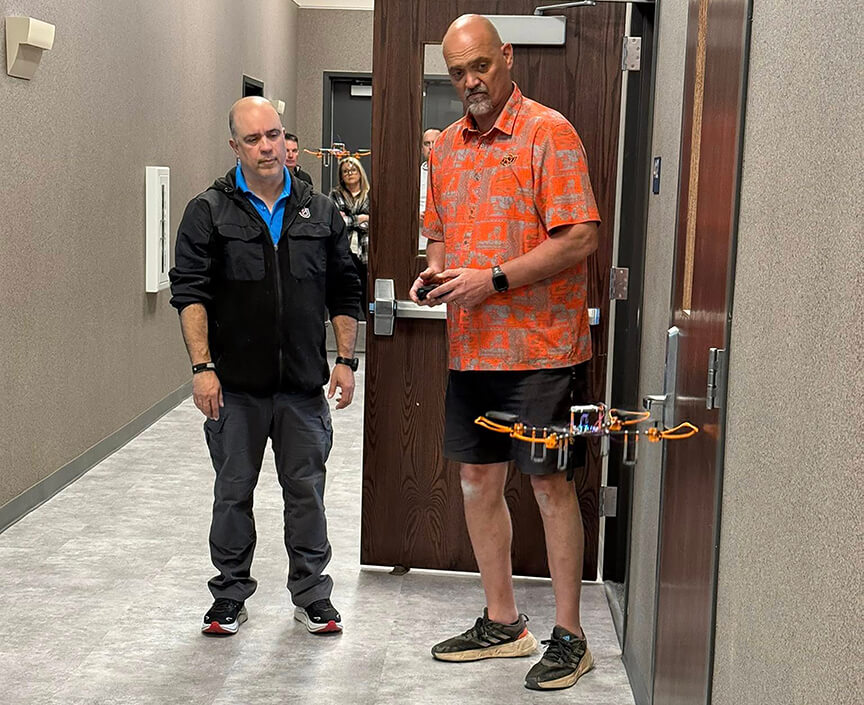
The Oklahoma Department of Aerospace and Aeronautics (ODAA) has partnered with the Oklahoma Aerospace Institute for Research and Education (OAIRE) to advance drone technology education in secondary schools, hosting a professional development event aimed at equipping teachers with practical skills in unmanned aerial systems.
Held at Oklahoma State University in Stillwater, the programme brought together aerospace educators from across the state for hands-on training and a collaborative drone build session. The initiative reflects Oklahoma’s broader ambition to strengthen its aerospace talent pipeline while integrating emerging technologies into classroom learning.
Organisers said the event underscored the state’s commitment to innovation in aviation and aerospace education, with a focus on expanding the use of Unmanned Aerial Systems (UAS) across high school programmes.
Teachers participating in the training were introduced to advanced drone technologies and classroom integration strategies designed to support STEM education and career pathways in aviation, engineering and aerospace operations.
The programme also highlighted the growing role educators play in preparing students for careers in a sector that continues to be a major contributor to Oklahoma’s economy.
“Our educators are the cornerstone of this program,” said Paula Kedy, ODAA Statewide Aerospace STEM education manager. “With our expanding network of schools, the support of our state legislators and partnerships with industry leaders, Oklahoma is well-positioned to continue leading the nation in aerospace education.”
Drone technology demonstrations and workforce links
The training event included a series of demonstrations showcasing real-world applications of drone technology. These demonstrations explored how unmanned aerial systems are being used across industries such as emergency management, agriculture and wildlife monitoring.
Participants observed how drones can assist first responders during disaster scenarios, support crop monitoring and environmental management, and aid wildlife conservation efforts through aerial data collection.
For educators, the demonstrations provided practical insights into how the technology can be translated into classroom lessons and project-based learning modules.
A central objective of the programme was to bridge the gap between academic learning and the requirements of the aerospace and defence sector. Industry representatives and education specialists emphasised the need to build technical skills early in the education system to support long-term workforce development.
Oklahoma’s aerospace industry currently supports around 120,000 professional roles across manufacturing, maintenance, engineering, defence and research activities. By introducing drone technology training into secondary education, the state hopes to prepare students with relevant technical capabilities before they enter higher education or the workforce.
The professional development sessions therefore focused not only on drone construction and operation but also on curriculum design, safety protocols and regulatory awareness surrounding UAS technology.
Educators were guided through methods for incorporating drone-based projects into science, technology, engineering and mathematics coursework, enabling students to gain hands-on experience with aviation technology.
Expanding aerospace education across Oklahoma schools
Oklahoma has positioned itself as a national leader in aerospace education through a network of schools delivering specialised aviation and STEM programmes.
More than 145 schools across the state currently offer aerospace-focused courses, many of which incorporate initiatives such as the Aircraft Owners and Pilots Association’s “You Can Fly” programme. These courses are designed to introduce students to aviation fundamentals, aircraft systems, flight operations and emerging aerospace technologies.
State officials believe the continued expansion of these programmes will strengthen the long-term competitiveness of Oklahoma’s aerospace sector.
By working closely with educational institutions and industry partners, the Oklahoma Department of Aerospace and Aeronautics aims to create a steady pipeline of skilled graduates capable of supporting future growth in the industry.
The collaboration with OAIRE represents a further step in that strategy, combining academic expertise, industry knowledge and practical teacher training.
Officials say initiatives such as the Stillwater training event help ensure that educators remain up to date with technological developments and can deliver relevant, modern coursework to students.
As drone technology becomes increasingly important across multiple industries, programmes that introduce these tools into school curricula are expected to play a key role in workforce preparation.
The partnership between ODAA and OAIRE is therefore seen as part of a broader effort to expand research, education and workforce development in the aerospace sector.
Further details about Oklahoma’s aerospace education initiatives can be found on the Oklahoma Department of Aerospace and Aeronautics website.