


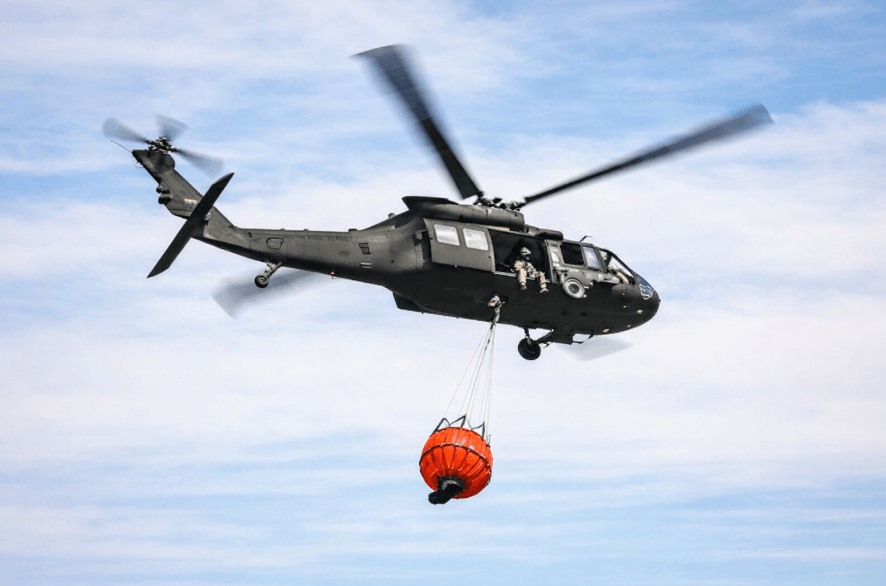
The Oklahoma Army National Guard has deployed helicopters and specialist firefighting crews to support wildfire suppression efforts in northwest Oklahoma, underscoring the growing operational and logistical role of military resources in responding to climate-driven emergencies.
The deployment follows a formal request from state emergency officials and authorisation from Governor Kevin Stitt, reflecting the severity of current wildfire conditions and the increasing reliance on coordinated inter-agency responses.
Military planners have mobilised UH-60 Black Hawk helicopters equipped with high-capacity water buckets, alongside certified wildland firefighting personnel operating on the ground. The move illustrates the expanding integration of defence assets into domestic emergency management, particularly in regions vulnerable to seasonal wildfires.
“The Oklahoma National Guard stands ready and equipped with both aerial and ground capacities to support our partner agencies in the state,” said Brig. Gen. Bob Walter, assistant adjutant general for Oklahoma. “We have been in continuous communication with the Office of Emergency Management, the Department of Public Safety and Forestry Services for close coordination.”
Helicopter capability boosts aerial firefighting capacity
Central to the National Guard’s aerial response are specialised buckets, commonly known in the industry as Bambi buckets, which can carry substantial volumes of water to fire zones that are often difficult to access by land.
Each bucket used by Oklahoma Army National Guard helicopter crews can hold up to 660 gallons of water. These loads can be released either directly onto active fire lines or in strategic locations identified by incident commanders to slow or prevent further spread.
This aerial capability provides a critical advantage during fast-moving wildfires, where rapid response times and precision drops can protect infrastructure, agricultural land and commercial assets.
Alongside aviation support, the Guard has committed trained personnel to frontline firefighting roles.
“We have two wildland firefighting crews of eight to ten red-card certified firefighters on State Active Duty working for the incident command,” Walter said.
Red Card certification is a recognised professional standard in the United States, confirming personnel are qualified to operate on active wildfire incidents. Such qualifications require formal training, physical fitness assessments and operational readiness verification.
Investment in workforce training strengthens state resilience
The deployment highlights the results of sustained investment in workforce preparedness by the Oklahoma Army National Guard, particularly through its Wildland Firefighting programme.
Over the past two years, the programme has trained 130 Guardsmen to achieve Red Card certification, with 80 currently qualified and available for in-state deployment.
This expansion reflects broader national and global trends, as governments allocate more resources to emergency preparedness amid rising wildfire frequency and intensity linked to drought conditions, extreme heat and changing weather patterns.
From a business and economic perspective, rapid wildfire suppression capability is essential to limit disruption to agriculture, energy infrastructure and regional supply chains. Oklahoma’s economy retains significant exposure to land-based industries, making wildfire management a critical component of economic resilience planning.
Coordinated response underscores importance of inter-agency planning
The National Guard’s mobilisation follows a structured request and approval process designed to ensure resources are deployed efficiently and in coordination with civilian authorities.
Once support is requested through Oklahoma Emergency Management and authorised by the Governor, operational planners from the Guard’s Domestic Operations Office work directly with incident commanders to determine how best to integrate military support into firefighting strategies.
This coordination model helps ensure that military aviation, manpower and logistics capabilities complement civilian firefighting efforts rather than duplicate them.
The collaborative nature of the response has been welcomed by state leadership.
“I’m very thankful for the National Guard and the expertise that they have to be part of this response,” said Oklahoma Secretary of Agriculture, Blayne Arthur. “We appreciate the opportunity to work collaboratively with them.”
Military support plays growing role in disaster response
The use of National Guard aviation and trained firefighting crews illustrates the increasingly multi-functional role of reserve military forces in supporting civil authorities during emergencies.
Beyond their traditional defence mission, National Guard units across the United States are now routinely deployed to assist with natural disasters, including wildfires, floods and hurricanes.
For policymakers and business leaders alike, such deployments highlight the importance of maintaining flexible emergency response infrastructure capable of protecting economic stability and public safety.
As wildfire risks persist, the integration of military capability into state emergency planning is expected to remain a key component of disaster mitigation strategies, particularly in regions facing heightened environmental pressures.