


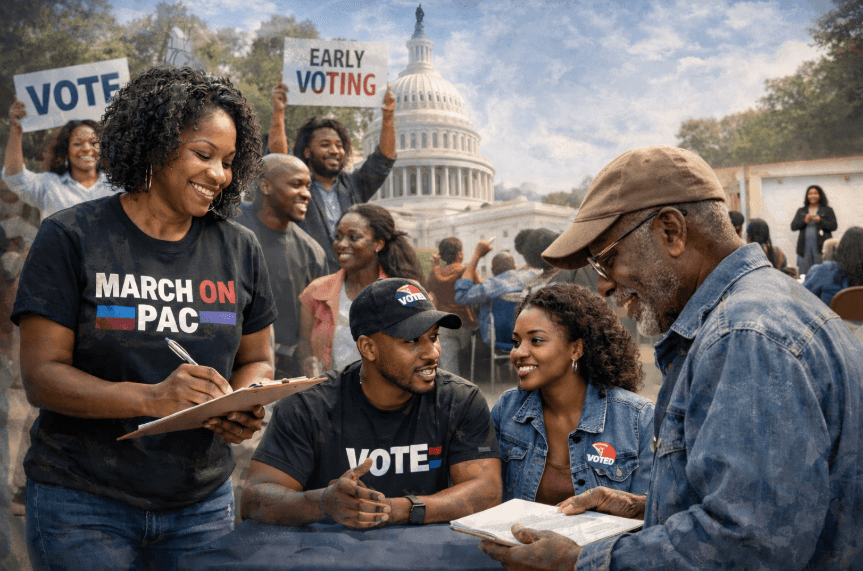
Washington, DC — March On PAC is stepping up its investment in voter engagement strategy after commissioning new national research examining the motivations, barriers, and behavioural triggers influencing Black voter participation, as Democrats prepare for a critical United States midterm election cycle in 2026.
The political action committee said the research, conducted as part of the Black Opps Coalition, will be used to refine outreach operations and strengthen turnout among a voting bloc widely regarded as essential to Democratic electoral success. The coalition brings together multiple organisations to analyse Black voter engagement during President Donald Trump’s second term and identify practical strategies to increase participation.
The first phase of the study, carried out by HIT Strategies, provides updated insight into what motivates Black voters to engage politically, the factors suppressing turnout, and which forms of messaging are most effective at encouraging participation. March On PAC said the findings would directly inform its operational and communications planning rather than serving purely academic purposes.
“As a PAC, our mission is clear: expand the coalition, increase turnout, and elect Democrats who will deliver economic justice,” said Andrea Pringle, President of March On PAC. “We have always believed that expanding the tent and investing early in voter engagement is the foundation of Democratic success. This research sharpens that work with real-time insight about where engagement gaps exist and how to close them.”
The move reflects a broader shift towards data-driven political organising, with campaign groups investing heavily in research to identify persuadable voters and optimise mobilisation efforts well in advance of election periods.
Terrance Woodbury, CEO of HIT Strategies, said the research highlights growing complexity in voter attitudes and engagement decisions, particularly amid perceived political and economic risks.
“Since the start of this administration, the Black Opps Coalition has been looking into ways in which to best mobilize Black voters to take political actions now that increase their likelihood to vote later,” said HIT Strategies CEO Terrance Woodbury. “Historically, Black organizing has helped gain protections and economic opportunity for all, but Today, many Black voters are weighing the real risks of resistance and prioritizing self-preservation over collective action. This research helps us understand what’s holding people back—and how to responsibly mobilize Black political power ahead of the midterm elections. By identifying lower-risk, high-impact ways to defend economic justice, we can meet people where they are and support action that protects individuals, families, and our collective future.”
According to the findings, a growing majority of Black voters report experiencing collective economic harm linked to federal policy decisions. However, engagement levels remain uneven, with a sizeable proportion of voters expressing openness to increased political participation if barriers are addressed effectively.
Among the most significant obstacles identified were fear of retaliation, doubts over whether participation would make a meaningful difference, and broader concerns about political leadership and accountability.
The research also concluded that messaging plays a decisive role in influencing engagement. Campaign communications that clearly connect economic conditions to specific policy decisions, demonstrate tangible outcomes from collective action, and provide practical and accessible pathways to participation were found to significantly increase willingness to engage.
Researchers identified five core elements that strengthen political engagement: explicitly linking economic harm to policy decisions; demonstrating real-world results from collective action; providing compelling motivations for participation; directly addressing perceived risks and barriers; and offering clear, manageable calls to action aligned with voter priorities.
March On PAC said it intends to embed these findings across its national operations as part of a broader strategy to strengthen its electoral position ahead of 2026.
The organisation plans to expand early-stage outreach in priority states, refine messaging to reflect voters’ lived economic experiences, and invest further in voter contact infrastructure well ahead of election day. The strategy also includes scaling digital engagement and coalition-based organising to ensure outreach is consistent and sustained.
From a business and operational perspective, the investment reflects the increasing professionalisation of political campaigning in the United States, where voter engagement efforts now mirror corporate-style customer targeting, data analytics, and long-term strategic planning.
The PAC said it will focus resources on states where Black voter turnout is expected to play a decisive role in determining control of Congress. By aligning its organising approach with data-identified turnout patterns, the organisation aims to maximise participation among key demographic groups and strengthen the broader Democratic coalition.
March On PAC added that it would continue working alongside coalition partners to ensure engagement strategies reflect the economic concerns, risk perceptions, and motivations identified in the research, as political groups intensify preparations for what is expected to be a highly contested midterm election cycle.