
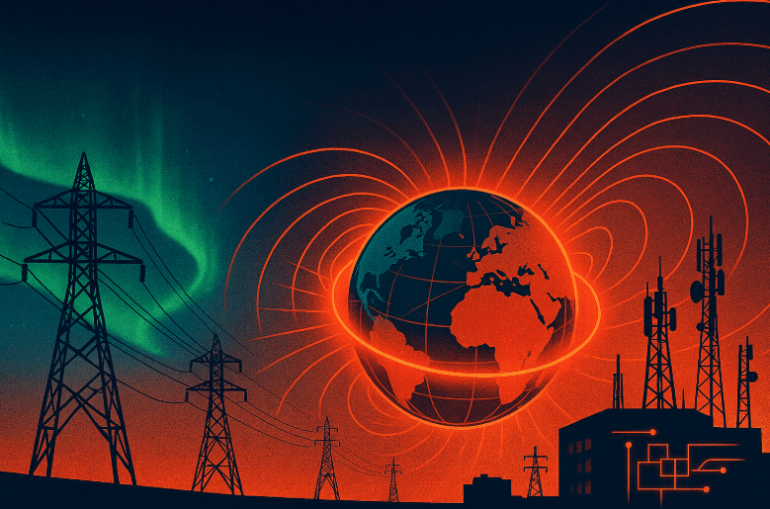
A new study from the University of Oulu has warned that critical infrastructure across northern Europe may be more vulnerable to extreme space weather than previously understood, after researchers found that geomagnetic disturbances can vary dramatically within relatively short geographical distances. The findings arrive as interest in space-weather resilience grows among energy companies, communications providers and policymakers facing the rising likelihood of severe solar activity in the coming years.
The research, led by Doctoral Researcher Otto Kärhä, examines how geomagnetic storms—triggered when eruptions from the Sun interact with Earth’s magnetic field—can generate highly localised disruptions that pose risks to power grids, communication systems and navigation technologies. These disturbances, measured in nanoteslas, can fluctuate significantly even between locations separated by less than 200 kilometres, underscoring the need for better monitoring coverage across the region.
Recent Storms Reveal Gaps in Monitoring Networks
The issue gained renewed attention during a strong geomagnetic storm in spring 2024, when the auroral oval expanded far beyond its normal boundary and the northern lights became visible unusually far south. Kärhä said the event exposed gaps in the Nordic monitoring network. “I am surprised at how sparse the measurement network is, even though we know that the impacts of space weather can vary greatly from one area to another,” he said.
According to Kärhä, the lack of monitoring equipment in certain regions could limit national and industry-level preparedness. “For safety reasons, it is important to expand measurement instrumentation also in southern Finland and across Arctic sea regions—areas where the network is currently sparse or non-existent—in order to better understand how disturbances are distributed,” he added. Kärhä will defend his doctoral thesis on 28 November 2025.
Understanding the Impact of Space Weather
Space weather refers to the complex interaction between solar wind, solar eruptions and Earth’s magnetic field. When major events occur, they can trigger magnetic storms capable of creating large, rapid variations in the geomagnetic field. These fluctuations may interfere with vital systems, including long-distance power transmission, radio communications, satellite operations and GNSS-based navigation. Kärhä notes that the behaviour of space weather resembles familiar meteorological variability. “The regional nature of space weather can be compared to ordinary weather—such as differences in temperature or cloud cover,” he explains.
Sparse Networks Limit Risk Assessment
Magnetometers are used to monitor these disturbances, and they are generally concentrated in the auroral zone, where geomagnetic fluctuations are typically strongest. However, the monitoring network in Fennoscandia is currently considered too sparse to capture the full spatial complexity of storm-time variations. For industries reliant on accurate space-weather forecasting—such as aviation, offshore operations, cargo shipping and energy transmission—improved resolution of local disturbance data is increasingly seen as critical.
Historical and Modern Data Reveal Extreme Variations
Kärhä’s dissertation investigates how large momentary differences in geomagnetic storm-time variations can become between individual measurement stations. The analysis draws on both contemporary digital data and historical analogue records. Several significant storms were examined, including the October 1977 event, during which the northward magnetic field component differed by more than 500 nanoteslas between two stations only 170 kilometres apart. During the Halloween superstorm of October 2003, the difference reached 1,200 nanoteslas across a distance of just 160 kilometres. The strongest variations were observed on Earth’s night side.
In addition to atmospheric drivers, geological factors also influence disturbance intensity. “Subsurface conductivity structures also guide the flow of currents and create areas with higher disturbance risk,” Kärhä notes. Looking ahead, he emphasises the importance of preparedness. “Future magnetic storms cannot be predicted precisely, but their probability increases as the solar cycle declines over the coming years. A deeper understanding of space weather is vital for global safety.”
Implications for Security and Infrastructure
Professor Eija Tanskanen, dissertation supervisor and Director of the Sodankylä Geophysical Observatory, said the work highlights a crucial challenge for both scientists and infrastructure operators. “This dissertation shows that the magnitude of space-weather-induced geomagnetic disturbances can vary significantly within just a few tens of kilometres. Natural geomagnetic disturbances may resemble human-made interference, and distinguishing between them is increasingly important in the current geopolitical climate,” she emphasised.
Digitising the Past to Prepare for the Future
The research also demonstrates the value of historical scientific archives. Kärhä developed a method to digitise approximately 40 kilometres of film-based magnetic field variation records from the 1970s, converting them into digital datasets for modern analysis and future research use.
Public Defence Scheduled for November 2025
Kärhä will publicly defend his dissertation, From strong to superstorms: regional effects and spatial geomagnetic gradients driven by extreme space weather, at the University of Oulu on Friday 28 November 2025. The event, held on the Linnanmaa campus in room TA105, will begin at noon and may also be followed remotely. The opponent will be Professor Pieter Kotzé of North-West University, with Professor Tanskanen serving as custos.




/cloudfront-eu-central-1.images.arcpublishing.com/diarioas/FXHLBOXLFB7OE2FB2AZ62WQN3U.jpg "Fans demand Keylor Navas to start after PSG defeat")